Striation (Geology)
 From Handwiki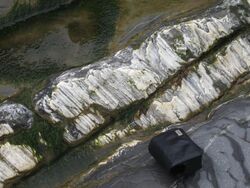
In geology, a striation is a groove, created by a geological process, on the surface of a rock or a mineral.
In structural geology, striations are linear furrows, or linear marks, generated from fault movement. The striation's direction reveals the movement direction in the fault plane.[1]
Similar striations, called glacial striations, can occur in areas subjected to glaciation. Striations can also be caused by underwater landslides.
Striations can also be a growth pattern or mineral habit that looks like a set of hairline grooves, seen on crystal faces of certain minerals. Examples of minerals that can show growth striations include pyrite, feldspar, quartz, tourmaline, chalcocite and sphalerite.
See also
- Slickenside
Bibliography
- ↑ "Glad You Asked: Glacial Striations and Slickensides" (in en-US). https://geology.utah.gov/map-pub/survey-notes/glad-you-asked/glacial-striations-vs-slickensides/.
External links
 |  |
Categories: [Structural geology] [Mineralogy] [Glacial erosion landforms]
↧ Download as ZWI file | Last modified: 08/13/2024 22:18:34 | 4 views
☰ Source: https://handwiki.org/wiki/Earth:Striation_(geology) | License: CC BY-SA 3.0
 KSF
KSF