Lancaran (Ship)
 From Handwiki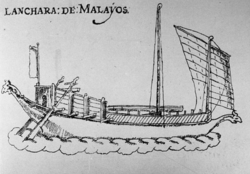
A lancaran or lanchara is a type of sailing ship used in Maritime Southeast Asia. Although similar in shape to Mediterranean galleys, the lancaran was the backbone of the regional fleet of the western half of Nusantara before Mediterranean influence came.[1]:151 For their war fleet, the Malays prefer to use shallow draught, oared longships similar to the galley, such as lancaran, penjajap, and kelulus.[note 1] This is very different from the Javanese who prefer long-range, deep-draught round ships such as jong and malangbang. The reason for this difference is that the Malays operated their ships in riverine water, sheltered straits zone, and archipelagic environment, while the Javanese are often active in the open and high sea. After contact with Iberian people, both the Javanese and Malay fleets began to use the ghurab and ghali more frequently.[4]:270–277, 290–291, 296–301[1]:148, 155
Etymology
The term lancaran is derived from the Malay word lancar, which means "swift", "fast", "not hindered", and "velocity without effort". Thus the word lancaran may be interpreted as "swift vessel".[5]
Description
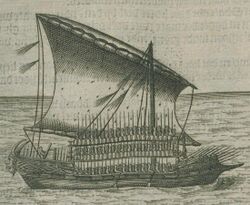
Lancaran is a swift, local ship propelled by oars and sails with two-quarter rudders, one on either side of the stern. In Aceh, lancarans were taller than galley but equaled them in length.[6]:146-147 They had one, two, or three masts, with junk sails or tanja sails (canted rectangular sail). Lancarans had a crew of between 150 and 200 crew. Lancaran can be equipped with several lela (medium cannon equivalent to falconet) and swivel guns of cetbang and rentaka variety. One distinguishing feature from the galley is the presence of an elevated fighting platform (called a balai), in which warriors usually stood and perform boarding actions.[1]:165 Cargo lancaran could carry 150 tons of cargo. The lancaran of Sunda had unique masts shaped like a crane, with steps between each so that they are easy to navigate.[7]:167
Role
Lancaran were used both as warships and for commerce. In the 14th–15th century CE, the Kingdom of Singapura and Sungai Raya each have 100 three-masted lancaran (lancaran bertiang tiga).[8]
In about 1500 CE, the Sultanate of Malacca opposed Siam with 200 boats, consisting of lancaran and kelulus.[9]:212 According to Afonso de Albuquerque, during the 1511 Portuguese attack on the Malacca Sultanate, the Malays used an unspecified number of lancaran (lanchara) and twenty penjajap (pangajaoa).[10]:80–81[11]:68 After Sultan Mahmud Shah of Malacca was deposed from Malacca in 1511, he took over Bintan. In 1519 and 1520 he had a fleet consisting of 60 and 100 boats respectively, both being made up of lancaran and kelulus.[9]:212
During the Demak Sultanate attack on Portuguese Malacca of 1512–1513, lancaran were used as armed troop transports for landing alongside penjajap and kelulus, as the Javanese junks were too large to approach the shore.[12]:74 Lancaran was the other type of vessel counted by Tome Pires after junks and penjajap upon arriving at a port.[7]:185, 195
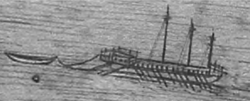
Royal lancaran of Lingga is said to carry 200 fighting men and is about the size of a large galleass (larger than ordinary galleys). The regular lancaran of Pasai is said to carry 150 men and is under the command of a Javanese captain. Large ones with 300 crew are said to have been Javanese vessels. In the 1520s, smaller lancarans of Bintan and Pahang were armed with only 1 berço (breech-loading swivel gun, likely refers to cetbang), but also had arrows, spears, and fire-hardened wooden spars. Nicolau Perreira's account of the 1568 Acehnese siege of Malacca said that Aceh's boats are usually lancaran. It has two rows of oars and was as long as a galley.[6]:146-147 An anonymous work depicting the 1568 siege showed a ship with a double quarter rudder and 3 masts, which corresponds with "lancaran bertiang tiga" (three-masted lancaran) mentioned in Malay texts.[1]:150-151
See also
- Balangay
- Garay (ship)
- Penjajap
- Pinisi
- Launch (boat), the term is derived from lancaran
- Galleas
Notes
- ↑ During the 1511 Portuguese attack on Malacca Sultanate, the Malays use lancaran (lanchara) and penjajap (pangajaoa).[2] Kelulus (calaluz) was used on several expeditions before and after the fall of Malacca.[3]
References
- ↑ 1.0 1.1 1.2 1.3 Manguin, Pierre-Yves (2012). Lancaran, Ghurab and Ghali: Mediterranean impact on war vessels in Early Modern Southeast Asia. In G. Wade & L. Tana (Eds.), Anthony Reid and the Study of the Southeast Asian Past (pp. 146–182). Singapore: ISEAS Publishing.
- ↑ Birch, Walter de Gray (1875). The Commentaries of the Great Afonso Dalboquerque, Second Viceroy of India, translated from the Portuguese edition of 1774 Vol. III. London: The Hakluyt Society, page 68; and Albuquerque, Afonso de (1774). Commentários do Grande Afonso Dalbuquerque parte III. Lisboa: Na Regia Officina Typografica, page 80–81.
- ↑ Manguin, Pierre-Yves (1993). 'The Vanishing Jong: Insular Southeast Asian Fleets in Trade and War (Fifteenth to Seventeenth Centuries)', in Anthony Reid (ed.), Southeast Asia in the Early Modern Era (Ithaca: Cornell University Press), page 212.
- ↑ Nugroho, Irawan Djoko (2011). Majapahit Peradaban Maritim. Suluh Nuswantara Bakti. ISBN 978-602-9346-00-8.
- ↑ Collins English Dictionary, Second Edition, Collins (London & Glasgow), 1986, p. 868, ISBN:0 00 433135-4.
- ↑ 6.0 6.1 Wicki, Joseph (1971). "Lista de moedas, pesos e embarcações do Oriente, composta por Nicolau Perreira S.J. por 1582". Studia 33: 137–148.
- ↑ 7.0 7.1 Cortesão, Armando (1944). The Suma oriental of Tomé Pires : an account of the East, from the Red Sea to Japan, written in Malacca and India in 1512-1515 ; and, the book of Francisco Rodrigues, rutter of a voyage in the Red Sea, nautical rules, almanack and maps, written and drawn in the East before 1515 volume I. London: The Hakluyt Society. ISBN 9784000085052. https://archive.org/details/McGillLibrary-136385-182.
 This article incorporates text from this source, which is in the public domain.
- ↑ Nugroho, Irawan Djoko (2011). Majapahit Peradaban Maritim. Suluh Nuswantara Bakti. p. 276 and 400, quoting Sejarah Melayu, 14.9: 126–127: "Karena pada masa itu kelengkapan Singapura juga seratus lancaran bertiang tiga, dan Sungai Raya pun demikian juga." (Because at that time, Singapura's equipment was also a hundred three-masted lancaran, and likewise with Sungai Raya).
- ↑ 9.0 9.1 Manguin, Pierre-Yves (1993). 'The Vanishing Jong: Insular Southeast Asian Fleets in Trade and War (Fifteenth to Seventeenth Centuries)', in Anthony Reid (ed.), Southeast Asia in the Early Modern Era (Ithaca: Cornell University Press), 197–213.
- ↑ Albuquerque, Afonso de (1774). Commentários do Grande Afonso Dalbuquerque parte III. Lisboa: Na Regia Officina Typografica. https://archive.org/details/commentariosdog00unkngoog/page/n165/mode/2up?q.
- ↑ Birch, Walter de Gray (1875). The Commentaries of the Great Afonso Dalboquerque, Second Viceroy of India, translated from the Portuguese edition of 1774 Vol. III. London: The Hakluyt Society. https://archive.org/details/commentariesgre02unkngoog/page/n7/mode/2up?q.
- ↑ Winstedt, Richard Olaf (1962). A History of Malaya. Singapore: Marican & Sons.
 |  |
Categories: [Naval sailing ship types] [Sailboat types] [Three-masted ships] [Indigenous boats] [Warships]
↧ Download as ZWI file | Last modified: 01/26/2025 16:15:24 | 2 views
☰ Source: https://handwiki.org/wiki/Engineering:Lancaran_(ship) | License: CC BY-SA 3.0
 KSF
KSF