Planet Symbols
 From Handwiki
 A planet symbol or planetary symbol is a graphical symbol used in astrology and astronomy to represent a classical planet (including the Sun and the Moon) or one of the modern planets. The symbols were also used in alchemy to represent the metals associated with the planets, and in calendars for their associated days. The use of these symbols derives from classical Greco-Roman astronomy, although their current altered shapes were developed in the 16th century.
The classical planets, their symbols, days and most commonly associated planetary metals are:
| planet | Moon | Mercury | Venus | Sun | Mars | Jupiter | Saturn |
|---|---|---|---|---|---|---|---|
| symbol | ☾ | ☿ | ♀ | ☉ | ♂ | ♃ | ♄ |
| unicode | ☾ | ☿ | ♀︎ | ☉ | ♂︎ | ♃ | ♄ |
| day | Monday | Wednesday | Friday | Sunday | Tuesday | Thursday | Saturday |
| metal | silver | quicksilver | copper | gold | iron | tin | lead |
The International Astronomical Union (IAU) discourages the use of these symbols in modern journal articles, and their style manual proposes one- and two-letter abbreviations for the names of the planets for cases where planetary symbols might be used, such as in the headings of tables.[1] The modern planets with their traditional symbols and IAU abbreviations are:
| planet | Mercury | Venus | Earth | Mars | Jupiter | Saturn | Uranus | Neptune |
|---|---|---|---|---|---|---|---|---|
| symbol | ☿ | ♀ | 🜨 | ♂ | ♃ | ♄ | ⛢ | ♆ |
| initial (IAU) | Me H[lower-alpha 1] |
V | E | Ma M[lower-alpha 1] |
J | S | U | N |
The symbols of Venus and Mars are also used to represent female and male in biology following a convention introduced by Carl Linnaeus in the 1750s.
History
Classical planets
Antecedents of the planetary symbols are attested in the attributes given to classical deities. The Roman planisphere of Bianchini (2nd century, currently in the Louvre, inv. Ma 540)[2] shows the seven planets represented by portraits of the seven corresponding gods, each a bust with a halo and an iconic object or dress, as follows: Mercury has a caduceus and a winged cap; Venus has a necklace and a shining mirror; Mars has a war-helmet and a spear; Jupiter has a laurel crown and a staff; Saturn has a conical headdress and a scythe; the Sun has rays emanating from his head; and the Moon has a crescent atop her head.
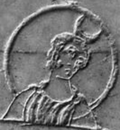
Luna with a crescent
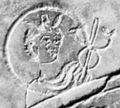
Mercury with a caduceus
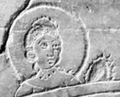
Venus with a shining mirror
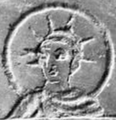
Sol emanating rays
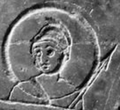
Mars with a spear
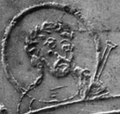
Jupiter with a staff
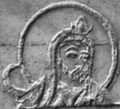
Saturn with a scythe
The written symbols for Mercury, Venus, Jupiter, and Saturn have been traced to forms found in late Greek papyri.[3] }}[lower-alpha 2]
Early forms are also found in medieval Byzantine codices which preserve horoscopes.[4]
.png)
The symbol for the Moon in a medieval Byzantine (11th c.) ms. The appearance in late Classical times was similar.[3]
.png)
The symbol for Mercury in late Classical (4th c.) and medieval Byzantine (11th c.) mss[3]
.png)
The symbol for Venus in late Classical (4th c.) and medieval Byzantine (11th c.) mss[3]
.png)
The disk with a ray as a symbol for the Sun in late Classical (4th c.) and medieval Byzantine (11th c.) mss[3]
.png)
The symbol for Mars in late Classical (6th c.) and medieval Byzantine (11th c.) mss.[3]
.png)
The symbol for Jupiter in late Classical (4th c.) and medieval Byzantine (11th c.) mss[3]
.png)
The symbol for Saturn in late Classical (4th & 5th c.) and medieval Byzantine (11th c.) mss. Cf. kappa-rho, ⟨κρ⟩.[3]
A diagram in the astronomical compendium by Johannes Kamateros (12th century) closely resembles the 11th-century forms shown above, with the Sun represented by a circle with a single ray, Jupiter by the letter zeta (the initial of Zeus, Jupiter's counterpart in Greek mythology), Mars by a round shield in front of a diagonal spear, and the remaining classical planets by symbols resembling the modern ones, though without the crosshatch-marks seen in modern versions of Mercury, Venus, Jupiter and Saturn.[citation needed] These cross-marks first appear in the late 15th or early 16th century. According to Maunder, the addition of crosses appears to be "an attempt to give a savour of Christianity to the symbols of the old pagan gods."[5] The modern forms of the classical planetary symbols are found in a woodcut of the seven planets in a Latin translation of Abu Ma'shar al-Balkhi's De Magnis Coniunctionibus printed at Venice in 1506, represented as the corresponding gods riding chariots.[6]
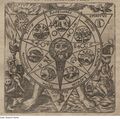
Early modern depiction of the planet symbols in an alchemical context (Musaeum Hermeticum, 1678)
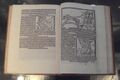
Page spread (with the signs for Mars and Venus) from a 1515 illustrated edition of Abu Ma'shar al-Balkhi's De Magnis Coniunctionibus (in the by translation by Herman of Carinthia, c. 1140, editio princeps by Erhard Ratdolt of Augsburg, 1489).
-850AD.png)
Depiction of the planets in a 15th-century Arabic manuscript of Abu Ma'shar's "Book of nativities"[lower-alpha 3]
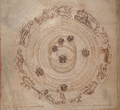
Medieval planisphere showing the zodiac and the classical planets. The planets are represented by seven faces.
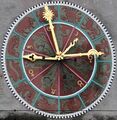
16th-century mechanical clock + calendar, using the symbols of the eponymous planets for the days of the week.
.jpg)
Planetary-metal symbols at the center of the coat of arms of the Royal Society of Chemistry
Earth symbol
.svg.png)
.svg.png)
Earth is not one of the classical planets, as "planets" by definition were "wandering stars" as seen from Earth's surface.
Earth's status as planet is a consequence of heliocentrism in the 16th century.
Nonetheless, there is a pre-heliocentric symbol for the world, now used as a planetary symbol for the Earth. This is a circle crossed by two lines, horizontal and vertical, representing the world divided by four rivers into the four quarters of the world (often translated as the four "corners" of the world): .svg.png) . A variant, now obsolete, had only the horizontal line: 16px|🜔.[7]
. A variant, now obsolete, had only the horizontal line: 16px|🜔.[7]
A medieval European symbol for the world – the globus cruciger, .svg.png) (the globe surmounted by a Christian cross) – is also used as a planetary symbol; it resembles an inverted symbol for Venus.
(the globe surmounted by a Christian cross) – is also used as a planetary symbol; it resembles an inverted symbol for Venus.
The planetary symbols for Earth are encoded in Unicode at U+1F728 🜨 ALCHEMICAL SYMBOL FOR VERDIGRIS and U+2641 ♁ EARTH.
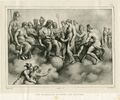
The Olympian gods, atop a
-shaped world

Stylized Earth symbol
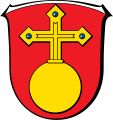
A simple globus cruciger
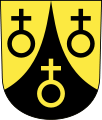
Three globi crucigeri in the coat of arms of Maschwanden in Switzerland
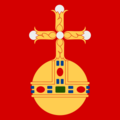
In the flag of Uppland, the globe of the globus cruciger is stylized as a T-and-O map, 16px
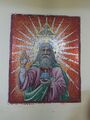
In this globus cruciger, the cross is surmounted on a celestial orb with stars
Classical planets
Moon
.svg.png)
.svg.png)
The crescent shape has been used to represent the Moon since earliest times. In classical antiquity, it is worn by lunar deities (Selene/Luna, Artemis/Diana, Men, etc.) either on the head or behind the shoulders, with its horns pointing upward. The representation of the moon as a simple crescent with the horns pointing to the side (as a heraldic crescent increscent or crescent decrescent) is attested from late Classical times.
The same symbol can be used in a different context not for the Moon itself but for a lunar phase, as part of a sequence of four symbols for "new moon" (U+1F311 🌑︎), "waxing" (U+263D ☽︎), "full moon" (U+1F315 🌕︎) and "waning" (U+263E ☾︎).

The Moon symbol, representing silver mining, in the municipal arms of Sala in Sweden

The Moon symbol in the municipal arms of Silvberg ('Silver Mountain') in Sweden

Stylized Moon symbol

The Moon for silver
Mercury
.svg.png)
The symbol ☿ for Mercury is a caduceus (a staff intertwined with two serpents), a symbol associated with Mercury / Hermes throughout antiquity. Some time after the 11th century, a crosshatch was added to the bottom of the staff to make it seem more Christian.[3]
.jpg)
The god Hermes (Mercury) with his caduceus
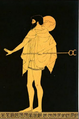
The caduceus, copied from pottery
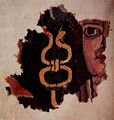
The caduceus in a tapestry, 3rd century

Mercury symbol, representing quicksilver mining, in the municipal coat of arms of Stahlberg, Rhineland-Palatinate, Germany.

Stylized Mercury symbol

Mercury for quicksilver
The ☿ symbol has also been used to indicate intersex, transgender, or non-binary gender.[8] A related usage is for the 'worker' or 'neuter' sex among social insects that is neither male nor (due to its lack of reproductive capacity) fully female, such as for example worker bees.[9] It was also once the designated symbol for hermaphroditic or 'perfect' flowers,[10] but botanists now use ⚥ for these instead.[11]
Its Unicode codepoint is U+263F ☿ MERCURY (HTML ☿).
Venus
.svg.png)
The Venus symbol, ♀, consists of a circle with a small cross below it. It has been interpreted as a depiction of the hand-mirror of the goddess, which may also explain Venus's association with the planetary metal copper, as mirrors in antiquity were made of polished copper (alloy),[12][lower-alpha 4] though this is not certain.[3] In the Greek Oxyrhynchus Papyri 235, the symbols for Venus and Mercury did not have the cross on the bottom stem,[3] and Venus still appears without the cross (⚲) in Johannes Kamateros (12th century).[citation needed]
In botany and biology, the symbol for Venus is used to represent the female sex, alongside the symbol for Mars representing the male sex,[13] following a convention introduced by Linnaeus in the 1750s.[10][lower-alpha 5] Arising from the biological convention, the symbol also came to be used in sociological contexts to represent women or femininity. This gendered association of Venus and Mars has been used to pair them heteronormatively, describing women and men stereotypically as being so different that they can be understood as coming from different planets, an understanding popularized in 1992 by the book titled Men Are from Mars, Women Are from Venus.[14][15]
Unicode encodes the symbol as U+2640 ♀ FEMALE SIGN, in the Miscellaneous Symbols block.[lower-alpha 6]
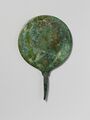
A bronze mirror, of the type associated with Venus
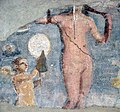
Cupid holding up a similar mirror to Venus
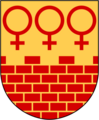
The Venus symbol, representing copper mining, in the municipal coat of arms of Falun Municipality in Sweden (1932)

Raised fist within Venus symbol, used as a symbol of second-wave feminism (1960s)[lower-alpha 7]

Stylized Venus symbol

Venus for copper
Sun
.svg.png)
The modern astronomical symbol for the Sun, the circumpunct (U+2609 ☉ SUN (HTML ☉)), was first used in the Renaissance. It possibly represents Apollo's golden shield with a boss; it is unknown if it traces descent from the nearly identical Egyptian hieroglyph for the Sun.
Bianchini's planisphere, produced in the 2nd century, shows a circlet with rays radiating from it.[5][2]
In late Classical times, the Sun is attested as a circle with a single ray. A diagram in Johannes Kamateros' 12th century Compendium of Astrology shows the same symbol.[18]
This older symbol is encoded by Unicode as U+1F71A 🜚 ALCHEMICAL SYMBOL FOR GOLD (HTML 🜚) in the Alchemical Symbols block. Both symbols have been used alchemically for gold, as have more elaborate symbols showing a disk with multiple rays or even a face.
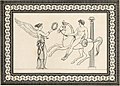
A buckler with a sun symbol and dot at center

Stylized circumpunct symbol for the Sun

The Sun for gold

🜚, the medieval astronomical symbol for the Sun
Mars
.svg.png)
The Mars symbol, ♂, is a depiction of a circle with an arrow emerging from it, pointing at an angle to the upper right in Europe and to the upper left in India. As astrological symbol it represents the planet Mars.[19][20] It is also the old and obsolete symbol for iron in alchemy. In zoology and botany, it is used to represent the male sex (alongside the astrological symbol for Venus representing the female sex),[13] following a convention introduced by Linnaeus in the 1750s.[10]
The symbol dates from at latest the 11th century, at which time it was an arrow across or through a circle, thought to represent the shield and spear of the god Mars; in the medieval form, for example in the 12th-century Compendium of Astrology by Johannes Kamateros, the spear is drawn across the shield.[18] The Greek Oxyrhynchus Papyri show a different symbol,[3] perhaps simply a spear.[2]
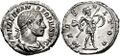
3rd-century coin with Mars on the reverse, with lance and shield. The same symbols were used for Athena (Pallas).
.jpg)
Mars with spear and shield, Pompeii.

The Mars symbol, representing iron mining, in the municipal coat of arms of Karlskoga in Sweden

The Mars symbol in the municipal coat of arms of Loppi in Finland
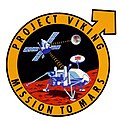
Mars symbol in the patch for NASA's Viking mission

Stylized Mars symbol. The spear partly crosses the shield.

Mars for iron
Its Unicode codepoint is U+2642 ♂ MALE SIGN (HTML ♂).
Jupiter
.svg.png)
The symbol for Jupiter, ♃, was originally a Greek zeta, Ζ, with a stroke indicating that it is an abbreviation (for Zeus, the Greek equivalent of Roman Jupiter).
Its Unicode codepoint is U+2643 ♃ JUPITER (HTML ♃).
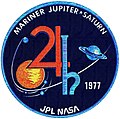
Jupiter and Saturn symbols in patch for NASA's Mariner Jupiter-Saturn mission

Stylized Jupiter symbol

Jupiter for tin
.svg.png)
A modern form of the symbol that reflects its origin in the letter 'Z'
Saturn
.svg.png)
Salmasius and earlier attestations show that the symbol for Saturn, ♄, derives from the initial letters (Kappa, rho) of its ancient Greek name Κρόνος (Script error: The function "transl" does not exist.), with a stroke to indicate an abbreviation.[10] By the time of Kamateros (12th century), the symbol had been reduced to a shape similar to a lower-case letter eta η, with the abbreviation stroke surviving (if at all) in the curl on the bottom-right end. The horizontal stroke was added along with the "Christianization" of other symbols in the early 16th century.
Its Unicode codepoint is U+2644 ♄ SATURN (HTML ♄).
- Error creating thumbnail: convert-im6.q16: width or height exceeds limit `/tmp/magick-UaHb7aBSjKr6aj99OUDeMYE-1LhMmrIK' @ error/cache.c/OpenPixelCache/3909.
convert-im6.q16: no images defined `PNG:/tmp/transform_8103a0198bff.png' @ error/convert.c/ConvertImageCommand/3229.
Emblem of the Fraternitas Saturni, a German magical order founded in 1926
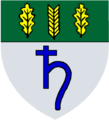
The Saturn symbol representing lead in the municipal coat of arms of Bleiwäsche, since 1975 part of Bad Wünnenberg, North Rhine-Westphalia, Germany

Stylized Saturn symbol

Saturn for lead (Pb)
Modern discoveries
Uranus
.svg.png)
.svg.png)
The symbols for Uranus were created shortly after its discovery in 1781. One symbol, ⛢, invented by J. G. Köhler and refined by Bode, was intended to represent the newly discovered metal platinum; since platinum, commonly called white gold, was found by chemists mixed with iron, the symbol for platinum combines the alchemical symbols for iron, ♂, and gold, ☉.[21][22] Gold and iron are the planetary metals for the Sun and Mars, and so share their symbols. Several orientations were suggested, but an upright arrow is now universal.
Another symbol, ♅, was suggested by Lalande in 1784. In a letter to Herschel, Lalande described it as "un globe surmonté par la première lettre de votre nom" ("a globe surmounted by the first letter of your name").[23] The platinum symbol tends to be used by astronomers and the monogram by astrologers.[24]
For use in computer systems, the symbols are encoded U+26E2 ⛢ ASTRONOMICAL SYMBOL FOR URANUS and U+2645 ♅ URANUS.
.png)
The planetary symbols as rendered in 1784, including the newly discovered Uranus (left)[21]
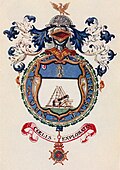
The Uranus platinum symbol on William Herschel's heraldry (center, blue background)

Stylized Uranus monogram
Neptune
.svg.png)
Several symbols were proposed for Neptune to accompany the suggested names for the planet. Claiming the right to name his discovery, Urbain Le Verrier originally proposed to name the planet for the Roman God Neptune[25]
and the symbol of a trident,[26]
while falsely stating that this had been officially approved by the French Bureau des Longitudes.[25] In October, he sought to name the planet Leverrier, after himself, and he had loyal support in this from the observatory director, François Arago,[27]
who in turn proposed a new symbol for the planet, ⯉ (.svg.png) ).[28]
However, this suggestion met with resistance outside France,[27] and French almanacs quickly reintroduced the name Herschel for Uranus, after that planet's discoverer Sir William Herschel, and Leverrier for the new planet,[29]
though it was used by anglophone institutions.[30]
Professor James Pillans of the University of Edinburgh defended the name Janus for the new planet, and proposed a key for its symbol.[26] Meanwhile, Struve presented the name Neptune on December 29, 1846, to the Saint Petersburg Academy of Sciences.[31]
In August 1847, the Bureau des Longitudes announced its decision to follow prevailing astronomical practice and adopt the choice of Neptune, with Arago refraining from participating in this decision.[32]
The planetary symbol was Neptune's trident, with the handle stylized either as a crosshatch
).[28]
However, this suggestion met with resistance outside France,[27] and French almanacs quickly reintroduced the name Herschel for Uranus, after that planet's discoverer Sir William Herschel, and Leverrier for the new planet,[29]
though it was used by anglophone institutions.[30]
Professor James Pillans of the University of Edinburgh defended the name Janus for the new planet, and proposed a key for its symbol.[26] Meanwhile, Struve presented the name Neptune on December 29, 1846, to the Saint Petersburg Academy of Sciences.[31]
In August 1847, the Bureau des Longitudes announced its decision to follow prevailing astronomical practice and adopt the choice of Neptune, with Arago refraining from participating in this decision.[32]
The planetary symbol was Neptune's trident, with the handle stylized either as a crosshatch .svg.png) , following Mercury, Venus, Jupiter, Saturn, and the asteroids, or as an orb
, following Mercury, Venus, Jupiter, Saturn, and the asteroids, or as an orb .svg.png) , following the symbols for Uranus, Earth, and Mars.[7] The crosshatch variant is the more common today.
, following the symbols for Uranus, Earth, and Mars.[7] The crosshatch variant is the more common today.
For use in computer systems, the symbols are encoded as U+2646 ♆ NEPTUNE and U+2BC9 ⯉ NEPTUNE FORM TWO.
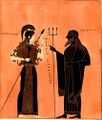
Athena (Pallas) with her lance and Poseidon (Neptune) with his trident. These weapons became the symbols of the planets Pallas and Neptune, respectively.
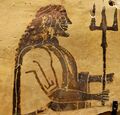
Poseidon with a trident, 6th century BCE
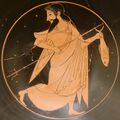
Poseidon with a trident, 6th century CE

Stylized Neptune symbol (orb base)

Stylized Neptune symbol (cross base)
.svg.png)
⯉, the obsolete Le Verrier monogram for Neptune
Pluto
.svg.png)
.svg.png)
Pluto was almost universally considered a planet from its discovery in 1930 until its re-classification as a dwarf planet (planetoid) by the IAU in 2006. Planetary geologists[33] and astrologers continue to treat it as a planet. The original planetary symbol for Pluto was a monogram of the letters P and L. Astrologers generally use a bident with an orb. NASA has used the bident symbol since Pluto's reclassification. These symbols are encoded as U+2647 ♇ PLUTO and U+2BD3 ⯓ PLUTO FORM TWO.

Pluto holding a bident

Pluto with a bident

Pluto symbol stylized as an inverted Mercury

Pluto compared in size to Earth's moon in a NASA publication
.svg.png)
⯖, an astrological symbol used for Pluto in Germany and Denmark, representing Pluto's orbit crossing Neptune's
.svg.png)
⯔, an astrological symbol used in the Mediterranean and Germany. The globe at bottom may be larger or omitted altogether.
Minor planets
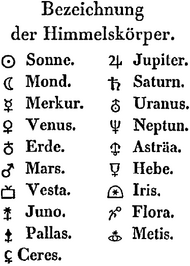
In the 19th century, planetary symbols for the major asteroids were also in use, including 1 Ceres (a reaper's sickle, encoded U+26B3 ⚳ CERES), 2 Pallas (a lance, U+26B4 ⚴ PALLAS) and 3 Juno (a sceptre, encoded U+26B5 ⚵ JUNO). Encke (1850) used symbols for 5 Astraea, 6 Hebe, 7 Iris, 8 Flora and 9 Metis in the Berliner Astronomisches Jahrbuch.[34]
In the late 20th century, astrologers abbreviated the symbol for 4 Vesta (the sacred fire of Vesta, encoded U+26B6 ⚶ VESTA),[35]
and introduced new symbols for 5 Astraea (.svg.png) , a stylised % sign, shift-5 on the keyboard for asteroid 5), 10 Hygiea (a caduceus – a common error in the US for a staff of Asclepius, itself an error for the snake symbol of Hygiea – encoded U+2BDA ⯚ HYGIEA)[36] and for 2060 Chiron, discovered in 1977 (a key, U+26B7 ⚷ CHIRON).[35] Chiron's symbol was adapted as additional centaurs were discovered; symbols for 5145 Pholus and 7066 Nessus have been encoded in Unicode.[36]
The abbreviated Vesta symbol is now universal, and the astrological symbol for Pluto has been used astronomically for Pluto as a dwarf planet.[37]
, a stylised % sign, shift-5 on the keyboard for asteroid 5), 10 Hygiea (a caduceus – a common error in the US for a staff of Asclepius, itself an error for the snake symbol of Hygiea – encoded U+2BDA ⯚ HYGIEA)[36] and for 2060 Chiron, discovered in 1977 (a key, U+26B7 ⚷ CHIRON).[35] Chiron's symbol was adapted as additional centaurs were discovered; symbols for 5145 Pholus and 7066 Nessus have been encoded in Unicode.[36]
The abbreviated Vesta symbol is now universal, and the astrological symbol for Pluto has been used astronomically for Pluto as a dwarf planet.[37]
In the early 21st century, symbols for the trans-Neptunian dwarf planets have come into use, particularly Eris (the hand of Eris, ⯰, but also ⯱), Sedna, Haumea, Makemake, Gonggong, Quaoar and Orcus which are in Unicode. All (except Eris, for which the hand of Eris is a traditional Discordian symbol) were devised by Denis Moskowitz, a software engineer in Massachusetts.[37][38]
| Code point | |||
|---|---|---|---|
| Ceres | .svg.png)
|
(⚳) CERES at U+26B3.[39] | |
| Pallas | .svg.png)
|
(⚴) PALLAS at U+26B4.[39] | |
| Juno | .svg.png)
|
(⚵) JUNO at U+26B5.[39] | |
| Vesta | .svg.png)
|
(⚶) VESTA at U+26B6.[39] | |
| Hygiea | .svg.png)
|
(⯚) HYGIEA at U+2BDA.[39] | |
| Chiron | .svg.png)
|
(⚷) CHIRON at U+26B7.[39] | |
| Pholus | 
|
(⯛) PHOLUS at U+2BDB | |
| Nessus | 
|
(⯜) NESSUS at U+2BDC | |
| Orcus | .svg.png)
|
(🝿) ORCUS at U+1F77F | |
| Haumea | .svg.png)
|
(🝻) HAUMEA at U+1F77B | |
| Quaoar | .svg.png)
|
(🝾) QUAOAR at U+1F77E | |
| Makemake | .svg.png)
|
(🝼) MAKEMAKE at U+1F77C | |
| Gonggong | .svg.png)
|
(🝽) GONGGONG at U+1F77D | |
| Eris | .svg.png)
|
(⯰) ERIS FORM ONE at U+2BF0 | |
.svg.png)
|
(⯱) ERIS FORM TWO at U+2BF1, used by astrologer Henry Seltzer | ||
| Sedna | .svg.png)
|
(⯲) SEDNA at U+2BF2 |

Ceres with her sickle
Athena (Pallas) with her lance (left)

Juno with her scepter

Vesta's sacred fire
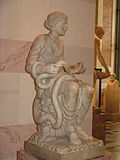
Hygiea with her snake (old astr. symbol
.svg.png) )
)
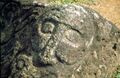
Petroglyph of Makemake

Orcus's gape
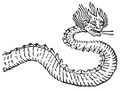
A human-headed serpent similar to depictions of Gonggong

The Hand of Eris from the Principia Discordia
Additional symbols
From 1845 to 1855, many symbols were created for newly discovered asteroids. But by 1851, the spate of discoveries had led to a general abandonment of these symbols in favour of numbering all asteroids instead.[40]

Astraea with her scales (astronomical symbol
.svg.png) or
or .svg.png) )
)
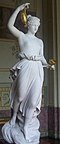
Hebe bearing a cup (astr. symbol
.svg.png) )
)

Iris as the rainbow (astr. symbol
.svg.png) )
)
_-_Napoli_MAN_8834.jpg)
Flora dispensing flowers (astr. symbol
.svg.png) )
)
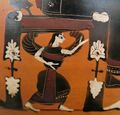
Metis (astr. symbol
.svg.png) )
)

Hygiea with her snake (astr. symbol
)

Parthenope (astr. symbol
.svg.png) )
)
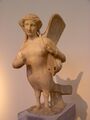
Parthenope with her lyre (astr. symbol
.svg.png) )
)

Victory (Victoria) with a laurel wreath (astr. symbol
.svg.png) or
or .svg.png) )
)
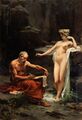
Egeria (astr. symbol
.svg.png) ) dictating the laws of Rome to Numa Pompilius
) dictating the laws of Rome to Numa Pompilius

Peace (Irene) as a freed dove (astr. symbol
.svg.png) )
)
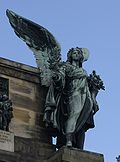
Peace with wings and an olive branch
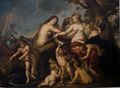
Eunomia (astr. symbol
.svg.png) ) at left, as allegory of law and good order; Irene in centre
) at left, as allegory of law and good order; Irene in centre
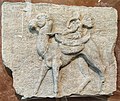
Psyche with butterfly wings (astr. symbol
.svg.png) )
)
.jpg)
Psyche accompanied by a butterfly, and Hermes with a multiply twisted caduceus
_(14759296956).jpg)
Psyche with butterfly wings, and Charon standing in his lunate boat

Insignia of the NASA Psyche mission, possibly influenced by the Psyche symbol[41]

Thetis with a dolphin (astro. symbol file:Thetis symbol (fixed width).svg)
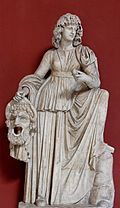
Melpomene with a dagger (astr. symbol file:Melpomene symbol (fixed width).svg)
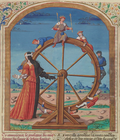
Fortuna with her wheel (astro. symbol file:Fortuna symbol (fixed width).svg)

blindfolded Fortuna balanced on a wheel

Proserpina with a pomegranate (astr. symbol file:Proserpina symbol (fixed width).svg)

Bellona with a lance and flail (astro. symbol file:Bellona symbol (fixed width).svg)
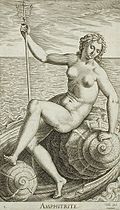
Amphitrite on a shell (astr. symbol file:Amphitrite symbol (fixed width).svg)
_issued_by_Wm._S._Kimball_&_Co._MET_DPB871036.jpg)
Leukothea (astr. symbol
.svg.png) ) as goddess of sailors
) as goddess of sailors
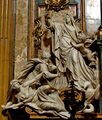
Faith (Fides, astr. symbol
.svg.png) ) triumphs over idolatry
) triumphs over idolatry
Moskowitz, who designed symbols for the trans-Neptunian dwarf planets, also designed symbols for the smaller trans-Neptunian objects Varuna, Ixion, and Salacia. Others have proposed symbols for even more trans-Neptunian objects, e.g. Zane Stein for Varda. Although mentioned in the Unicode proposal for the other dwarf planets, they lack broader adoption.[37]

Salacia riding her hippocamp (symbol
.svg.png) )
)
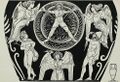
Ixion bound to his wheel (symbol
.svg.png) or
or .svg.png) )
)
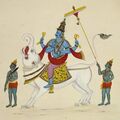
Varuna with his snake-lasso (symbol
.svg.png) )
)

Varda kindling the stars (symbol
.svg.png) )
)

The Symbol of Chaos (
.svg.png) ) in Warhammer 40,000
) in Warhammer 40,000
See also
- Astrological symbol
- Astronomical symbol
- Gender symbol
- Classical planets in Western alchemy
Footnotes
- ↑ 1.0 1.1 In order to have one-letter abbreviations for every planet, the IAU recommends 'H' (Hermes) for Mercury and 'M' for Mars. In the unlikely event a satellite were ever discovered around Mercury, its official abbreviation would be H1.
- ↑ "It is now possible to trace the medieval symbols for at least four of the five planets to forms that occur in some of the latest papyrus horoscopes ([ P.Oxy. ] 4272, 4274, 4275 [...]). Mercury's is a stylized caduceus. ... The ideal form of Mars' symbol is uncertain, and perhaps not related to the later circle with an arrow through it." — Jones (1999)[3]
- ↑ BNF Arabe 2583 folio 15v: Saturn is shown as a black bearded man, kneeling and holding a scythe or axe; Mercury is shown as a scribe holding an open codex; Jupiter as a man of the law wearing a turban; Venus as a lute-player; Mars as a helmeted warrior holding a sword and the head of an enemy.
- ↑ "The symbol, the stylized hand mirror of the Goddess Venus, also represents femininity. It has also been used for the element copper: Mirrors had been manufactured from polished copper." — Rehder (2011)[12]
- ↑
"In his Systema Naturae (Leyden, 1735) he [Linnaeus] used them with their traditional associations for metals. Their first biological use is in the Linnaean dissertation Plantae hybridae xxx sistit J.J. Haartman (1751) where in discussing hybrid plants Linnaeus denoted the supposed female parent species by the sign ♀, the male parent by the sign ♂, the hybrid by ☿: 'matrem signo ♀, patrem ♂ & plantam hybridam ☿ designavero'. In subsequent publications he retained the signs ♀ and ♂ for male and female individuals but discarded ☿ for hybrids; the last are now indicated by the multiplication sign ×."
- ↑ Glossed in the official Unicode code chart as " = Venus = alchemical symbol for copper → 1F469 👩 woman → 1F6BA 🚺 women's symbol". [16]
- ↑ The raised fist symbol is attributed to Robin Morgan, in the 1960s: "Morgan designed the universal logo of the women's movement, the woman's symbol centered with a raised fist."[17]
References
- ↑ The IAU Style Manual. 1989. p. 27. http://www.iau.org/static/publications/stylemanual1989.pdf.
- ↑ 2.0 2.1 2.2 "plaque; planisphère de Bianchini". Paris: Louvre. https://collections.louvre.fr/en/ark:/53355/cl010278829.
- ↑ 3.00 3.01 3.02 3.03 3.04 3.05 3.06 3.07 3.08 3.09 3.10 3.11 3.12 Jones, Alexander (1999) (in en). Astronomical Papyri from Oxyrhynchus: (P. Oxy. 4133-4300a). American Philosophical Society. ISBN 978-0-87169-233-7. https://books.google.com/books?id=8MokzymQ43IC.
- ↑ Neugebauer, Otto (1975). A History of Ancient Mathematical Astronomy. pp. 788–789. ISBN 0-387-06995-X.
- ↑ 5.0 5.1 Maunder (1934)
- ↑ Maunder (1934:239)
- ↑ 7.0 7.1 "Solar System". The English Cyclopaedia of Arts and Sciences. VII–VIII. 1861.
- ↑ van den Akker, Olga B.A. (2012). Reproductive Health Psychology. Wiley-Blackwell. p. 40. ISBN 978-1-119-96747-7. https://books.google.com/books?id=TjWIp25pOjcC&pg=PA40.
- ↑ Bingham, C. T. (1903). The Fauna of British India, Including Ceylon and Burma. Hymenoptera, Vol. II. Ants and Cuckoo-Wasps. London: Taylor and Francis. p. v. https://biodiversitylibrary.org/page/10943626.
- ↑ 10.0 10.1 10.2 10.3 10.4 "The origin of the male and female symbols of biology". Taxon 11 (4): 109–113. May 1962. doi:10.2307/1217734. ISSN 0040-0262. https://iapt-taxon.org/historic/Congress/IBC_1964/male_fem.pdf.
- ↑ Simpson, Niki (2010). "Botanical symbols: A new symbol set for new images". Botanical Journal of the Linnean Society 162 (2): 117–129. doi:10.1111/j.1095-8339.2009.01021.x. https://academic.oup.com/botlinnean/article/162/2/117/2418432.
- ↑ 12.0 12.1 Rehder, Dieter (2011). Chemistry in Space: From interstellar matter to the origin of life. Wiley-VCH.
- ↑ 13.0 13.1 Schott, G.D. (December 2005). "Sex symbols ancient and modern: their origins and iconography on the pedigree". The British Medical Journal 331 (7531): 1509–1510. doi:10.1136/bmj.331.7531.1509. ISSN 0959-8138. PMID 16373733.
- ↑ Brammer, John Paul (2020-02-10). "Love / hate reads: Men are from Mars, Women are from Venus, revisited". https://www.vice.com/en/article/n7j3nm/lovehate-reads-men-are-from-mars-women-are-from-venus-revisited.
- ↑ Morin, Amy (2016-08-19). "Why the Mars and Venus conversations must end: The truth about gender differences in the workplace". Forbes. https://www.forbes.com/sites/amymorin/2016/08/19/why-the-mars-and-venus-conversations-must-end-the-truth-about-gender-differences-in-the-workplace/. Retrieved 2023-04-17.
- ↑ U+2640 (Report). Unicode code chart. U+26××. The Unicode Consortium. https://www.unicode.org/charts/PDF/U2600.pdf.
- ↑ "Activism", robinmorgan.net, September 8, 2023. Retrieved 2024-01-02.
- ↑ 18.0 18.1 Neugebauer, Otto; Van Hoesen, H.B. (1987). Greek Horoscopes. pp. 1, 159, 163.
- ↑ Maunder, A.S.D. (August 1934). "The origin of the symbols of the planets". The Observatory 57: 238–247. Bibcode: 1934Obs....57..238M.
- ↑ Evans, James (1998). The History & Practice of Ancient Astronomy. Oxford University Press/U.S.. p. 350. ISBN 0-19-509539-1.
- ↑ 21.0 21.1 (in de) Von dem neu entdeckten Planeten. Beim Verfaszer. 1784. pp. 95–96. Bibcode: 1784vdne.book.....B. https://archive.org/details/bub_gb_ZqA5AAAAcAAJ.
- ↑ Gould, B.A. (1850). Report on the history of the discovery of Neptune. Smithsonian Institution. p. 5. https://archive.org/details/bub_gb_uyANAQAAIAAJ.
- ↑ Herschel, Francisca (August 1917). "The meaning of the symbol H+o for the planet Uranus". The Observatory 40: 306. Bibcode: 1917Obs....40..306H.
- ↑ Iancu, Laurentiu (14 August 2009). Proposal to encode the astronomical symbol for Uranus (Report). The Unicode Consortium. L2009/09300. https://www.unicode.org/L2/L2009/09300-uranus.pdf.
- ↑ 25.0 25.1 Littmann, Mark; Standish, E.M. (2004). Planets Beyond: Discovering the outer Solar System. Courier Dover Publications. p. 50. ISBN 0-486-43602-0.
- ↑ 26.0 26.1 Pillans, James (1847). "Ueber den Namen des neuen Planeten" (in de). Astronomische Nachrichten 25 (26): 389–392. doi:10.1002/asna.18470252602. Bibcode: 1847AN.....25..389.. https://books.google.com/books?id=yOAzAQAAIAAJ&pg=RA1-PA39-IA11.
- ↑ 27.0 27.1 Baum, Richard; Sheehan, William (2003). In Search of Planet Vulcan: The ghost in Newton's clockwork universe. Basic Books. pp. 109–110. ISBN 0-7382-0889-2.
- ↑ Schumacher, H.C. (1846). "Name des Neuen Planeten" (in de). Astronomische Nachrichten 25: 81–82. doi:10.1002/asna.18470250603. Bibcode: 1846AN.....25...81L. https://books.google.com/books?id=wlc_AAAAcAAJ&pg=PA89.
- ↑ Gingerich, Owen (October 1958). The naming of Uranus and Neptune (Report). ASP Leaflets. 8. Astronomical Society of the Pacific. pp. 9–15.
- ↑ "[title not cited]". Proceedings of the American Academy of Arts and Sciences 1: 287 ff, 334 ff. 1848.[title+not+cited]&rft.jtitle=Proceedings+of+the+American+Academy+of+Arts+and+Sciences&rft.date=1848&rft.volume=1&rft.pages=287 ff,+334 ff&rfr_id=info:sid/en.wikibooks.org:Unsolved:Planet_symbols">
- ↑ Hind, J.R. (1847). "Second report of proceedings in the Cambridge Observatory relating to the new planet (Neptune)". Astronomische Nachrichten 25 (21): 309–314. doi:10.1002/asna.18470252102. Bibcode: 1847AN.....25..309.. https://zenodo.org/record/1424623.
- ↑ (in fr) Connaissance des Temps: ou des mouvementes célestes, à l'usage des astronomes. Connaissance des Temps. 1847. Paris, France: Bureau des Longitudes. 1847. p. [unnumbered front matter]. https://books.google.com/books?id=5q03AAAAMAAJ&pg=PP9.
- ↑ Metzger, Philip T.; Grundy, W.M.; Sykes, Mark V.; Stern, Alan; Bell, James F. III; Detelich, Charlene E. et al. (March 2022). "Moons are planets: Scientific usefulness versus cultural teleology in the taxonomy of planetary science". Icarus 374: 114768. doi:10.1016/j.icarus.2021.114768. ISSN 0019-1035.
- ↑ 34.0 34.1 Berliner Astronomisches Jahrbuch für 1853. Berlin, DE. 1850. p. viii.viii&rft.place=Berlin,+DE&rfr_id=info:sid/en.wikibooks.org:Unsolved:Planet_symbols">
- ↑ 35.0 35.1 Faulks, David (9 May 2006). Proposal to add some western astrology symbols to the UCS (Report). The Unicode Consortium. p. 4. L2006/06171. https://www.unicode.org/L2/L2006/06171-astroprop.pdf. Retrieved 20 November 2017.
- ↑ 36.0 36.1 Faulks, David (15 April 2016). Additional symbols for astrology (Report). The Unicode Consortium. L2016/16080. https://www.unicode.org/L2/L2016/16080-add-astrology.pdf.
- ↑ 37.0 37.1 37.2 Miller, Kirk (26 October 2021). Unicode request for dwarf-planet symbols (Report). L2021/21224. https://www.unicode.org/L2/L2021/21224-dwarf-planet-syms.pdf.
- ↑ Anderson, Deborah (4 May 2022). "Out of this world: New astronomy symbols approved for the Unicode standard". unicode.org (Press release). The Unicode Consortium. Retrieved 6 August 2022.
- ↑ 39.0 39.1 39.2 39.3 39.4 39.5 In the official code chart.
- ↑ When did the asteroids become minor planets? (Report). Astronomical Almanac Division. Washington, DC: United States Naval Observatory. 14 June 2011. http://aa.usno.navy.mil/faq/docs/minorplanets.php. Retrieved April 24, 2013.
- ↑ Bala, Gavin Jared; Miller, Kirk (18 September 2023). "Unicode request for historical asteroid symbols". Unicode. https://www.unicode.org/L2/L2023/23207-historical-asteroids.pdf.
 |  |
Categories: [Alchemical symbols]
↧ Download as ZWI file | Last modified: 04/10/2025 01:07:11 | 76 views
☰ Source: https://handwiki.org/wiki/Unsolved:Planet_symbols | License: CC BY-SA 3.0
 KSF
KSF