Skoll (Moon)
 From Handwiki
 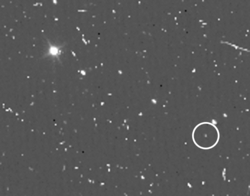 Image of Skoll taken by Cassini on February 23, 2016 | |
| Discovery[1] | |
|---|---|
| Discovered by | S. S. Sheppard D. C. Jewitt J. Kleyna |
| Discovery date | 2006 |
| Designations | |
Designation | Saturn XLVII |
| Pronunciation | English: /skɒl/ Old Norse: [skœlː] (approximately /skɜːrl/) |
| Named after | Sköll |
Alternative names | S/2006 S 8 |
| Orbital characteristics[2] | |
Semi-major axis | 17560000000 km |
| Eccentricity | 0.418 |
| Orbital period | 869 days (2.38 yr) |
| Inclination | 156° |
| Satellite of | Saturn |
| Group | Norse group |
| Physical characteristics | |
| Mean diameter | 5+50% −30% km[3] |
| Rotation period | 7.26±0.09? h[3] |
| Albedo | 0.04 (assumed)[4] |
Skoll or Saturn XLVII (provisional designation S/2006 S 8) is a retrograde irregular satellite of Saturn. Its discovery was announced by Scott S. Sheppard, David C. Jewitt and Jan Kleyna on 26 June 2006 from observations taken between 5 January and 30 April 2006.[2][5]
Skoll is about 6 kilometres in diameter (assuming an albedo of 0.04) and orbits Saturn at an average distance of 17.6 Gm (million km) in 869 days, following a highly eccentric and moderately inclined orbit.[4] A rotation period of 7.26±0.04 h was obtained by Cassini–Huygens in 2016, but this is in strong disagreement with 2013 data for unknown reasons; one possible explanation is variation in the rotation speed and axis due to Milankovitch wobble.[6]
It was named in April 2007[7] after Sköll, a giant wolf from Norse mythology, son of Fenrir and twin brother of Hati.
References
- ↑ Discovery Circumstances from JPL
- ↑ 2.0 2.1 MPEC 2006-M45: Eight New Satellites of Saturn 26 June 2006 (discovery and ephemeris)
- ↑ 3.0 3.1 Denk, T.; Mottola, S. (2019). "Cassini Observations of Saturn's Irregular Moons". 50th Lunar and Planetary Science Conference. Lunar and Planetary Institute. https://www.hou.usra.edu/meetings/lpsc2019/pdf/2654.pdf.
- ↑ 4.0 4.1 Scott Sheppard's pages
- ↑ IAUC 8727: Satellites of Saturn 30 June 2006 (discovery)
- ↑ Denk, T.; Mottola, S.; Bottke, W. F.; Hamilton, D. P. (2018). "The Irregular Satellites of Saturn". Enceladus and the Icy Moons of Saturn. 322. University of Arizona Press. pp. 409–434. doi:10.2458/azu_uapress_9780816537075-ch020. ISBN 9780816537488. Bibcode: 2018eims.book..409D. https://tilmanndenk.de/wp-content/uploads/DenkEtAl2018_IrregularMoons.pdf.
- ↑ "IAUC 8826: Sats OF JUPITER, SATURN; RING OF URANUS; 2006 VV_2". http://www.cbat.eps.harvard.edu/iauc/08800/08826.html.
- MPC: Natural Satellites Ephemeris Service
- Mean orbital parameters from NASA JPL
External links
- David Jewitt's pages
Saturn | ||
|---|---|---|
| ||
| Geography |
| .jpg) |
| Moons |
| |
| Astronomy |
| |
| Exploration |
| |
| Related |
| |
Natural satellites of the Solar System | ||
|---|---|---|
| Planetary satellites |
|  |
| Dwarf-planet satellites |
| |
| Minor-planet moons |
| |
| Ranked by size |
| |
| ||
 |  |
Categories: [Moons of Saturn] [Irregular satellites]
↧ Download as ZWI file | Last modified: 07/16/2024 01:20:08 | 7 views
☰ Source: https://handwiki.org/wiki/Astronomy:Skoll_(moon) | License: CC BY-SA 3.0
 KSF
KSF