Indazoles
 From Britannica 11th Edition (1911)
 Indazoles (Benzopyrazoles), organic substances containing
the ring system 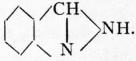 The parent substance
indazole, C7H6N2, was obtained by E. Fischer (Ann. 1883, 221,
p. 280) by heating ortho-hydrazine cinnamic acid,
The parent substance
indazole, C7H6N2, was obtained by E. Fischer (Ann. 1883, 221,
p. 280) by heating ortho-hydrazine cinnamic acid,

It has also been obtained by heating ortho-diazoaminotoluene with acetic acid and benzene (F. Heusler, Ber., 1891, 24, p. 4161).

It crystallizes in needles (from hot water), which melt at 146.5° C. and boil at 269°-270° C. It is readily soluble in hot water, alcohol and dilute hydrochloric acid. Nitrous acid converts it into nitrosoindazole; whilst on heating with the alkyl iodides it is converted into alkyl indazoles.
A series of compounds isomeric with these alkyl derivatives
is known, and can be considered as derived from the ring system
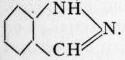 These isomers are called isindazoles, and may
be prepared by the reduction of the nitroso-ortho-alkylamino-acetophenones
with zinc dust and water or acetic acid. The
indazoles are weak bases, which crystallize readily. Phenyl
indazole, on reduction with sodium and absolute alcohol, gives
a dihydro derivative (K. L. Paal, Ber., 1891, 24, p. 963).
These isomers are called isindazoles, and may
be prepared by the reduction of the nitroso-ortho-alkylamino-acetophenones
with zinc dust and water or acetic acid. The
indazoles are weak bases, which crystallize readily. Phenyl
indazole, on reduction with sodium and absolute alcohol, gives
a dihydro derivative (K. L. Paal, Ber., 1891, 24, p. 963).
For other derivatives, see E. Fischer and J. Tafel, Ann. 1885, 227, p. 314.
↧ Download as ZWI file | Last modified: 11/17/2022 15:23:14 | 61 views
☰ Source: https://oldpedia.org/article/britannica11/Indazoles | License: Public domain in the USA. Project Gutenberg License
 ZWI signed:
 KSF
KSF