Flat Spot (Reflection Seismology)
 From Handwiki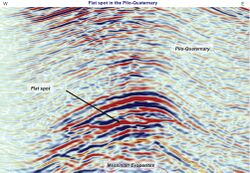
In reflection seismology, a flat spot is a seismic attribute anomaly that appears as a horizontal reflector cutting across the stratigraphy elsewhere present on the seismic image.[1] Its appearance can indicate the presence of hydrocarbons. Therefore, it is known as a direct hydrocarbon indicator and is used by geophysicists in hydrocarbon exploration.
Theory
A flat spot can result from the increase in acoustic impedance when a gas-filled porous rock (with a lower acoustic impedance) overlies a liquid-filled porous rock (with a higher acoustic impedance). It may stand out on a seismic image because it is flat and will contrast with surrounding dipping reflections.[2]
Caution
There are a number of other possible reasons for there being a flat spot on a seismic image. It could be representative of a mineralogical change in the subsurface or an unresolved shallower multiple. Additionally, the interpretation of a flat spot should be attempted after depth conversion to confirm that the anomaly is actually flat.[1]
See also
- Bright spot
- Seismic attribute
- Reflection seismology
References
- ↑ 1.0 1.1 Gluyas, J.; Swarbrick, R. (2011). Petroleum Geoscience (2nd ed.). Blackwell Publishing. p. 242. ISBN 978-0-632-03767-4.
- ↑ Sheriff, R. E.; Geldart, L. P. (1995). Exploration Seismology (2nd ed.). Cambridge University Press. p. 416. ISBN 0-521-46826-4.
 |  |
Categories: [Seismology measurement]
↧ Download as ZWI file | Last modified: 03/22/2024 02:44:19 | 16 views
☰ Source: https://handwiki.org/wiki/Earth:Flat_spot_(reflection_seismology) | License: CC BY-SA 3.0
 KSF
KSF