Hawaii Supreme Court
 From Ballotpedia
 | Hawaii Supreme Court |
|---|
|
| Court Information |
| Justices: 5 |
| Founded: 1959 |
| Location: Honolulu |
| Salary |
| Associates: $263,652[1] |
| Judicial Selection |
| Method: Assisted appointment (Hybrid) |
| Term: 10 years |
| Active justices |
| Vladimir P. Devens, Todd Eddins, Lisa M. Ginoza |
Founded in 1959, the Hawaii Supreme Court is the state's court of last resort and has five judgeships. The current acting chief of the court is Sabrina S. McKenna.[2]
As of October 2025, four judges on the court were appointed by a Democratic governor and no judges on the court were appointed by a Republican governor.
The Hawaii Supreme Court meets in the meets in Aliʻiōlani Hale building in Honolulu, Hawaii.[2]
In Hawaii, state supreme court justices are selected through assisted appointment with a hybrid judicial nominating commission. Justices are appointed by the governor with the assistance of a commission who has no majority of members selected either by the governor or the state Bar Association. There are 10 states that use this selection method. To read more about the assisted appointment of judges, click here.
Jurisdiction[edit]
The Hawaii Supreme Court has appellate jurisdiction over cases decided in lower courts within the state. These appeals come in the form of reserved and certified questions from lower courts or federal courts, and writs of certiorari. The court has exclusive jurisdiction over elections cases, rules governing the procedures of all state courts, and the regulation and discipline of attorneys and judges.[2]
The chief justice is the administrative head of the courts. He or she may assign judges from one circuit court to another and carries out administration of the judiciary.[3]
Justices[edit]
The table below lists the current judges of the Hawaii Supreme Court, their political party, when they assumed office, and the appointing governor.
| Office | Name | Party | Date assumed office | Appointed by |
|---|---|---|---|---|
| Hawaii Supreme Court | Vladimir P. Devens | Nonpartisan | January 12, 2024 | Joshua Green (D) |
| Hawaii Supreme Court | Todd Eddins | Nonpartisan | December 11, 2020 | David Ige (D) |
| Hawaii Supreme Court | Lisa M. Ginoza | Nonpartisan | January 12, 2024 | Joshua Green (D) |
| Hawaii Supreme Court | Vacant | |||
| Hawaii Supreme Court Chief Justice | Sabrina S. McKenna | Nonpartisan | October 1, 2025 | Joshua Green (D) |
Salary[edit]
- See also: Hawaii court salaries and budgets
In 2025, the justices of the court received a salary of $263,652, according to the National Center for State Courts.[4]
Judicial selection[edit]
- See also: Judicial selection in Hawaii
The five justices of the Hawaii Supreme Court are selected through the assisted appointment method. The Hawaii Judicial Selection Commission is responsible for screening candidates and submitting a shortlist to the governor. The commission is made up of nine members: two appointed by the governor, two appointed by the state Senate president, two appointed by the state House speaker, two appointed by the Hawaii Bar Association, and one appointed by the chief justice of the supreme court. The governor must appoint a judge from the commission's shortlist and the appointee must then be confirmed by the Hawaii State Senate.[5]
Justices serve for 10 years after their appointment. To continue to serve on the court, they must receive a majority vote of the selection commission.[5]
Qualifications[edit]
To serve on this court, a judge must be:[5]
- a U.S. resident and citizen;
- a resident and citizen of the state;
- a practicing attorney in the state for at least ten years; and
- under the age of 70 (retirement by 70 is mandatory retirement).
Chief justice[edit]
In Hawaii, the position of chief justice is a specific seat on the court (similar to the Supreme Court of the United States) rather than a peer-selected leadership position. The chief justice is appointed in the same manner as the other justices on the court.[5]
Vacancies[edit]
If a midterm vacancy occurs, the position is filled just as it would be if the vacancy occurred at the end of a justice's term. The governor appoints a successor from a list provided by a nominating commission, and the appointee faces confirmation from the state Senate. Newly appointed justices serve full 10-year terms.[5]
The map below highlights how vacancies are filled in state supreme courts across the country.
Appointments[edit]
2025[edit]
Hawaii Supreme Court Chief Justice Mark Recktenwald retired on September 30, 2025 after he reached the mandatory retirement age of 70.[6] Recktenwald's replacement was Governor Green's (D) third nominee to the five-member supreme court.
Gov. Green appointed Hawaii Supreme Court Justice Sabrina S. McKenna as acting chief justice on October 1, 2025.[7] As of September 29, 2025, she confirmed to KHON that she had applied to the permanent position on the court.[8]
In Hawaii, state supreme court justices are selected through assisted appointment with a hybrid judicial nominating commission. Justices are appointed by the governor with the assistance of a commission who has no majority of members selected either by the governor or the state Bar Association. There are 10 states that use this selection method. To read more about the assisted appointment of judges, click here.
If a midterm vacancy occurs, the position is filled just as it would be if the vacancy occurred at the end of a justice's term. The governor appoints a successor from a list provided by a nominating commission, and the appointee faces confirmation from the state Senate. Newly appointed justices serve full 10-year terms.[5]
2023[edit]
Justice Wilson vacancy[edit]
Hawaii governor Joshua Green (D) appointed Lisa M. Ginoza to the Hawaii Supreme Court on October 23, 2023. She was confirmed on November 21, 2023.[9]
Ginoza succeeded Justice Michael D. Wilson, who retired on March 31, 2023, due to reaching Hawaii's mandatory retirement age. Wilson's replacement was Governor Green's (D) first nominee to the five-member supreme court.
In Hawaii, state supreme court justices are selected through assisted appointment with a hybrid judicial nominating commission. Justices are appointed by the governor with the assistance of a commission who has no majority of members selected either by the governor or the state Bar Association. There are 10 states that use this selection method. To read more about the assisted appointment of judges, click here.
Justice Nakayama vacancy[edit]
Hawaii governor Joshua Green (D) appointed Vladimir P. Devens to the Hawaii Supreme Court on October 23, 2023. The Hawaii State Senate confirmed Green's appointment on November 21, 2023.[9]
Devens replaced Justice Paula Nakayama, who retired on April 21, 2023 due to reaching the state's mandatory retirement age of 70. Nakayama's replacement was Governor Green's (D) second nominee to the five-member supreme court.
In Hawaii, state supreme court justices are selected through assisted appointment with a hybrid judicial nominating commission. Justices are appointed by the governor with the assistance of a commission who has no majority of members selected either by the governor or the state Bar Association. There are 10 states that use this selection method. To read more about the assisted appointment of judges, click here.
2020[edit]
Hawaii Governor David Ige (D) appointed Todd Eddins to the Hawaii Supreme Court on October 23, 2020. The Hawaii State Senate confirmed Eddins to succeed Justice Richard W. Pollack on November 19, 2020.[10][11] Eddins was Ige's first nominee to the five-member supreme court.
The seat became vacant when Pollack retired on June 30, 2020, after reaching the mandatory retirement age of 70 years.[12]
Under Hawaii law as of June 2020, state supreme court justices were selected through the assisted appointment method. The governor chose an appointee from a list of candidates submitted by the judicial nominating commission. The nominee required confirmation from the Hawaii State Senate.[13]
Caseloads[edit]
The table below details the number of cases filed with the court and the number of dispositions (decisions) the court reached in each year.[14]
| Hawaii Supreme Court caseload data | ||
|---|---|---|
| Year | Filings | Dispositions |
| 2023 | 458 | 459 |
| 2022 | 407 | 430 |
| 2021 | 692 | 689 |
| 2020 | 297 | 337 |
| 2019 | 255 | 237 |
| 2018 | 250 | 253 |
| 2017 | 267 | 290 |
| 2016 | 304 | 315 |
| 2015 | 169 | 130 |
| 2014 | 252 | 194 |
| 2013 | 245 | 209 |
| 2012 | 185 | 181 |
| 2011 | 166 | 161 |
| 2010 | 143 | 147 |
| 2009 | 127 | 127 |
Analysis[edit]
Ballotpedia Courts: Determiners and Dissenters (2021)[edit]
 In 2020, Ballotpedia published Ballotpedia Courts: Determiners and Dissenters, a study on how state supreme court justices decided the cases that came before them. Our goal was to determine which justices ruled together most often, which frequently dissented, and which courts featured the most unanimous or contentious decisions.
The study tracked the position taken by each state supreme court justice in every case they decided in 2020, then tallied the number of times the justices on the court ruled together. We identified the following types of justices:
- We considered two justices opinion partners if they frequently concurred or dissented together throughout the year.
- We considered justices a dissenting minority if they frequently opposed decisions together as a -1 minority.
- We considered a group of justices a determining majority if they frequently determined cases by a +1 majority throughout the year.
- We considered a justice a lone dissenter if he or she frequently dissented alone in cases throughout the year.
Summary of cases decided in 2020[edit]
- Number of justices: 5
- Number of cases: 411
- Percentage of cases with a unanimous ruling: 89.5% (368)
- Justice most often writing the majority opinion: Justice Sabrina McKenna (38)
- Per curiam decisions: 324
- Concurring opinions: 3
- Justice with most concurring opinions: Justice Michael Wilson (3)
- Dissenting opinions: 42
- Justice with most dissenting opinions: Justice Mark Recktenwald (15)
For the study's full set of findings in Hawaii, click here.
Ballotpedia Courts: State Partisanship (2020)[edit]
- See also: Ballotpedia Courts: State Partisanship
 Last updated: June 15, 2020
In 2020, Ballotpedia published Ballotpedia Courts: State Partisanship, a study examining the partisan affiliation of all state supreme court justices in the country as of June 15, 2020.
The study presented Confidence Scores that represented our confidence in each justice's degree of partisan affiliation, based on a variety of factors. This was not a measure of where a justice fell on the political or ideological spectrum, but rather a measure of how much confidence we had that a justice was or had been affiliated with a political party. To arrive at confidence scores we analyzed each justice's past partisan activity by collecting data on campaign finance, past political positions, party registration history, as well as other factors. The five categories of Confidence Scores were:
- Strong Democrat
- Mild Democrat
- Indeterminate[15]
- Mild Republican
- Strong Republican
We used the Confidence Scores of each justice to develop a Court Balance Score, which attempted to show the balance among justices with Democratic, Republican, and Indeterminate Confidence Scores on a court. Courts with higher positive Court Balance Scores included justices with higher Republican Confidence Scores, while courts with lower negative Court Balance Scores included justices with higher Democratic Confidence Scores. Courts closest to zero either had justices with conflicting partisanship or justices with Indeterminate Confidence Scores.[16]
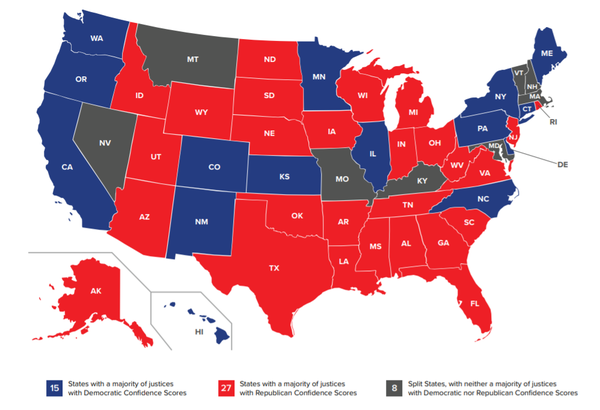
Hawaii had a Court Balance Score of -0.60, indicating Democrat control of the court. In total, the study found that there were 15 states with Democrat-controlled courts, 27 states with Republican-controlled courts, and eight states with Split courts. The map below shows the court balance score of each state.
Bonica and Woodruff campaign finance scores (2012)[edit]
In October 2012, political science professors Adam Bonica and Michael Woodruff of Stanford University attempted to determine the partisan outlook of state supreme court justices in their paper, "State Supreme Court Ideology and 'New Style' Judicial Campaigns." A score above 0 indicated a more conservative-leaning ideology while scores below 0 were more liberal. The state Supreme Court of Hawaii was given a campaign finance score (CFscore), which was calculated for judges in October 2012. At that time, Hawaii received a score of -0.29. Based on the justices selected, Hawaii was the 17th most liberal court. The study was based on data from campaign contributions by judges themselves, the partisan leaning of contributors to the judges, or—in the absence of elections—the ideology of the appointing body (governor or legislature). This study was not a definitive label of a justice but rather an academic gauge of various factors.[17]
Noteworthy cases[edit]
The following are noteworthy cases heard before the Hawaii Supreme Court. For a full list of opinions published by the court, click here. Know of a case we should cover here? Let us know by emailing us.
| • Hawaii Supreme Court rescinds construction permit for world's largest telescope (2015) Judge(s):Mark Recktenwald (Hou v. Board of Land and Natural Resources, Hawai'i, SCAP-14-0000873) | Click for summary→ |
|---|---|
|
The Hawaii Supreme Court rescinded the construction permit for the Thirty Meter Telescope (TMT), intended to be the largest and most powerful optical telescope in the world. The TMT was planned to be an 18-story high, $1.4 billion observatory and to have a resolution 12 times sharper than that of the Hubble Space Telescope. The TMT was designed to study distant planets and discover information about the birth of galaxies. On December 2, 2015, the court ruled that the state Board of Land and Natural Resources did not follow due process when it approved the permit in 2011, before Hawaiians had a chance to submit their complaints in a court hearing.[18][19] The opinion was written by Chief Justice Mark Recktenwald.[20] Construction was led by the California Institute of Technology and the University of California in an international collaboration. Construction had been stalled since April 2015 due to protesters blocking workers from accessing the telescope's construction site near the summit of Mauna Kea, the state's tallest mountain and a dormant volcano with religious and cultural value to Hawaiians. Mauna Kea is a state-designated conservation district.[18][19] Opponents of the TMT said the telescope was industrial development and would therefore violate the rules for such conservation districts. A court-ordered environmental impact statement in 2005 concluded that 30 years of astronomy had an adverse effect on nature and culture on the mountain. At the time of this case, there were 13 other telescopes on Mauna Kea.[18] The ruling meant that the Thirty Meter Telescope Observatory Corporation and its board would be forced to restart the permit process or find a different site. The corporation said in a Twitter message, "This is not a judgment against T.M.T., but rather against the state's process in granting the permits."[18] | |
Ethics[edit]
The Hawaii Revised Code of Judicial Conduct sets forth ethical guidelines and principles for the conduct of judges and judicial candidates in Hawaii. It consists of four overarching canons:
| “ |
|
” |
| —Hawaii State Judiciary website[22] | ||
The full text of the Hawaii Revised Code of Judicial Conduct can be found here.
History of the court[edit]
Hawaii's judicial evolution began well before statehood in 1959. Up until the 1840s, all functions of government, including executive, legislative, and judicial functions, were feudal in nature, with supremacy entrusted to a king and his chiefs. The first Hawaiian constitution of October 8, 1840, created under King Kamehameha III, distinguished between the three branches of government, and judicial power was vested in a supreme court, consisting of the king, the premier, and four chiefs elected by a representative body.[23] King Kamehameha sought to modernize the indigenous judicial system to one based on the Anglo-American legal system, as the arrival of foreigners grew sharply in the 1830s and 1840s, and with it, the attendant concerns over Hawaiian sovereignty, land, and resource rights. Though a court was included in the 1840 constitution, it was not set up until legislation was passed in 1847, that changed the court's original structure. Power was stripped from the supreme court and its justices, and the superior court of law and equity was created instead, with three appointed justices. There was also a system of judicial districts, circuit courts, civil and criminal actions, and judicial independence that greatly resembled the Anglo-American model. The chief justice was William Little Lee, a Harvard trained lawyer. [24][25]
The 1887 constitution, known as the "Bayonet Constitution," stripped the monarch's remaining power, and a complete overthrow of the monarchy followed in 1893. The United States annexed Hawaii in 1898.[26] Power was once again vested in the state supreme court through the Organic Act of 1900, with presidential appointment of the justices for a term of four years.[27]
The Hawaiian state constitution vests the supreme court with the highest judicial power in the state, providing that the governor, with the consent of the senate, fills vacancies on the court from a list of candidates brought forth by the Hawaii Judicial Selection Commission. The constitution provides for five justices on the supreme court and terms of ten years, with a mandatory retirement age of seventy.[28]
Removal of judges[edit]
In Hawaii, a commission on judicial conduct hears allegations of misconducts, investigates, and then submits a recommendation to the Hawaii Supreme Court that a judge be removed from the bench, suspended, reprimanded, or disciplined.[29]
Courts in Hawaii[edit]
- See also: Courts in Hawaii
In Hawaii, there is one federal district court, a state supreme court, a state court of appeals, and trial courts with both general and limited jurisdiction. These courts serve different purposes.
The image below depicts the flow of cases through Hawaii's state court system. Cases typically originate in the trial courts and can be appealed to courts higher up in the system.

Party control of Hawaii state government[edit]
A state government trifecta is a term that describes single-party government, when one political party holds the governor's office and has majorities in both chambers of the legislature in a state government. A state supreme court plays a role in the checks and balances system of a state government.
Hawaii has a Democratic trifecta. The Democratic Party controls the office of governor and both chambers of the state legislature.
Hawaii Party Control: 1992-2025
Twenty-six years of Democratic trifectas • No Republican trifectas
Scroll left and right on the table below to view more years.
| Year | 92 | 93 | 94 | 95 | 96 | 97 | 98 | 99 | 00 | 01 | 02 | 03 | 04 | 05 | 06 | 07 | 08 | 09 | 10 | 11 | 12 | 13 | 14 | 15 | 16 | 17 | 18 | 19 | 20 | 21 | 22 | 23 | 24 | 25 |
|---|---|---|---|---|---|---|---|---|---|---|---|---|---|---|---|---|---|---|---|---|---|---|---|---|---|---|---|---|---|---|---|---|---|---|
| Governor | D | D | D | D | D | D | D | D | D | D | D | R | R | R | R | R | R | R | R | D | D | D | D | D | D | D | D | D | D | D | D | D | D | D |
| Senate | D | D | D | D | D | D | D | D | D | D | D | D | D | D | D | D | D | D | D | D | D | D | D | D | D | D | D | D | D | D | D | D | D | D |
| House | D | D | D | D | D | D | D | D | D | D | D | D | D | D | D | D | D | D | D | D | D | D | D | D | D | D | D | D | D | D | D | D | D | D |
See also[edit]


External links[edit]
Footnotes[edit]
- ↑ The salary of the chief justice may be higher than an associate justice.
- ↑ 2.0 2.1 2.2 Hawaii State Judiciary, "Hawaii Supreme Court," accessed September 14, 2021
- ↑ Legislative Reference Bureau,"The Judiciary," accessed June 13, 2024
- ↑ National Center for State Courts, "2025 Salaries and Rankings," accessed October 8, 2025
- ↑ 5.0 5.1 5.2 5.3 5.4 5.5 Hawai'i State Judiciary, "Overview of the Hawai`i Judicial System," accessed April 18, 2025
- ↑ Hawai'i State Judiciary, "Hawaiʻi Supreme Court Leadership Transition," September 25, 2025
- ↑ Hawaii News Now, "Hawaii Supreme Court set for upcoming leadership transition," September 25, 2025
- ↑ KHON, "The search is on for a new Hawaii Chief Justice," September 29, 2025
- ↑ 9.0 9.1 Honolulu Civil Beat, "Senate Confirms Ginoza, Devens To Hawaii Supreme Court," November 21, 2023
- ↑ Honolulu Civil Beat, "Senate Confirms Todd Eddins To Hawaii Supreme Court," November 19, 2020
- ↑ Governor.Hawaii.gov, "Governor Ige Appoints First Circuit Judge To Hawai‘i Supreme Court," October 23, 2020
- ↑ Civil Beat, "A New Direction For The Hawaii Supreme Court?" June 30, 2020
- ↑ American Judicature Society, "Methods of Judicial Selection: Hawaii; Judicial Nomination Commissions," archived January 13, 2012
- ↑ Hawai'i State Judiciary, "News and Reports," accessed September 26, 2024
- ↑ An Indeterminate score indicates that there is either not enough information about the justice’s partisan affiliations or that our research found conflicting partisan affiliations.
- ↑ The Court Balance Score is calculated by finding the average partisan Confidence Score of all justices on a state supreme court. For example, if a state has justices on the state supreme court with Confidence Scores of 4, -2, 2, 14, -2, 3, and 4, the Court Balance is the average of those scores: 3.3. Therefore, the Confidence Score on the court is Mild Republican. The use of positive and negative numbers in presenting both Confidence Scores and Court Balance Scores should not be understood to that either a Republican or Democratic score is positive or negative. The numerical values represent their distance from zero, not whether one score is better or worse than another.
- ↑ Stanford University, "State Supreme Court Ideology and 'New Style' Judicial Campaigns," October 31, 2012
- ↑ 18.0 18.1 18.2 18.3 New York Times, "Hawaii court rescinds permit to build thirty meter telescope," December 3, 2015
- ↑ 19.0 19.1 Gizmodo, "Why the world's most powerful telescope has just been ruled unlawful," December 7, 2015
- ↑ Global Construction Review, "Hawaii supreme court stops construction of world’s largest telescope," March 12, 2015
- ↑ Note: This text is quoted verbatim from the original source. Any inconsistencies are attributable to the original source.
- ↑ Hawai'i State Judiciary, "Hawaii Revised Code of Judicial Conduct," accessed August 18, 2025
- ↑ University of Hawaii at Manoa, William S. Richardson School of Law,"Papers of the Hawaiian Historical Society No. 7, The Evolution of the Hawaiian Judiciary," accessed June 13, 2024
- ↑ University of Hawaii at Manoa, William S. Richardson School of Law,"Papers of the Hawaiian Historical Society No. 7, The Evolution of the Hawaiian Judiciary," accessed June 13, 2024
- ↑ Yale Law Journal,"Contentious Business: Merchants and the Creation of a Westernized Judiciary in Hawai'i," accessed June 13, 2024
- ↑ National Archives,"Joint Resolution to Provide for Annexing the Hawaiian Islands to the United States," accessed June 13, 2024
- ↑ Department of Interior,"Fifty-Sixth Congress, Session I, Chapters 338, 339, 1900," accessed June 13, 2024
- ↑ Legislative Reference Bureau,"The Constitution of the State of Hawaii," accessed June 13, 2024
- ↑ National Center For State Courts, "Methods of Judicial Selection: Removal of Judges," accessed May 22, 2015
Federal courts:
Ninth Circuit Court of Appeals • U.S. District Court: District of Hawaii • U.S. Bankruptcy Court: District of Hawaii
State courts:
Hawaii Supreme Court • Hawaii Intermediate Court of Appeals • Hawaii Circuit Courts • Hawaii District Courts • Hawaii Family Courts
State resources:
Courts in Hawaii • Hawaii judicial elections • Judicial selection in Hawaii

↧ Download as ZWI file | Last modified: 01/07/2026 03:09:46 | 19 views
☰ Source: https://ballotpedia.org/Hawaii_Supreme_Court | License: CC BY-SA 3.0
 KSF
KSF