Discount Rate#Tutorials
 From Citizendium


The present value of future costs and benefits[edit]
The present value V of a cost (or benefit) occurring after an interval of t years at a discount rate of r is given by:

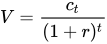
The net present expected value of a future cost (or benefit) that has z possible values is given by calculating the value of in the above equation as:

where is the probability of occurrence of the value


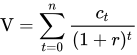
The present value of a series of annual costs and benefits, ocurring after annual intervals 0 to n is given by:
- .
The social time preference rate[edit]
The social time preference rate, s, is given by the Ramsey equation:-
- s = δ + ηg
where:
- δ is the pure time preference rate (otherwise known as the utility discount rate);
- η is the elasticity of marginal utility with respect to consumption; and,
- g is the expected future growth rate of consumption.
Estimates of η[edit]
Evidence based upon the structure of personal income tax rates in OECD countries suggests that the value of η for most developed countries is close to 1.4 [1]. Estimates for the United Kingdom have ranged from 0.7 t0 1.5. [2].
Estimates of s[edit]
The UK Treasury Green Book uses
- δ = 1.5%, η = 1.0, g = 2%, yielding s = 3.5%
The Stern review uses
- δ = 0.1%, η = 1.0, g = 2%, yielding s = 2.1%
The intergeneration transfer controversy[edit]
The Stern review's insistence upon a zero pure rate of time preference reflects the ethical principle of utilitarianism according to which equal weight should be placed upon the consequences of a decision upon every person that it effects. It is controversial because most decision-making actually makes use of a modification to utilitarianism known as "agent-relative ethics" according to which it is acceptable, for example, to attach more weight to effects upon family members than to effects upon strangers. Crtics have questioned whether it is consistent with the principles of representative government for a government to impose upon its citizens, a decision-making rule that differs from their own. Professor William Nordhaus referred to the review's utilitarian imposition of a zero pure rate of time preference as "the government house" approach, [3], and has claimed that the review's value of eta is inconsistent with its choice of delta. Sir Partha Dasgupta did not object to the value adopted for delta, but objected to the review's choice of eta on the grounds that it placed insufficient weight upon the comparative prosperity of current and future generations [4]. Wilfred Beckerman has argued that it is theoretically invalid to combine the effects upon economic efficiency of the cost to one generation with that of a benefit to another because to do so violates the Kaldor-Hicks criterion that gainers should be able to compensate losers[5].
References[edit]
- ↑ David Evans: "The Elasticity of Marginal Utility of Consumption: Estimates for 20 OECD Countries", Fiscal Studies 2005
- ↑ David Pearce and David Ulph: A Social Time Discount Rate for the United Kingdom, GSERGE Working Paper No GEC95.01, 1995
- ↑ William Nordhaus: The Stern Review on the Economics of Climate Change, May 2007
- ↑ Sir Partha Dasgupta: Comments on The Stern Review’s Economics of Climate Change, November 2006
- ↑ Wilfred Beckerman and Cameron Hepburn: Ethics of the Discount Rate in the Stern Review on the Economics of Climate Change, World Economics, January-March 2007
↧ Download as ZWI file | Last modified: 04/28/2025 10:56:52 | 2 views
☰ Source: https://citizendium.org/wiki/Discount_rate/Tutorials | License: CC BY-SA 3.0
 KSF
KSF