Erythema Multiforme
 From Mdwiki
 | Erythema multiforme | |
|---|---|
| Other names: Erythema exudativum multiforme[1] | |
 | |
| Erythema multiforme minor of the hands (note the blanching centers of the lesion) | |
 | |
| Specialty | Dermatology |
| Symptoms | Target lesions, fever, joint pain[2][1] |
| Usual onset | Within 72 hrs[3] |
| Duration | Up to 6 wks[3] |
| Types | Minor, major[1] |
| Risk factors | Infections: Herpes simplex, cytomegalovirus, Epstein-Barr virus, SARS-CoV-2[2] Medications: NSAIDs, antibiotics, vaccines[2] Other: Inflammatory bowel disease, leukemia, other cancers[2] |
| Diagnostic method | Based on symptoms[3] |
| Differential diagnosis | Hives, pemphigus, Stevens-Johnson syndrome[1][3] |
| Treatment | Based on trigger, supportive care[1][2] |
| Prognosis | Generally good[3] |
| Frequency | Uncommon[3] |
Erythema multiforme (EM) is a skin condition that classically appears as target lesions.[2] The skin or mouth can be involved.[2] These come on over a couple of days and resolve within 3 to 6 weeks.[3] Often they are most clearly seen on the palms and soles.[1] Other symptoms may include fever and joint pain.[1] Some have recurrent episodes.[3]
The most common trigger is a herpes simplex (HSV) infection.[2] Other triggers may include infections such as cytomegalovirus, Epstein-Barr virus, and SARS-CoV-2; medications such as NSAIDs, antibiotics, and vaccines; and other problems such as inflammatory bowel disease, leukemia, and other cancers.[2] The underlying mechanism is believed to involve the immune system.[2] Diagnosis is based on symptoms and may be confirmed by tissue biopsy.[3] There are two types erythema multiforme minor and erythema multiforme major.[1]
Treatment is generally supportive or based on the underlying trigger.[1][2] In those with HSV sunscreen or valacyclovir may be used.[1] In more severe cases corticosteroids, dapsone, or cyclosporine may be used.[1] Outcomes are generally good.[3]
Erythema multiforme is uncommon.[3] It most commonly occurs in the second and third decades of life.[2] Males are more commonly affected than females.[2] It was first described by von Hebra in 1860.[1]
Signs and symptoms[edit | edit source]
The condition varies from a mild, self-limited rash (E. multiforme minor)[4] to a severe, life-threatening form known as erythema multiforme major (or erythema multiforme majus) that also involves mucous membranes.[citation needed]
Consensus classification:[5]
- Erythema multiforme minor—typical targets or raised, edematous papules distributed acrally
- Erythema multiforme major—typical targets or raised, edematous papules distributed acrally with involvement of one or more mucous membranes; epidermal detachment involves less than 10% of total body surface area
Stevens–Johnson syndrome and toxic epidermal necrolysis used to be considered part of the erythema multiforme spectrum, but that is no longer the case.[6]
The mild form usually presents with mildly itchy (but itching can be very severe), pink-red blotches, symmetrically arranged and starting on the extremities. It often takes on the classical "target lesion" appearance,[7] with a pink-red ring around a pale center. Resolution within 7–10 days is the norm.
Individuals with persistent (chronic) erythema multiforme will often have a lesion form at an injury site, e.g. a minor scratch or abrasion, within a week. Irritation or even pressure from clothing will cause the erythema sore to continue to expand along its margins for weeks or months, long after the original sore at the center heals.[citation needed]
-
.jpg)
Erythema multiforme
-
.jpg)
Erythema multiforme
-
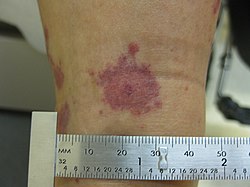
Target lesion
-
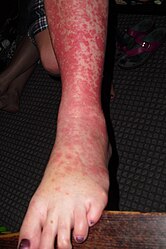
Erythema multiforme target lesions on the leg
-
.jpg)
Erythema multiforme
.jpg)
.jpg)


.jpg)
Causes[edit | edit source]
Many suspected aetiologic factors have been reported to cause EM.[8]
- Infections: bacterial (including Bacillus Calmette–Guérin (BCG) vaccination, haemolytic Streptococci, legionellosis, leprosy, Neisseria meningitidis, Mycobacterium, Pneumococcus, Salmonella species, Staphylococcus species, Mycoplasma pneumoniae), chlamydial.
- Fungal (Coccidioides immitis)
- Parasitic (Trichomonas species, Toxoplasma gondii),
- Viral (especially Herpes simplex)
- Drug reactions, most commonly to: antibiotics (including, sulphonamides, penicillin), anticonvulsants (phenytoin, barbiturates), aspirin, modafinil, antituberculoids, and allopurinol and many others.
- Physical factors: radiotherapy, cold, sunlight
- Others: collagen diseases, vasculitides, non-Hodgkin lymphoma, leukaemia, multiple myeloma, myeloid metaplasia, polycythemia
EM minor is regarded as being triggered by HSV in almost all cases.[7] A herpetic aetiology also accounts for 55% of cases of EM major.[7] Among the other infections, Mycoplasma infection appears to be a common cause.
Herpes simplex virus suppression and even prophylaxis (with acyclovir) has been shown to prevent recurrent erythema multiforme eruption.[citation needed]
Treatment[edit | edit source]
Erythema multiforme is frequently self-limiting and requires no treatment. The appropriateness of glucocorticoid therapy can be uncertain, because it is difficult to determine if the course will be a resolving one.[9]
Terminology[edit | edit source]
The disorder has various forms or presentations, which its name reflects (multiforme, "multiform", from multi- + formis).
See also[edit | edit source]
References[edit | edit source]
- ↑ 1.00 1.01 1.02 1.03 1.04 1.05 1.06 1.07 1.08 1.09 1.10 1.11 James, William D.; Elston, Dirk; Treat, James R.; Rosenbach, Misha A.; Neuhaus, Isaac (2020). "7. Erythema and urticaria". Andrews' Diseases of the Skin: Clinical Dermatology (13th ed.). Elsevier. pp. 141–142. ISBN 978-0-323-54753-6. Archived from the original on 2021-10-20. Retrieved 2021-10-19.
- ↑ 2.00 2.01 2.02 2.03 2.04 2.05 2.06 2.07 2.08 2.09 2.10 2.11 2.12 "Erythema multiforme - DermNet". dermnetnz.org. Archived from the original on 16 March 2022. Retrieved 30 March 2022.
- ↑ 3.00 3.01 3.02 3.03 3.04 3.05 3.06 3.07 3.08 3.09 3.10 Hafsi, W; Badri, T (January 2022). "Erythema Multiforme". PMID 29261983.
{{cite journal}}: Cite journal requires|journal=(help) - ↑ "erythema multiforme" at Dorland's Medical Dictionary
- ↑ Erythema Multiforme at eMedicine
- ↑ Wetter, David. "Erythema multiforme: Pathogenesis, clinical features, and diagnosis". UpToDate.com. Archived from the original on 20 September 2020. Retrieved 29 December 2018.
- ↑ 7.0 7.1 7.2 Lamoreux MR, Sternbach MR, Hsu WT (December 2006). "Erythema multiforme". Am Fam Physician. 74 (11): 1883–8. PMID 17168345. Archived from the original on 2021-08-28. Retrieved 2008-08-19.
- ↑ "Erythema Multiforme". Pubmed Health. Archived from the original on 17 November 2012. Retrieved 28 November 2012.
- ↑ Yeung AK, Goldman RD (November 2005). "Use of steroids for erythema multiforme in children". Can Fam Physician. 51 (11): 1481–3. PMC 1479482. PMID 16353829. Archived from the original on 2021-08-28. Retrieved 2008-08-19.
External links[edit | edit source]
| Classification | |
|---|---|
| External resources |
Categories: [Erythemas] [Herpes simplex virus-associated diseases] [RTT]
↧ Download as ZWI file | Last modified: 06/08/2024 11:22:41 | 4 views
☰ Source: https://mdwiki.org/wiki/Erythema_multiforme | License: CC BY-SA 3.0
 KSF
KSF