Cyperaceae
 From Britannica 11th Edition (1911)
 Cyperaceae, in botany, a natural order of the monocotyledonous group of seed-bearing plants. They are grass-like herbs, sometimes annual, but more often persist by means of an underground stem from which spring erect solitary or clustered, generally three-sided aerial stems, with leaves in three rows. The minute flowers are arranged in spikelets somewhat as in grasses, and these again in larger spike-like or panicled inflorescences. The flower has in rare cases a perianth of six scale-like leaves arranged in two whorls, and thus conforming to the common monocotyledonous type of flower. Generally the perianth is represented by hairs, bristles or similar developments, often indefinite in number; in the two largest genera, Cyperus, (fig. 1) and Carex (fig. 2), the flowers are naked. In a few cases two whorls of stamens are present, with three members in each, but generally only three are present; the pistil consists of three or two carpels, united to form an ovary bearing a corresponding number of styles and containing one ovule. The flowers, which are often unisexual, are wind-pollinated. The fruit is one-seeded, with a tough, leathery or hard wall. There are nearly 70 genera containing about 3000 species and widely distributed throughout the earth, chiefly as marsh-plants. In the arctic zone they form 10% of the flora; they will flourish in soils rich in humus which are too acid to support grasses. The large genus Cyperus contains about 400 species, chiefly in the warmer parts of the earth; C. Papyrus is the Egyptian Papyrus. Carex, the largest genus of the order, the sedges, is widely distributed in the temperate, alpine and arctic regions of both hemispheres, and is represented by 60 species in Britain. Carex arenaria, the sea-bent, grows on sand-dunes and helps to bind the sand with its long cord-like underground stem which branches widely. Scirpus lacustris (fig. 3, 1) the true bulrush, occurs in lakes, ditches and marshes; it has a spongy, green, cylindrical stem, reaching nearly an inch in thickness and 1 to 8 ft. high, which is usually leafless with a terminal branched inflorescence. Eriophorum (fig. 3), cotton grass, is represented in Britain by several species in boggy land; they are small tufted herbs with cottony heads due to the numerous hair-like bristles which take the place of the perianth and become much elongated in the fruiting stage.
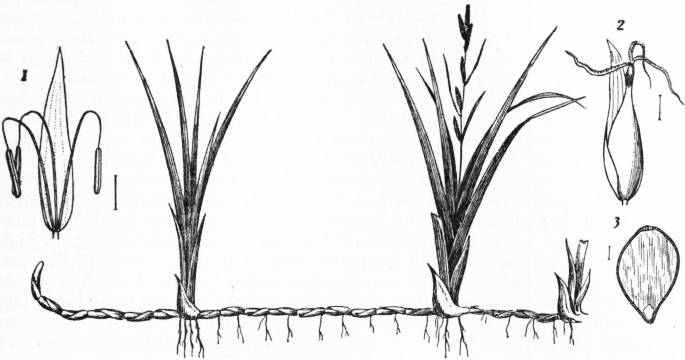 |
| Fig. 2.—Carex riparia, the largest British sedge, from 3 to 5 ft. high. 1, Male flower of Carex; 2, female flower of Carex; 3, seed of Carex, cut lengthwise. |
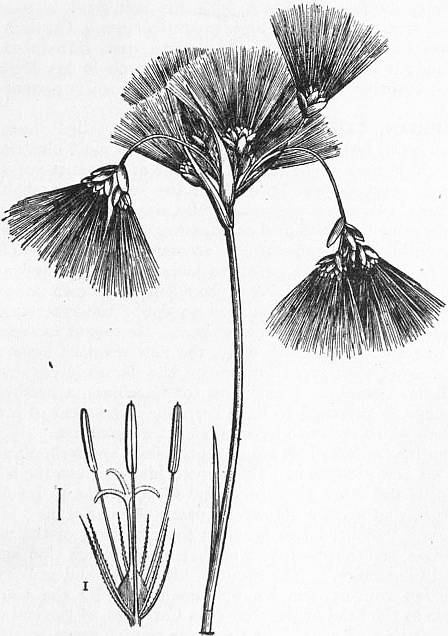 |
| Fig. 3.—Inflorescence of Cotton-grass (Eriophorum polystachion), about 2⁄3 nat. size. 1, Flower of true bulrush (Scirpus lacustris). |
↧ Download as ZWI file | Last modified: 11/17/2022 15:23:43 | 1 views
☰ Source: https://oldpedia.org/article/britannica11/Cyperaceae | License: Public domain in the USA. Project Gutenberg License
 ZWI signed:
 KSF
KSF