Toro Toro Formation
 From Handwiki
 | Toro Toro Formation Stratigraphic range: Late Campanian ~80–71 Ma PreЄ
Є
O
S
D
C
P
T
J
K
Pg
N
| |
|---|---|
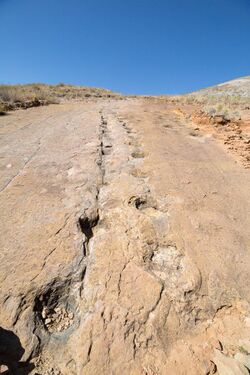 Dinosaur ichnofossils in the Toro Toro Formation | |
| Type | Geological formation |
| Unit of | Puca Group |
| Lithology | |
| Primary | Sandstone |
| Other | Mudstone, gypsum |
| Location | |
| Coordinates | [ ⚑ ] : 18°06′S 65°48′W / 18.1°S 65.8°W |
| Paleocoordinates | [ ⚑ ] 21°18′S 47°48′W / 21.3°S 47.8°W |
| Region | Cochabamba Department |
| Country |  Bolivia Bolivia |
| Extent | Potosí Basin |
| Type section | |
| Named for | Torotoro National Park |
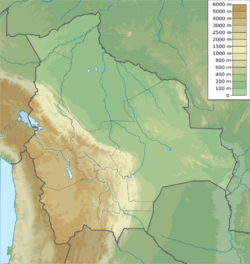  Toro Toro Formation (Bolivia) | |
The Toro Toro Formation is a Late Campanian geologic formation pertaining to the Puca Group of central Bolivia. The porous yellowish medium-to-coarse grained ferruginous (iron-containing) sandstones and mudstones with gypsum intercalations, deposited in a beach environment, preserve many ichnofossils of Ligabueichnium bolivianum, Dromaeopodus sp.,[1] Ornithopoda indet., Theropoda indet. and Titanosauridae indet.[2] The formation has provided the earliest known tracksite of dinosaurs in Bolivia.[3] The Toro Toro Formation represents part of the postrift stage in an alluvial to deltaic environment within the Potosí Basin. The formation is a local equivalent of the Chaunaca Formation.[4] The most famous of the dinosaur tracksites is Cal Orcko, however these are in the El Molino Formation
See also
- List of fossiliferous stratigraphic units in Bolivia
- List of stratigraphic units with dinosaur tracks
- List of stratigraphic units with theropod tracks
- Cajones Formation
- La Puerta Formation
References
- ↑ Apesteguía et al., 2011, p.663
- ↑ Toro Toro, Pista de Danzas at Fossilworks.org
- ↑ Lockley et al., 2002, p.389
- ↑ Apesteguía et al., 2011, p.662
Bibliography
- Apesteguía, Sebastián; Silvina De Valais; Giovanni Ríos Cordero, and Omar Medina Ramírez. 2011. New Ichnological Record from the Late Campanian Toro Toro Formation at Toro Toro, Potosí (bolivia): First probable Dromaeosaurid Tracks from South America. Ameghiniana 48. 662–667. Accessed 2019-03-03.
- Lockley, M.G.; A.S. Schulp; C.A. Meyer; G. Leonardi, and D.K. Mamani. 2002. Titanosaurid trackways from the Upper Cretaceous of Bolivia: evidence for large manus, wide-gauge locomotion and gregarious behaviour. Cretaceous Research 23. 383–400. Accessed 2019-03-03.
 |  |
Categories: [Geologic formations of Bolivia] [Campanian Stage] [Sandstone formations] [Mudstone formations] [Alluvial deposits]
↧ Download as ZWI file | Last modified: 03/09/2025 21:09:54 | 2 views
☰ Source: https://handwiki.org/wiki/Earth:Toro_Toro_Formation | License: CC BY-SA 3.0
 KSF
KSF