Menelaus Theorem
 From Encyclopediaofmath
 A theorem on the relations between the lengths of the segments on the sides of a triangle determined by an intersecting straight line. It asserts that if the given line intersects the sides of a triangle $ABC$ (or their extensions) at the points $C'$, $A'$ and $B'$, then
$$\frac{AC'}{BC'}\cdot\frac{BA'}{CA'}\cdot\frac{CB'}{AB'}=1.$$
Menelaus' theorem is a particular case of the Carnot theorem; it can be generalized to the case of a polygon. Thus, suppose that a straight line $l$ intersects the edges $A_1A_2,\dots,A_{n-1}A_n,A_nA_1$ of a polygon $A_1\dots A_n$ at the respective points $a_1,\dots,a_n$. Then the following relation is valid:
$$\frac{A_1a_1}{A_2a_1}\cdots\frac{A_{n-1}a_{n-1}}{A_na_{n-1}}\cdot\frac{A_na_n}{A_na_n}=1.$$
The theorem was proved by Menelaus (1st century) and apparently it was known to Euclid (3rd century B.C.).
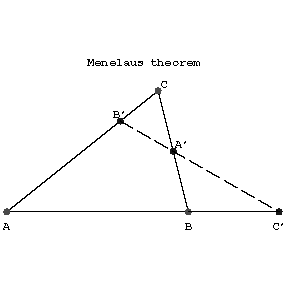
Figure: m063400a
Comments[edit]
References[edit]
| [a1] | B.L. van der Waerden, "Science awakening" , 1 , Noordhoff & Oxford Univ. Press (1961) pp. 275 (Translated from Dutch) |
↧ Download as ZWI file | Last modified: 09/09/2026 14:44:00 | 32 views
☰ Source: https://encyclopediaofmath.org/wiki/Menelaus_theorem | License: CC BY-SA 3.0
 KSF
KSF