Aegis
 From Handwiki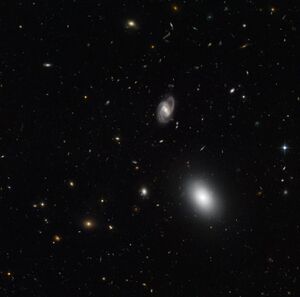
Extended Groth Strip taken with Hubble’s Advanced Camera for Surveys.[1]
AEGIS, or the All-Wavelength Extended Groth Strip International Survey, is a multi-wavelength astronomical survey of a patch of the sky with low extinction and zodiacal scattering. The purpose of the survey is to study the physical processes and evolution of galaxies at redshift z ~ 1. As of February 2011 more than 80 research papers have been published based on data from the survey.[2]
Observatories
AEGIS makes use of multiple terrestrial and space based observatories to conduct the survey. These observatories make overlapping scans of the survey area.[3] The primary telescopes are:[4]
- Very Large Array
- Spitzer Space Telescope
- Palomar Observatory
- Canada-France-Hawaii Telescope
- Keck Observatory
- Hubble Space Telescope
- GALEX
- Chandra X-ray Observatory (AEGIS-X)[5]
See also
- Extended Groth Strip – a visible image taken by Hubble of the region.
References
- ↑ "A Snapshot of Galactic Evolution". ESA/Hubble. 10 October 2011. http://spacetelescope.org/images/potw1141a/. Retrieved 11 October 2011.
- ↑ AEGIS Papers retrieved February 10, 2011
- ↑ EGS Coverage
- ↑ "Official Project Site". http://aegis.ucolick.org/.
- ↑ https://web.archive.org/web/20110811231439/http://astro.imperial.ac.uk/research/aegis/
External links
- Official Project Site
- Hubblesite News Release
 |
Categories: [Astronomical surveys]
↧ Download as ZWI file | Last modified: 09/21/2024 00:27:19 | 2 views
☰ Source: https://handwiki.org/wiki/Astronomy:AEGIS | License: CC BY-SA 3.0
✘
ZWI is not signed. [what is this?]
ZWI viewer
by the  KSF
KSF
KSF