John Boehner
 From Ballotpedia
Contents
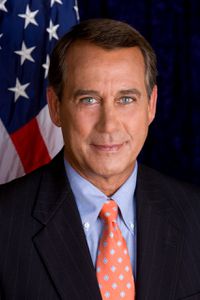
John Andrew Boehner (b. November 17, 1949, in Cincinnati, Ohio) is a former Republican member of the U.S. House of Representatives from the state of Ohio. He served in the U.S. House from 1991-2015. Boehner served as the Speaker of the House from 2011-2015.[1][2]
On September 25, 2015, Boehner announced that he would resign from Congress on October 31, 2015. On the eve of his retirement, Boehner remarked that he left "with no regrets, no burdens. If anything, I leave the way I started, just a regular guy, humbled by the chance to do a big job."
Boehner was first elected by voters from Ohio's 8th Congressional District in 1990. Prior to his election to the U.S. House of Representatives, Boehner was a member of the Ohio House of Representatives.[3]
Biography[edit]
Boehner was born in West Chester, Ohio. He earned his B.S. from Xavier University in 1977.[3]
Career[edit]
Below is an abbreviated outline of Boehner's academic, professional, and political career:[3]
- 1991-2015: U.S. Representative from Ohio's 8th Congressional District
- 1985-1990: Ohio House of Representatives
- 1981-1984: Board of Trustees, Union Township, Ohio
- 1968: United States Navy
Committee assignments[edit]
U.S. House[edit]
2011-2015[edit]
As Speaker of the House, Boehner did not serve on any committees.
Key votes[edit]
114th Congress[edit]

The first session of the 114th Congress enacted into law six out of the 2,616 introduced bills (0.2 percent). Comparatively, the 113th Congress had 1.3 percent of introduced bills enacted into law in the first session. In the second session, the 114th Congress enacted 133 out of 3,159 introduced bills (4.2 percent). Comparatively, the 113th Congress had 7.0 percent of introduced bills enacted into law in the second session.[4][5] For more information pertaining to Boehner's voting record in the 114th Congress, please see the below sections.[6]
Economic and fiscal[edit]
Trade Act of 2015[edit]
Trade adjustment assistance
 On June 12, 2015, the House rejected the trade adjustment assistance (TAA) measure in HR 1314—the Trade Act of 2015—by a vote of 126-302. Trade adjustment assistance (TAA) is a federal program providing American workers displaced by foreign trade agreements with job training and services. The measure was packaged with trade promotion authority (TPA), also known as fast-track authority. TPA is a legislative procedure that allows Congress to define "U.S. negotiating objectives and spells out a detailed oversight and consultation process for during trade negotiations. Under TPA, Congress retains the authority to review and decide whether any proposed U.S. trade agreement will be implemented," according to the Office of the United States Trade Representative. Boehner was one of 158 Republicans to vote against TAA.[7][8]
Trade promotion authority
 On June 12, 2015, the House passed the trade promotion authority (TPA) measure in HR 1314—the Trade Act of 2015 —by a vote of 219-211. TPA gives the president fast-track authority to negotiate trade agreements sent to Congress without the opportunity for amendment or filibuster. Although the House approved TPA, it was a largely symbolic vote given the measure was part of a package trade bill including trade adjustment assistance (TAA), which was rejected earlier the same day. Boehner was one of 191 Republicans to support the measure.[9][10]
Trade promotion authority second vote
After the trade adjustment assistance (TAA) and trade promotion authority (TPA) did not pass the House together on June 12, 2015, representatives voted to authorize TPA alone as an amendment to HR 2146—the Defending Public Safety Employees' Retirement Act—on June 18, 2015. The amendment passed by a vote of 218-208, with all voting members of the House maintaining their original positions on TPA except for Ted Yoho (R-Fla.). Boehner was one of 190 Republicans to vote in favor of the amendment.[11][12]
2016 Budget proposal[edit]
On April 30, 2015, the House voted to approve SConRes11, a congressional budget proposal for fiscal year 2016, by a vote of 226-197. The non-binding resolution was designed to create 12 appropriations bills to fund the government. All 183 Democrats who voted, voted against the resolution. Boehner voted with 225 other Republicans to approve the bill.[13][14][15]
2015 budget[edit]
On October 28, 2015, the House passed HR 1314—the Bipartisan Budget Act of 2015—by a vote of 266-167. The bill increased military and domestic spending levels and suspended the debt ceiling until March 2017.[16] Boehner voted with 78 Republicans and 187 Democrats in favor of the bill.[17] It passed the Senate on October 30, 2015.[18] President Barack Obama signed it into law on November 2, 2015.
113th Congress[edit]
The second session of the 113th Congress enacted into law 224 out of the 3215 introduced bills (7 percent). Comparatively, the 112th Congress had 4.2 percent of introduced bills enacted into law in the second session.[19] For more information pertaining to Boehner's voting record in the 113th Congress, please see the below sections.[20]
Economy[edit]
Farm bill[edit]
- See also: United States Farm Bill 2013
In January 2014, Boehner said he believed supply management would be successfully left out of the farm bill in 2014. He said, “I have fought off the supply management ideas for 23 years that I’ve been in Congress, and my position hasn’t changed. Mr. Peterson and others are aware of that."[21]
Government shutdown[edit]
- See also: United States budget debate, 2013
On September 30, 2013, the House passed a final stopgap spending bill before the shutdown went into effect. The bill included a one-year delay of the Affordable Care Act's individual mandate and would have also stripped the bill of federal subsidies for congressional members and staff. It passed through the House with a vote of 228-201.[22] At 1 a.m. on October 1, 2013, one hour after the shutdown officially began, the House voted to move forward with going to a conference. In short order, Sen. Harry Reid rejected the call to conference.[23] Boehner voted in favor of the stopgap spending bill that would have delayed the individual mandate.[24]
The shutdown ended on October 16, 2013, when the House took a vote on HR 2775 after it was approved by the Senate. The bill to reopen the government lifted the $16.7 trillion debt limit and funded the government through January 15, 2014. Federal employees also received retroactive pay for the shutdown period. The only concession made by Senate Democrats was to require income verification for Obamacare subsidies.[25] The House passed the legislation shortly after the Senate, by a vote of 285-144, with all 144 votes against the legislation coming from Republican members. Boehner voted for HR 2775.[26]
Prior to both votes, Boehner released a statement on September 29, 2013, blasting Senate Democratic leaders over the looming shutdown. He said, "If the Senate stalls until Monday afternoon instead of working today, it would be an act of breathtaking arrogance by the Senate Democratic leadership. They will be deliberately bringing the nation to the brink of a government shutdown for the sake of raising taxes on seniors’ pacemakers and children’s hearing aids and plowing ahead with the train wreck that is the president’s health care law. The American people will not stand for it."[27] While Boehner attempted to shift blame for a potential shutdown on Senate Democrats, a CNN poll found that 46% of Americans blamed congressional Republicans.[28]
Boehner refused his pay for the duration of the shutdown.[29]
Government affairs[edit]
HR 676[edit]
On July 30, 2014, the U.S. House approved a resolution 225 to 201 to sue President Barack Obama for exceeding his constitutional authority. Five Republicans—Thomas Massie of Kentucky, Paul Broun of Georgia, Scott Garrett of New Jersey, Walter Jones of North Carolina and Steve Stockman of Texas—voted with Democrats against the lawsuit.[30] Boehner joined the other 224 Republicans in favor of the lawsuit. All Democrats voted against the resolution.[31][32]
Previous congressional sessions[edit]
Fiscal Cliff[edit]
Boehner voted for the fiscal cliff compromise bill, which made permanent most of the Bush tax cuts originally passed in 2001 and 2003 while also raising tax rates on the highest income levels. He was 1 of 85 Republicans that voted in favor of the bill. The bill was passed in the House by a 257 - 167 vote on January 1, 2013.[33]
Issues[edit]
Political positions[edit]
American response in Syria[edit]
- See also: United States involvement in Syria
Boehner supported President Barack Obama's proposed military strikes against Syria. He stated, "The use of these weapons has to be responded to and only the United States has the capability and the capacity to stop Assad and to warn others around the world that this type of behavior is not to be tolerated."[34]
Response to Putin's op-ed[edit]
In September 2013, Russia's President Vladimir Putin wrote an opinion piece in The New York Times arguing that the Syrian government was not responsible for the use of chemical weapons. In response, Boehner stated that he was insulted by Putin's editorial. When asked to elaborate, he replied:
- "The president does foreign policy and I’ve always believed while we have opinions, I probably already said more than I should have, but you got the truth."[35]
Unemployment benefits[edit]
Boehner commented on the debate over extending unemployment benefits. He said, "One month ago I personally told the White House that another extension of temporary emergency unemployment benefits should not only be paid for but include something to help put people back to work. To date, the president has offered no such plan. If he does, I’ll be happy to discuss it, but right now the House is going to remain focused on growing the economy and giving America’s unemployed the independence that only comes from finding a good job."[36]
Presidential preference[edit]
2012
John Boehner endorsed Mitt Romney in the 2012 presidential election.[37]
Speaker of the House elections[edit]
114th Congress[edit]
On January 6, 2015, Boehner was re-elected as Speaker of the House with 216 out of 408 votes cast. Twenty-five Republicans cast votes against Boehner.[38] The Washington Post called it "the biggest defection in at least 100 years."[39]
Three other Republicans, Reps. Louie Gohmert (TX), Ted Yoho (FL) and Daniel Webster (FL), were also nominated for the speakership. Webster received 12 votes, while various other Republicans received three or less votes. House Minority Leader Nancy Pelosi (D-CA) received the majority of Democratic support with 164 votes.[40]
113th Congress[edit]
During the swearing-in ceremony and election for Speaker of the House, nine Republican members of Congress either voted for someone other than Boehner or abstained and voted present. This was a change from the Speaker election in 2010, when the entire Republican caucus voted for him, then 241 members. Boehner won re-election to the speakership with 220 votes. He needed a majority of members voting, which was 214 of the 426 who voted. Former Speaker and California Representative Nancy Pelosi (D) received 192 votes.[41]
The nine Republican members who voted for someone other than Boehner were Justin Amash, Steve Pearce, Jim Bridenstine, Ted Yoho, Paul Broun, Louie Gohmert, Walter Jones, Thomas Massie, and Tim Huelskamp. Not all members who voted for someone other than Boehner or Pelosi voted for a current member of the U.S. House. Out-going member Allen West, former Comptroller General David Walker, and former Secretary of State Colin Powell all received votes.[41] This highlighted the fact that the speaker does not have to be a member of the U.S. House, although all previous speakers had been.[42]
Noteworthy events[edit]
Resignation from the House[edit]
On September 25, 2015, Boehner announced that he would resign the speakership and his seat at the end of October 2015. When he announced the move, Boehner told reporters that he was leaving to avoid conflict with members of his caucus who disagreed with his leadership decisions. “It’s become clear to me this prolonged leadership turmoil would do irreparable harm to the institution,” he said.[43] In the months leading up to the announcement, some conservative Republicans threatened to pursue a motion that would have stripped Boehner of the speakership.[44]
Bartender indicted for murder threats[edit]
Michael Hoyt, Boehner's bartender at Wetherington Country Club, was indicted on January 14, 2015, for plotting to kill Boehner either by poisoning his drink or shooting him. Hoyt had been fired from the country club and appeared to be troubled, claiming that he was Jesus and Boehner was the Devil. The report stated, "Hoyt told the officer he was Jesus Christ and he was going to kill Boehner because Boehner was mean to him at the country club and because Boehner is responsible for Ebola."[45] A spokesman for Boehner responded, "Speaker Boehner is aware of this situation, and sincerely thanks the FBI, the Capitol Police and local authorities in Ohio for their efforts."[46]
Leno appearance[edit]
In January 2014, Boehner appeared on The Tonight Show with Jay Leno. He told Leno he was not planning to run for president in 2016. He said, "Listen, I like to play golf. I like to cut my own grass. You know, I do drink red wine. I smoke cigarettes. And I'm not giving that up to be president of the United States." He also offered his thoughts on the October 2013 government shutdown. He said, "When I looked up, I saw my colleagues going this way. And you learn that a leader without followers is simply a man taking a walk. So I said, 'You want to fight this fight? I'll go fight the fight with you.' But it was a very predictable disaster. The sooner we got it over with, the better." Boehner told Leno that he thought his friend Jeb Bush would make a good president, but he stopped short of endorsing him.[47]
Lawsuit against the Obama Administration[edit]
On June 24, 2014, Boehner confirmed to reporters at a press conference that he planned to initiate a lawsuit against President Obama over the president's use of executive orders.[48]
In a June 2014 memo to House members, Boehner indicated that the legal action would cover a number of issues—including healthcare law, energy regulations, foreign policy, and education—but did not cite specific cases of executive overreach.[48]
On July 10, 2014, the speaker's office announced that the lawsuit would focus on Obama's failure to enforce the Patient Protection and Affordable Care Act's employer mandate.[49] The House voted to sue President Obama on July 30, 2014.[50]
The case was filed as U.S. House of Representatives v. Burwell on November 21, 2014.[51] In September 2015, the U.S. District Court for the District of Columbia ruled that the House could proceed with its lawsuit challenging the use of unappropriated funds for new healthcare subsidies; however, the House could not sue the executive branch for delaying implementation of the employer mandate.[52] In May 2016, the same district court ruled that the executive branch could not use unappropriated funds to subsidize insurance companies.[53]
Elections[edit]
2014[edit]
Boehner won re-election to the U.S. House in 2014. He won the Republican nomination in the primary on May 6, 2014. Boehner defeated Tom Poetter (D) and Jim Condit Jr. (Constitution) in the general election on November 4, 2014.[54]
| U.S. House, Ohio District 8 General Election, 2014 | ||||
|---|---|---|---|---|
| Party | Candidate | Vote % | Votes | |
| Republican |  John Boehner Incumbent John Boehner Incumbent |
67.2% | 126,539 | |
| Democratic | Tom Poetter | 27.4% | 51,534 | |
| Constitution | Jim Condit Jr. | 5.4% | 10,257 | |
| Total Votes | 188,330 | |||
| Source: Ohio Secretary of State | ||||
| U.S. House, Ohio District 8 Republican Primary, 2014 | ||||
|---|---|---|---|---|
| Candidate | Vote % | Votes | ||
|
John Boehner Incumbent |
71.5% | 47,261 | ||
| J.D. Winteregg | 22.7% | 15,030 | ||
| Eric Gurr | 5.8% | 3,812 | ||
| Total Votes | 66,103 | |||
| Source: Ohio Secretary of State, Official Election Results | ||||
2012[edit]
Boehner won re-election in the 2012 election for the U.S. House, to represent Ohio's 8th District.[55] He defeated David Lewis in the March 6 Republican primary and was unopposed in the general election on November 6.
The Washington Post listed the House of Representatives elections in Ohio in 2012 as one of the 10 states that could have determined whether Democrats retook the House or Republicans held their majority in 2013.[56] Ohio tied with Pennsylvania for ninth on the list.[56]
| U.S. House, Ohio District 8 General Election, 2012 | ||||
|---|---|---|---|---|
| Party | Candidate | Vote % | Votes | |
| Republican | John A. Boehner Incumbent |
99.2% | 246,378 | |
| Write-In | James Condit Jr. | 0.8% | 1,938 | |
| Total Votes | 248,316 | |||
| Source: Ohio Secretary of State "Official Election Results, 2012 General Election" | ||||
| U.S. House, Ohio District 8 Republican Primary, 2012 | ||
|---|---|---|
| Candidate | Vote % | Votes |
|
John Boehner Incumbent |
83.8% | 71,120 |
| David Lewis | 16.2% | 13,733 |
| Total Votes | 84,853 | |
Full history[edit]
To view the full congressional electoral history for John Boehner, click [show] to expand the section. | ||||||||||||||||||||||||||||||||||||||||||||||||||||||||||||||||||||||||||||||||||||||||||||||||||||||||||||||||||||||||||||||||||||||||||||||||||||||||||||||||||||||||||||||||||||||||||||||||||||||||||||||||||||||||||||||||||||||||||||||||||||||||||||||||||||||||||||||||||||||||||||||||||||||||
|---|---|---|---|---|---|---|---|---|---|---|---|---|---|---|---|---|---|---|---|---|---|---|---|---|---|---|---|---|---|---|---|---|---|---|---|---|---|---|---|---|---|---|---|---|---|---|---|---|---|---|---|---|---|---|---|---|---|---|---|---|---|---|---|---|---|---|---|---|---|---|---|---|---|---|---|---|---|---|---|---|---|---|---|---|---|---|---|---|---|---|---|---|---|---|---|---|---|---|---|---|---|---|---|---|---|---|---|---|---|---|---|---|---|---|---|---|---|---|---|---|---|---|---|---|---|---|---|---|---|---|---|---|---|---|---|---|---|---|---|---|---|---|---|---|---|---|---|---|---|---|---|---|---|---|---|---|---|---|---|---|---|---|---|---|---|---|---|---|---|---|---|---|---|---|---|---|---|---|---|---|---|---|---|---|---|---|---|---|---|---|---|---|---|---|---|---|---|---|---|---|---|---|---|---|---|---|---|---|---|---|---|---|---|---|---|---|---|---|---|---|---|---|---|---|---|---|---|---|---|---|---|---|---|---|---|---|---|---|---|---|---|---|---|---|---|---|---|---|---|---|---|---|---|---|---|---|---|---|---|---|---|---|---|---|---|---|---|---|---|---|---|---|---|---|---|---|---|---|---|---|---|---|---|---|---|---|---|---|---|---|---|---|---|---|---|---|
|
2010 On November 2, 2010, John Boehner won re-election to the United States House. He defeated Justin Coussoule (D), David Harlow (L) and James Condit (Constitution) in the general election.[57]
2008 On November 4, 2008, John Boehner won re-election to the United States House. He defeated Nicholas Von Stein (D) in the general election.[58]
2006 On November 7, 2006, John Boehner won re-election to the United States House. He defeated Mort Meier (D) in the general election.[59]
2004 On November 2, 2004, John Boehner won re-election to the United States House. He defeated Jeff Hardenbrook (D) in the general election.[60]
2002 On November 5, 2002, John Boehner won re-election to the United States House. He defeated Jeff Hardenbrook (D) in the general election.[61]
2000 On November 7, 2000, John Boehner won re-election to the United States House. He defeated John Parks (D) and David Shock (L) in the general election.[62]
1998 On November 3, 1998, John Boehner won re-election to the United States House. He defeated John Griffin (D) in the general election.[63]
1996 On November 5, 1996, John Boehner won re-election to the United States House. He defeated Jeffrey Kitchen (D) and William Baker (Natural Law) in the general election.[64]
1994 On November 8, 1994, John Boehner won re-election to the United States House. He defeated write-in candidates in the general election.[65]
1992 On November 3, 1992, John Boehner won re-election to the United States House. He defeated Fred Sennet (D) in the general election.[66]
1990 On November 6, 1990, John Boehner won election to the United States House. He defeated Gregory Jolivette (D) in the general election.[67]
| ||||||||||||||||||||||||||||||||||||||||||||||||||||||||||||||||||||||||||||||||||||||||||||||||||||||||||||||||||||||||||||||||||||||||||||||||||||||||||||||||||||||||||||||||||||||||||||||||||||||||||||||||||||||||||||||||||||||||||||||||||||||||||||||||||||||||||||||||||||||||||||||||||||||||
Campaign donors[edit]
Comprehensive donor history[edit]
 The finance data shown here comes from the disclosures required of candidates and parties. Depending on the election or state, this may not represent all the funds spent on their behalf. Satellite spending groups may or may not have expended funds related to the candidate or politician on whose page you are reading this disclaimer, and campaign finance data from elections may be incomplete. For elections to federal offices, complete data can be found at the FEC website. Click here for more on federal campaign finance law and here for more on state campaign finance law.
| John Boehner campaign contribution history | ||||
|---|---|---|---|---|
| Year | Office | Result | Contributions | |
| 2014 | U.S. House (Ohio, District 8) |  |
$17,446,641 | |
| 2012 | U.S. House (Ohio, District 8) | |
$22,024,288 | |
| 2010 | U.S. House (Ohio, District 8) | |
$9,796,947 | |
| 2008 | U.S. House (Ohio, District 8) | |
$5,161,985 | |
| 2006 | U.S. House (Ohio, District 8) | |
$3,200,084 | |
| 2004 | U.S. House (Ohio, District 8) | |
$1,544,255 | |
| 2002 | U.S. House (Ohio, District 8) | |
$1,190,181 | |
| 2000 | U.S. House (Ohio, District 8) | |
$916,015 | |
| Grand total raised | $61,280,396 | |||
| Source: [[68] Follow the Money] | ||||
2014[edit]
Boehner won re-election to the U.S. House in 2014. During that election cycle, Boehner's campaign committee raised a total of $17,446,641 and spent $17,106,253.[69] This is more than the average $1.45 million spent by House winners in 2014.[70]
Cost per vote[edit]
Boehner spent $135.19 per general election vote received in 2014.
| U.S. House, Ohio District 8, 2014 - John Boehner Campaign Contributions | |
|---|---|
| Total Raised | $17,446,641 |
| Total Spent | $17,106,253 |
| Total Raised by Election Runner-up | $193,360 |
| Total Spent by Election Runner-up | $192,079 |
| Top contributors to John Boehner's campaign committee | |
| Murray Energy | $142,878 |
| FirstEnergy Corp | $118,950 |
| Comcast Corp | $107,775 |
| CME Group | $72,900 |
| Jennmar Corp | $57,300 |
| Top 5 industries that contributed to campaign committee | |
| Securities & Investment | $1,197,710 |
| Retired | $1,184,900 |
| Real Estate | $696,866 |
| Oil & Gas | $674,389 |
| Mining | $528,798 |
To view the breakdown of campaign funding by type click [show] to expand the section. | |
|---|---|

In advance of the 2014 midterm elections, Boehner had raised more than $30 million by July 2013. Of that, he gave more than $5 million to the National Republican Congressional Committee. As of July, he had held over 100 fundraising events.[71]
Candidates for Congress were required to file up to seven main reports with the Federal Election Commission during the 2014 elections season. Below are Boehner’s reports.[72]
| John A. Boehner (2014) Campaign Finance Reports | |||||||||
|---|---|---|---|---|---|---|---|---|---|
| Report | Date Filed | Beginning Balance | Total Contributions for Reporting Period | Expenditures | Cash on Hand | ||||
| April Quarterly[73] | April 15, 2013 | $952,828.44 | $2,387,085.22 | $(1,517,898.76) | $1,822,014.90 | ||||
| July Quarterly[74] | July 15, 2013 | $1,822,014.90 | $3,537,635.25 | $(2,832,720.80) | $2,526,929.35 | ||||
| October Quarterly[75] | October 15, 2013 | $2,526,929.35 | $3,149,615.34 | $(2,888,913.48) | $2,787,631.21 | ||||
| Year-End Quarterly[76] | December 31, 2013 | $2,787,631.00 | $909,615.00 | $(1,000,183.00) | $2,877,802.00 | ||||
| April Quarterly[77] | April 15, 2014 | $2,877,802.26 | $1,786,187.19 | $(1,363,260.95) | $3,300,728.50 | ||||
| Pre-Primary[78] | April 24, 2014 | $3,300,728.50 | $51,008.50 | $(1,154,217.93) | $2,197,519.07 | ||||
| July Quarterly[79] | July 15, 2014 | $2,197,519.07 | $2,331,206.97 | $(2,551,945.33) | $1,976,780.71 | ||||
| October Quarterly[80] | October 15, 2014 | $1,976,780.71 | $2,260,427.09 | $(2,313,532.15) | $1,923,675.65 | ||||
| Pre-General[81] | October 23, 2014 | $1,923,675.65 | $451,979.28 | $(1,000,906.85) | $1,374,748.08 | ||||
| Running totals | |||||||||
| $16,864,759.84 | $(16,623,579.25) | ||||||||
2013[edit]
Top recipients of lobbyist contributions[edit]
On a list of Top 10 Recipients of Contributions from Lobbyists in 2013 from OpenSecrets.org, Boehner ranked seventh on the list with $67,930 in lobbyist contributions.[82]
2012[edit]
Boehner won election to the U.S. House in 2012. During that election cycle, Boehner's campaign committee raised a total of $22,024,288 and spent $21,197,801.[83]
Cost per vote[edit]
Boehner spent $86.04 per vote received in 2012.
| U.S. House, Ohio District 8, 2012 - John Boehner Campaign Contributions | |
|---|---|
| Total Raised | $22,024,288 |
| Total Spent | $21,197,801 |
| Total Raised by Election Runner-up | No reports on record for candidate |
| Total Spent by Election Runner-up | No reports on record for candidate |
| Top contributors to John Boehner's campaign committee | |
| AT&T Inc | $161,750 |
| Murray Energy | $103,317 |
| Slm Corp | $92,000 |
| FirstEnergy Corp | $90,250 |
| Paulson & Co | $81,050 |
| Top 5 industries that contributed to campaign committee | |
| Securities & Investment | $1,413,575 |
| Retired | $1,253,532 |
| Health Professionals | $602,247 |
| Real Estate | $570,576 |
| Misc Manufacturing & Distributing | $491,084 |
To view the breakdown of campaign funding by type click [show] to expand the section. | |
|---|---|

2010[edit]
Boehner won re-election to the U.S. House of Representatives in 2010. During that re-election cycle, Boehner's campaign committee raised a total of $9,796,947 and spent $9,876,911.[84]
His top five contributors between 2009-2010 were:
| U.S. House, Ohio District 8, 2010 - John Boehner Campaign Contributions | |
|---|---|
| Total Raised | $9,796,947 |
| Total Spent | $9,876,911 |
| Total Raised by General Election Opponent | $248,141 |
| Total Spent by General Election Opponent | $247,030 |
| Top contributors to John Boehner's campaign committee | |
| AT&T Inc | $77,300 |
| Murray Energy | $58,100 |
| FirstEnergy Corp | $47,800 |
| American Financial Group | $38,900 |
| CME Group | $38,650 |
| Top 5 industries that contributed to campaign committee | |
| Retired | $366,399 |
| Securities & Investment | $356,050 |
| Insurance | $303,990 |
| Electric Utilities | $244,250 |
| Health Professionals | $231,865 |
Personal Gain Index[edit]

- See also: Personal Gain Index (U.S. Congress)
- See also: Personal Gain Index (U.S. Congress)
The Personal Gain Index (U.S. Congress) is a two-part measurement that illustrates the extent to which members of the U.S. Congress have prospered during their tenure as public servants.
It consists of two different metrics:
PGI: Change in net worth[edit]

Based on congressional financial disclosure forms and calculations made available by OpenSecrets.org, Boehner's net worth as of 2012 was estimated between $1,914,122 to $5,935,000. That averages to $3,924,561, which is lower than the average net worth of Republican House members in 2012 of $7,614,097.96. Boehner ranked as the 90th most wealthy representative in 2012.[85] Between 2004 and 2012, Boehner's calculated net worth[86] increased by an average of 2 percent per year. Between 2004 and 2012, the average annual percentage increase for a member of Congress was 15.4 percent.[87]
| John Boehner Yearly Net Worth | |
|---|---|
| Year | Average Net Worth |
| 2004 | $3,302,325 |
| 2012 | $3,924,561 |
| Growth from 2004 to 2012: | 19% |
| Average annual growth: | 2%[88] |
| Comparatively, the American citizen experienced a median yearly decline in net worth of -0.94%.[89] | |
PGI: Donation Concentration Metric[edit]
Filings required by the Federal Election Commission report on the industries that give to each candidate. Using campaign filings and information calculated by OpenSecrets.org, Ballotpedia calculated the percentage of donations by industry received by each incumbent over the course of his or her career (or 1989 and later, if elected prior to 1988). Boehner received the most donations from individuals and PACs employed by the Securities & Investment industry.
From 1989-2014, 19.29 percent of Boehner's career contributions came from the top five industries as listed below.[90]

| John Boehner Campaign Contributions | |
|---|---|
| Total Raised | $63,734,366 |
| Total Spent | $61,620,906 |
| Top five industries that contributed to campaign committee | |
| Securities & Investment | $3,491,046 |
| Retired | $3,220,506 |
| Insurance | $2,099,157 |
| Real Estate | $1,776,027 |
| Misc Manufacturing & Distributing | $1,705,697 |
| % total in top industry | 5.48% |
| % total in top two industries | 10.53% |
| % total in top five industries | 19.29% |
Analysis[edit]
Ideology and leadership[edit]
Based on an analysis of bill sponsorship by GovTrack, Boehner was a centrist Republican as of August 2014.[91] This was the same rating Boehner received in June 2013.
Like-minded colleagues[edit]
The website OpenCongress tracks the voting records of each member to determine with whom he or she votes most and least often. The results include a member from each party.The following information was recorded in 2015.[92]
|
Boehner most often voted with: |
Boehner least often voted with: |


Lifetime voting record[edit]
According to the website GovTrack, Boehner missed 513 of 12,811 roll call votes from January 1991 to September 2015. This amounted to 4 percent, which was higher than the median of 2.2 percent among representatives as of September 2015.[91]
Congressional staff salaries[edit]
The website Legistorm compiles staff salary information for members of Congress. Boehner paid his congressional staff a total of $951,055 in 2011. Overall, Ohio ranked 30th in average salary for representative staff. The average U.S. House of Representatives congressional staff was paid $954,912.20 in fiscal year 2011.[93]
National Journal vote ratings[edit]
- See also: National Journal vote ratings
Each year National Journal publishes an analysis of how liberally or conservatively each member of Congress voted in the previous year. Click the link above for the full ratings of all members of Congress.
- As Speaker of the House, Boehner is not ranked by National Journal.[94]
Voting with party[edit]
The website OpenCongress tracks how often members of Congress vote with the majority of the chamber caucus.
2014[edit]
Boehner voted with the Republican Party 93.8 percent of the time, which ranked 142nd among the 234 House Republican members as of August 2014.[95]
2013[edit]
Boehner voted with the Republican Party 100.0 percent of the time, which ranked first among the 234 House Republican members as of June 2013.[96]
Recent news[edit]
This section links to a Google news search for the term John + Boehner + Ohio + House
See also[edit]
- United States House of Representatives
- United States congressional delegations from Ohio
- Ohio's 8th Congressional District elections, 2014
- Ohio's 8th Congressional District elections, 2012
- Ohio's 8th Congressional District
External links[edit]

- Social media:
- Biographies:
- Political profiles:
- Fact-checking:
- Financial (federal level):
- Interest group ratings:
- Issue positions:
- Legislation:
- Public statements:
- Voting record:
- Works by or about:
- Media appearances:
- Media coverage:
Footnotes[edit]
- ↑ The New York Times, "Boehner Will Resign from Congress," September 25, 2015
- ↑ NPR, "House Speaker John Boehner Says Goodbye," October 29, 2015
- ↑ 3.0 3.1 3.2 Biographical Directory of the United States Congress, "BOEHNER, John Andrew, (1949 - )," accessed March 19, 2012
- ↑ Congressional Record, "Resume of Congressional Activity, First Session of the 113th Congress," accessed April 29, 2015
- ↑ Congressional Record, "Resume of Congressional Activity, Second Session of the 114th Congress," accessed January 5, 2017
- ↑ Congressional Record, "Resume of Congressional Activity, First Session of the One Hundred Fourteenth Congress," April 13, 2015
- ↑ Clerk.House.gov, "Final Vote Results for Roll Call 361," June 12, 2015
- ↑ Roll Call, "Deadline for TAA Do-Over Vote Extended to July 30 (Updated)," June 15, 2015
- ↑ Clerk.House.gov, "Final Vote Results for Roll Call 362," June 12, 2015
- ↑ Roll Call, "Deadline for TAA Do-Over Vote Extended to July 30 (Updated)," June 15, 2015
- ↑ Clerk.House.gov, "Final Vote Results for Roll Call 374," June 18, 2015
- ↑ Politico, "Trade turnaround: House backs new power for Obama," June 18, 2015
- ↑ Congress.gov, "S.Con.Res.11," accessed May 5, 2015
- ↑ Clerk.House.gov, "Final Vote Results for Roll Call 183," accessed May 5, 2015
- ↑ The Hill, "Republicans pass a budget, flexing power of majority," accessed May 5, 2015
- ↑ Congress.gov, "HR 1314 - Bipartisan Budget Act of 2015," accessed November 1, 2015
- ↑ Clerk.House.gov, "Final Vote Results for Roll Call 579," accessed November 1, 2015
- ↑ Senate.gov, "On the Motion (Motion to Concur in the House Amendment to the Senate Amendment to H.R. 1314)," accessed November 1, 2015
- ↑ Congressional Record, "Resume of Congressional Activity, First Session of the 112th Congress," accessed September 5, 2013
- ↑ Congressional Record, "Resume of Congressional Activity, Second Session of the 113th Congress," accessed March 4, 2014
- ↑ Roll Call, "Boehner predicts he’ll win dairy fight in Farm Bill," accessed January 9, 2014
- ↑ Clerk of the U.S. House, "Final vote results for Roll Call 504," accessed October 31, 2013
- ↑ Buzzfeed, "Government shutdown: How we got here," accessed October 1, 2013
- ↑ Clerk of the U.S. House, "Final vote results for Roll Call 504," accessed October 31, 2013
- ↑ The Washington Post, "Reid, McConnell propose bipartisan Senate bill to end shutdown, extend borrowing," accessed October 16, 2013
- ↑ U.S. House, "Final vote results for Roll Call 550," accessed October 31, 2013
- ↑ Politico, "Government shutdown: John Boehner’s pivotal moment," accessed September 30, 2013
- ↑ CNN, "CNN Poll: GOP would bear the brunt of shutdown blame," accessed September 30, 2013
- ↑ Washington Post, "Which lawmakers will refuse their pay during the shutdown?" accessed October 3, 2013
- ↑ U.S. House, "House Resolution 676," accessed July 30, 2014
- ↑ Associated Press, "Suing Obama: GOP-led House gives the go-ahead," July 31, 2014
- ↑ Washington Post, "House clears way for lawsuit against Obama," accessed July 30, 2014
- ↑ U.S. House, "Roll Call Vote on the Fiscal Cliff," accessed January 4, 2013
- ↑ Politico, "John Kerry, House leaders make case for action," September 3, 2013
- ↑ Politico, "John Boehner ‘insulted’ by Vladimir Putin op-ed," accessed September 12, 2013
- ↑ The Hill, "Boehner says jobless aid must be paid for," accessed January 7, 2014
- ↑ MSNBC, "Boehner, McConnell endorse Romney for president," April 17, 2012
- ↑ Politico, "John Boehner re-elected as speaker despite throng of no votes," accessed January 6, 2015
- ↑ The Washington Post, "John Boehner just endured the biggest revolt against a House speaker in more than 100 years," accessed January 6, 2015
- ↑ USA Today, "Boehner re-elected to third term as House speaker," accessed January 6, 2015
- ↑ 41.0 41.1 The Hill, "Boehner re-elected as Speaker; Nine Republicans defect in vote," January 3, 2013
- ↑ Office of the Clerk, "House Leadership & Officers," accessed January 3, 2013
- ↑ Reuters, "House Speaker Boehner to resign from Congress at end of October," Sept. 25, 2015
- ↑ Politico, "House conservative seeks Boehner's ouster," July 28, 2015
- ↑ New York Daily News, "John Boehner’s bartender planned to poison him at Ohio country club: FBI," accessed January 15, 2015
- ↑ CNN, "Report: Boehner's bartender planned to poison him," accessed January 15, 2015
- ↑ NPR, "President Boehner? Not if that rules out wine and cigarettes," accessed January 25, 2014
- ↑ Politico, "GOP’s Obama lawsuit to focus on employer mandate," July 10, 2014
- ↑ Washington Post, "House clears way for lawsuit against Obama," accessed July 30, 2014
- ↑ U.S. House of Representatives v. Burwell
- ↑ Washington Post, "House GOP can pursue part of healthcare lawsuit, judge rules," September 10,2015
- ↑ Washington Post, "House of Representatives Prevails In Obamacare Suit," May 12, 2016
- ↑ Politico, "2014 Ohio House Election Results," accessed November 11, 2014
- ↑ Politico, "2012 Election Map, Ohio," accessed November 11, 2012
- ↑ 56.0 56.1 Washington Post, "The 10 states that will determine control of the House in 2012," accessed April 25, 2012
- ↑ U.S. Congress House Clerk, "Statistics of the Congressional Election of November 2, 2010," accessed March 28, 2013
- ↑ U.S. Congress House Clerk, "Statistics of the Congressional Election of November 4, 2008," accessed March 28, 2013
- ↑ U.S. Congress House Clerk, "Statistics of the Congressional Election of November 7, 2006," accessed March 28, 2013
- ↑ U.S. Congress House Clerk, "Statistics of the Congressional Election of November 2, 2004," accessed March 28, 2013
- ↑ U.S. Congress House Clerk, "Statistics of the Congressional Election of November 5, 2002," accessed March 28, 2013
- ↑ U.S. Congress House Clerk, "Statistics of the Congressional Election of November 7, 2000," accessed March 28, 2013
- ↑ U.S. Congress House Clerk, "Statistics of the Congressional Election of November 3, 1998," accessed March 28, 2013
- ↑ U.S. Congress House Clerk, "Statistics of the Congressional Election of November 5, 1996," accessed March 28, 2013
- ↑ U.S. Congress House Clerk, "Statistics of the Congressional Election of November 8, 1994," accessed March 28, 2013
- ↑ U.S. Congress House Clerk, "Statistics of the Congressional Election of November 3, 1992," accessed March 28, 2013
- ↑ U.S. Congress House Clerk, "Statistics of the Congressional Election of November 6, 1990," accessed March 28, 2013
- ↑ Open Secrets, "Career Fundraising for John Boehner," accessed March 2013
- ↑ Open Secrets, "John Boehner 2014 Election Cycle," accessed April 10, 2015
- ↑ Open Secrets, "Winning vs. Spending," accessed April 10, 2015
- ↑ Politico, "John Boehner raises big bucks for GOP," accessed July 8, 2013
- ↑ Federal Election Commission, "John A. Boehner Summary Report," accessed August 1, 2013
- ↑ Federal Election Commission, "John A. Boehner April Quarterly," accessed August 1, 2013
- ↑ Federal Election Commission, "John A. Boehner July Quarterly," accessed July 30, 2013
- ↑ Federal Election Commission, "John Boehner October Quarterly," accessed October 22, 2013
- ↑ Federal Election Commission, "John Boehner Year-End Quarterly," accessed February 7, 2014
- ↑ Federal Election Commission, "John Boehner April Quarterly," accessed May 13, 2014
- ↑ Federal Election Commission, "John Boehner Pre-Primary," accessed October 31, 2014
- ↑ Federal Election Commission, "John Boehner July Quarterly," accessed October 31, 2014
- ↑ Federal Election Commission, "John Boehner October Quarterly," accessed October 31, 2014
- ↑ Federal Election Commission, "John Boehner Pre-General," accessed October 31, 2014
- ↑ Open Secrets, "Top recipients of lobbyists cash in 2013," accessed July 3, 2013
- ↑ Open Secrets, "John Boehner 2012 Election Cycle," accessed March 4, 2013
- ↑ Open Secrets, "John A. Boehner 2010 Election Cycle," accessed November 16, 2011
- ↑ Open Secrets, "Boehner (R-Ohio), 2012," accessed January 14, 2014
- ↑ This figure represents the average annual percentage growth from either 2004 (if the member entered office in 2004 or earlier) or their first year in office (as noted in the chart below) to 2012, divided by the number of years calculated.
- ↑ This number was found by dividing each member's total net worth growth percentage by the number of years included in the calculation.
- ↑ This figure represents the total percentage growth divided by the number of years for which there are net worth figures for each member.
- ↑ This figure was calculated using median asset data from the Census Bureau. Please see the Congressional Net Worth data for Ballotpedia spreadsheet for more information on this calculation.
- ↑ OpenSecrets.org, "Rep. John Boehner," accessed September 30, 2014
- ↑ 91.0 91.1 GovTrack, "John Boehner," accessed August 19, 2014
- ↑ OpenCongress, "John Boehner," archived February 28, 2016
- ↑ LegiStorm, "John Boehner," accessed September 25, 2012
- ↑ National Journal, "2013 Congressional Vote Ratings," accessed August 19, 2014
- ↑ OpenCongress, "Voting With Party," accessed July 2014
- ↑ OpenCongress, "Voting With Party," accessed July 2014
| Political offices | ||
|---|---|---|
| Preceded by Buz Lukens |
U.S. House of Representatives - Ohio, District 8 2004–2015 |
Succeeded by Warren Davidson |
| Preceded by ' |
Ohio House of Representatives 1984-1990 |
Succeeded by ' |
| Preceded by ' |
Board of Trustees, Union Township, Ohio 1981-1984 |
Succeeded by ' |

Categories: [{{Greener] [U.S. House, Ohio] [Republican Party] [112th Congress] [113th Congress] [114th Congress] [Ohio]
↧ Download as ZWI file | Last modified: 12/24/2021 03:03:22 | 12 views
☰ Source: https://ballotpedia.org/John_Boehner | License: CC BY-SA 3.0
 ZWI signed:
 KSF
KSF