Hamilton O. Smith
 From Handwiki
 Hamilton O. Smith | |
|---|---|
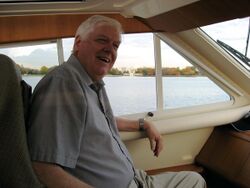 Smith in 2006 | |
| Nationality | United States |
| Alma mater | University of California, Berkeley, BA Johns Hopkins School of Medicine, MD |
| Known for | Restriction enzymes |
| Awards | Nobel Prize in Physiology or Medicine in 1978 |
| Scientific career | |
| Fields | Molecular biology, biochemistry, genomics |
| Institutions | Washington University School of Medicine |
Hamilton Othanel Smith (born August 23, 1931) is an American microbiologist and Nobel laureate.[1][2]
Smith graduated from University Laboratory High School of Urbana, Illinois. He attended the University of Illinois at Urbana-Champaign, but in 1950 transferred to the University of California, Berkeley, where he earned his B.A. in Mathematics in 1952 [1]. He received his medical degree from Johns Hopkins School of Medicine in 1956. Between 1956 and 1957 Smith worked for the Washington University in St. Louis Medical Service. In 1975, he was awarded a Guggenheim Fellowship he spent at the University of Zurich.
In 1970, Smith and Kent W. Wilcox discovered the first type II restriction enzyme,[3] that is now called as HindII.[1] Smith went on to discover DNA methylases that constitute the other half of the bacterial host restriction and modification systems, as hypothesized by Werner Arber of Switzerland.[1]
He was awarded the Nobel Prize in Physiology or Medicine in 1978 for discovering type II restriction enzymes with Werner Arber and Daniel Nathans as co-recipients.
He later became a leading figure in the nascent field of genomics, when in 1995 he and a team at The Institute for Genomic Research sequenced the first bacterial genome, that of Haemophilus influenzae.[4] H. influenza was the same organism in which Smith had discovered restriction enzymes in the late 1960s. He subsequently played a key role in the sequencing of many of the early genomes at The Institute for Genomic Research, and in the assembly of the human genome at Celera Genomics, which he joined when it was founded in 1998.
More recently, he has directed a team at the J. Craig Venter Institute that works towards creating a partially synthetic bacterium, Mycoplasma laboratorium. In 2003 the same group synthetically assembled the genome of a virus, Phi X 174 bacteriophage. Smith is scientific director of privately held Synthetic Genomics, which was founded in 2005 by Craig Venter to continue this work. Synthetic Genomics is working to produce biofuels on an industrial-scale using recombinant algae and other microorganisms.[5]
References
This article incorporates CC-BY-2.5 text from the reference[1]
- ↑ 1.0 1.1 1.2 1.3 Gitschier, J. (2012). "A Half-Century of Inspiration: An Interview with Hamilton Smith". PLOS Genetics 8 (1): e1002466. doi:10.1371/journal.pgen.1002466. PMID 22253610.
- ↑ Multiple sources:
- Raju, T. N. (1999). "The Nobel Chronicles". The Lancet 354 (9189): 1567. doi:10.1016/S0140-6736(05)76606-X. PMID 10551539.
- Shampo, M. A.; Kyle, R. A. (1995). "Hamilton Smith--Nobel Prize winner in medicine or physiology". Mayo Clinic Proceedings (Elsevier) 70 (6): 540. doi:10.1016/s0025-6196(11)64310-3. PMID 7776712.
- Berg, K. (1978). "The Nobel prize in physiology and medicine 1978. Nobel prize to a controversial research field". Tidsskrift for den Norske Laegeforening 98 (34–36): 1741–1742. PMID 725894.
- "Molecular genetics takes Nobel Prize". JAMA: The Journal of the American Medical Association (American Medical Association) 240 (20): 2137–2138. 1978. doi:10.1001/jama.240.20.2137. PMID 359842.
- "Brazil learns its ecological lessons–the hard way". Nature 275 (5682): 689–90. 1978. doi:10.1038/275684a0. PMID 360075. Bibcode: 1978Natur.275..684..
- ↑ Smith H, Wilcox KW (1970). "A Restriction enzyme from Hemophilus influenzae *1I. Purification and general properties". Journal of Molecular Biology 51 (2): 379–391. doi:10.1016/0022-2836(70)90149-X. PMID 5312500.
- ↑ Smith, H. O.; Wilcox, K. W. (1992). "A restriction enzyme from Hemophilus influenzae. I. Purification and general properties. 1970". Biotechnology (Reading, Mass.) 24: 38–50. PMID 1330118.
- ↑ "Craig Venter Has Algae Biofuel in Synthetic Genomics' Pipeline - Xconomy". Xconomy. 4 June 2009. http://www.xconomy.com/san-diego/2009/06/04/craig-venter-has-algae-biofuel-in-synthetic-genomics-pipeline/.
Further reading
- Lagerkvist, U (October 1978). "To split a gene" (in sv). Läkartidningen 75 (43): 3892–4. PMID 279742.
External links
- Miss nobel-id as parameter
Laureates of the Prince or Princess of Asturias Award for Technical and Scientific Research | ||||||||||||
|---|---|---|---|---|---|---|---|---|---|---|---|---|
|  | |||||||||||
|
 |  |
Categories: [Nobel laureates in Physiology or Medicine] [American Nobel laureates]
↧ Download as ZWI file | Last modified: 01/11/2024 08:58:54 | 1 views
☰ Source: https://handwiki.org/wiki/Biography:Hamilton_O._Smith | License: CC BY-SA 3.0
 ZWI signed:
 KSF
KSF