Medicago
 From Handwiki
| Medicago | |
|---|---|
| |
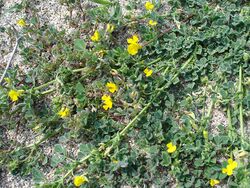
| Medicago littoralis | |
| |
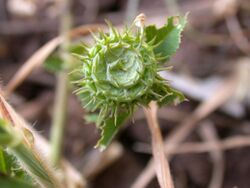
| Medicago granadensis bur | |
Scientific classification 
| |
| Kingdom: | Plantae |
| Clade: | Tracheophytes |
| Clade: | Angiosperms |
| Clade: | Eudicots |
| Clade: | Rosids |
| Order: | Fabales |
| Family: | Fabaceae |
| Subfamily: | Faboideae |
| Clade: | Inverted repeat-lacking clade |
| Tribe: | Trifolieae |
| Genus: | Medicago L. (1753) |
| Type species | |
| Medicago sativa | |
| Species | |
|
87–105; see text. | |
| Synonyms[1] | |
| |
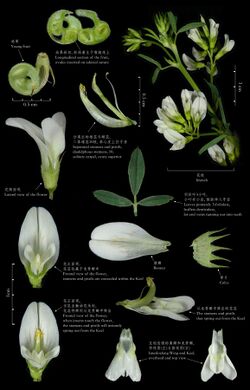
Medicago is a genus of flowering plants, commonly known as medick or burclover, in the legume family (Fabaceae). It contains at least 87 species and is distributed mainly around the Mediterranean Basin,[2][3] and extending across temperate Eurasia and sub-Saharan Africa.[1] The best-known member of the genus is alfalfa (M. sativa), an important forage crop,[4] and the genus name is based on the Latin name for that plant, medica, from Greek: μηδική (πόα) Median (grass).[5] Most members of the genus are low, creeping herbs, resembling clover, but with burs (hence the common name). However, alfalfa grows to a height of 1 meter, and tree medick (M. arborea) is a shrub. Members of the genus are known to produce bioactive compounds such as medicarpin (a flavonoid) and medicagenic acid (a triterpenoid saponin).[3] Chromosome numbers in Medicago range from 2n = 14 to 48.[6]
The species Medicago truncatula is a model legume[7] due to its relatively small stature, small genome (450–500 Mbp), short generation time (about 3 months), and ability to reproduce both by outcrossing and selfing.
Comprehensive descriptions of the genus are Lesinš and Lesinš 1979[8] and Small and Jomphe 1989.[9] Major collections are SARDI (Australia),[10] USDA-GRIN (United States),[11] ICARDA (Syria),[12] and INRA (France).[13]
Evolution
Medicago diverged from Glycine (soybean) about 53–55 million years ago (in the early Eocene),[14] from Lotus (deervetch) 49–51 million years ago (also in the Eocene),[14] and from Trigonella 10–22 million years ago (in the Miocene).[15]
Ecological interactions with other organisms
Symbiosis with nitrogen-fixing rhizobia
Béna et al. (2005) constructed a molecular phylogeny of 23 Sinorhizobium strains and tested the symbiotic ability of six strains with 35 Medicago species.[16] Comparison of these phylogenies indicates many transitions in the compatibility of the association over evolutionary time. Furthermore, they propose that the geographical distribution of strains limits the distribution of particular Medicago species.
Agricultural uses
Other than alfalfa, several of the creeping members of the family (such as Medicago lupulina and Medicago truncatula) have been used as forage crops.[citation needed]
Insect herbivores
Medicago species are used as food plants by the larvae of some Lepidoptera species including the common swift, flame, latticed heath, lime-speck pug, nutmeg, setaceous Hebrew character, and turnip moths and case-bearers of the genus Coleophora, including C. frischella (recorded on M. sativa) and C. fuscociliella (feeds exclusively on Medicago spp.).[citation needed]
Species
This list is compiled from:[9][17][18][19][20][21][22][23][24][25][26]
Section Buceras
Subsection Deflexae
- Medicago retrorsa (Boiss.) E. Small
Subsection Erectae
- Medicago arenicola (Huber-Mor.) E. Small
- Medicago astroites (Fisch. & Mey.) Trautv.
- Medicago carica (Huber-Mor.) E. Small
- Medicago crassipes (Boiss.) E. Small
- Medicago fischeriana (Ser.) Trautv.
- Medicago halophila (Boiss.) E. Small
- Medicago heldreichii (Boiss.) E. Small
- Medicago medicaginoides (Retz.) E. Small
- Medicago monantha (C. A. Meyer) Trautv.
- Medicago orthoceras (Kar. & Kir.) Trautv.
- Medicago pamphylica (Huber-Mor. & Sirjaev) E. Small
- Medicago persica (Boiss.) E. Small
- Medicago phrygia (Boiss. & Bal.) E. Small
- Medicago polyceratia (L.) Trautv.
- Medicago rigida (Boiss. & Bal.) E. Small
Subsection Isthmocarpae
- Medicago rhytidiocarpa (Boiss. & Bal.) E. Small
- Medicago isthmocarpa (Boiss. & Bal.) E. Small
Subsection Reflexae
- Medicago monspeliaca (L.) Trautv.
Section Carstiensae
- Medicago carstiensis Wulf.
Section Dendrotelis
- Medicago arborea L.
- Medicago citrina (Font Quer) Greuter[Note 1]
- Medicago strasseri Greuter, Matthas & Risse
Section Geocarpa
- Medicago hypogaea E. Small
Section Heynianae
- Medicago heyniana Greuter
Section Hymenocarpos
- Medicago radiata L.
Section Lunatae
- Medicago biflora (Griseb.) E. Small
- Medicago brachycarpa M. Bieb.
- Medicago huberi E. Small
- Medicago rostrata (Boiss. & Bal.) E. Small
Section Lupularia
- Medicago lupulina L.
- Medicago secundiflora Durieu
Section Medicago
- Medicago cancellata M. Bieb.
- Medicago daghestanica Rupr.
- Medicago hybrida (Pourr.) Trautv.
- Medicago marina L.
- Medicago papillosa Boiss.
- M. p. macrocarpa
- M. p. papillosa
- Medicago pironae Vis.
- Medicago prostrata Jacq.
- M. p. prostrata
- M. p. pseudorupestris
- Medicago rhodopea Velen.
- Medicago rupestris M. Bieb
- Medicago sativa L. (alfalfa)
- M. s. caerulea
- M. s. falcata (Medicago falcata)
- M. s. f. var. falcata
- M. s. f. var. viscosa
- M. s. glomerata
- M. s. sativa
- Medicago saxatilis M. Bieb
- Medicago suffruticosa Ramond ex DC.
- M. s. leiocarpa
- M. s. suffruticosa
Section Orbiculares
- Medicago orbicularis (L.) Bart.
Section Platycarpae
- Medicago archiducis-nicolai Sirjaev
- Medicago cretacea M. Bieb.
- Medicago edgeworthii Sirjaev
- Medicago ovalis (Boiss.) Sirjaev
- Medicago playtcarpa (L.) Trautv.
- Medicago plicata (Boiss.) Sirjaev
- Medicago popovii (E. Kor.) Sirjaev
- Medicago ruthenica (L.) Ledebour
Subsection Rotatae
- Medicago blancheana Boiss.
- Medicago noeana Boiss.
- Medicago rugosa Desr.
- Medicago rotata Boiss.
- Medicago scutellata (L.) Miller
- Medicago shepardii Post
Section Spirocarpos
Subsection Intertextae
- Medicago ciliaris (L.) Krocker
- Medicago granadensis Willd.
- Medicago intertexta (L.) Miller
- Medicago muricoleptis Tin.
Subsection Leptospireae
- Medicago arabica (L.) Huds.
- Medicago coronata (L.) Bart.
- Medicago disciformis DC.
- Medicago laciniata (L.) Miller
- Medicago lanigera Winkl. & Fedtsch.
- Medicago laxispira Heyn
- Medicago minima (L.) Bart.
- Medicago polymorpha L.
- Medicago praecox DC.
- Medicago sauvagei Nègre
- Medicago tenoreana Ser.
Subsection Pachyspireae
- Medicago constricta Durieu
- Medicago doliata Carmign.
- Medicago italica (Miller) Fiori
- Medicago lesinsii E. Small
- Medicago littoralis Rohde ex Lois.
- Medicago murex Willd.
- Medicago rigidula (L.) All.
- Medicago rigiduloides E. Small
- Medicago sinskiae Uljanova[Note 2]
- Medicago soleirolii Duby
- Medicago sphaerocarpos Bertol.[27]
- Medicago syriaca E. Small
- Medicago truncatula Gaertn.
- Medicago turbinata (L.) All.
Species names with uncertain taxonomic status
The status of the following species is unresolved:[9]
- Medicago agropyretorum Vassilcz.
- Medicago alatavica Vassilcz.
- Medicago caucasica Vassilcz.
- Medicago cyrenaea Maire & Weiller
- Medicago difalcata Sinskaya
- Medicago grossheimii Vassilcz.
- Medicago gunibica Vassilcz.
- Medicago hemicoerulea Sinskaya
- Medicago karatschaica (A. Heller) A. Heller
- Medicago komarovii Vassilcz.
- Medicago meyeri Gruner
- Medicago polychroa Grossh.
- Medicago schischkinii Sumnev.
- Medicago talyschensis Latsch.
- Medicago transoxana Vassilcz.
- Medicago tunetana (Murb.) A.W. Hill
- Medicago vardanis' Vassilcz.
- Medicago virescens Grossh.
Recent molecular phylogenic analyses of Medicago indicate that the sections and subsections defined by Small & Jomphe, as outlined above, are generally polyphyletic.[2][15][16][28][29][30][31][32] However, with minor revisions sections and subsections could be rendered monophyletic.[15][28][29][30][31][32]
Notes
- ↑ Some sources treat Medicago citrina as a synonym of Medicago arborea.
- ↑ The validity of Medicago sinskiae has been questioned by Small and Jomphe, 1988.[9]
References
 |
Wikimedia Commons has media related to Medicago. |
- ↑ 1.0 1.1 Medicago L. Plants of the World Online. Retrieved 6 September 2023.
- ↑ 2.0 2.1 "Phylogeny and character evolution in Medicago (Leguminosae): Evidence from analyses of plastid trnK/matK and nuclear GA3ox1 sequences". Am J Bot 97 (7): 1142–1155. 2010. doi:10.3732/ajb.1000009. PMID 21616866.
- ↑ 3.0 3.1 "Natural product biosynthesis in Medicago species". Natural Product Reports 31 (3): 356–380. 2014. doi:10.1039/C3NP70104B. PMID 24481477.
- ↑ "Alfalfa Crop Germplasm Committee Report, 2000". http://www.ars-grin.gov/npgs/cgc_reports/alfalfa/alfalfacgc2000.htm.
- ↑ New Oxford American Dictionary (2nd ed., 2005), p. 1054, s.v. medick.
- ↑ "Amplification, contraction and genomic spread of a satellite DNA family (E180) in Medicago (Fabaceae) and allied genera". Ann Bot 109 (4): 773–82. 2012. doi:10.1093/aob/mcr309. PMID 22186276.
- ↑ "Medicago truncatula". http://www.medicago.org/.
- ↑ Genus Medicago (Leguminosae): A Taxogenetic Study. The Hague, The Netherlands: Dr. W. Junk B. V. Publishers. 1979. pp. 132. ISBN 978-90-6193-598-8.
- ↑ 9.0 9.1 9.2 9.3 "A Synopsis of the Genus Medicago (Leguminosae)". Can J Bot 67 (11): 3260–94. 1989. doi:10.1139/b89-405.
- ↑ "SARDI". http://www.sardi.sa.gov.au/.
- ↑ "GRIN National Genetic Resources Program". http://www.ars-grin.gov/.
- ↑ "ICARDA Sustainable Agriculture for the Dry Areas". http://www.icarda.org/.
- ↑ "INRA". http://www1.montpellier.inra.fr/BRC-MTR/.
- ↑ 14.0 14.1 Cannon S. (2008). "3. Legume Comparative Genomics". in Stacey G. Genetics and Genomics of Soybean. Plant Genetics and Genomics: Crops and Models. II. New York, NY: Springer. p. 38. ISBN 978-0-387-72298-6. http://ddr.nal.usda.gov/bitstream/10113/17513/1/IND44083204.pdf.
- ↑ 15.0 15.1 15.2 "The reticulate history of Medicago (Fabaceae)". Syst Biol 57 (6): 466–482. 2008. doi:10.1080/10635150802172168. PMID 18570039.
- ↑ 16.0 16.1 "Medicago–Sinorhizobium symbiotic specificity evolution and the geographic expansion of Medicago". J. Evol. Biol. 18 (6): 1547–58. 2005. doi:10.1111/j.1420-9101.2005.00952.x. PMID 16313467.
- ↑ "ILDIS LegumeWeb". http://www.ildis.org/LegumeWeb.
- ↑ "Genera Containing Currently Accepted Names: Medicago". http://www.ildis.org/LegumeWeb/6.00/names/npall/npall_445.shtml.
- ↑ "Species Nomenclature in GRIN". http://www.ars-grin.gov/cgi-bin/npgs/html/genform.pl.
- ↑ "IPNI Plant Name Query Results". http://www.ipni.org/ipni/advPlantNameSearch.do?find_family=&find_genus=Medicago&find_species=&find_infrafamily=&find_infragenus=&find_infraspecies=&find_authorAbbrev=&find_includePublicationAuthors=on&find_includePublicationAuthors=off&find_includeBasionymAuthors=on&find_includeBasionymAuthors=off&find_publicationTitle=&find_isAPNIRecord=on&find_isAPNIRecord=false&find_isGCIRecord=on&find_isGCIRecord=false&find_isIKRecord=on&find_isIKRecord=false&find_rankToReturn=all&output_format=normal&find_sortByFamily=on&find_sortByFamily=off&query_type=by_query&back_page=plantsearch.
- ↑ "AgroAtlas - Relatives". http://www.agroatlas.spb.ru/en/content/related/#M.
- ↑ "ITIS". https://www.itis.gov/index.html. (enter Medicago as the search term)
- ↑ "Discover Life". http://www.discoverlife.org/mp/20q?search=Medicago.
- ↑ eFloras
- ↑ The Biota of North America Program[yes|permanent dead link|dead link}}]
- ↑ "The Plant List". http://www.theplantlist.org/tpl/search?q=Medicago.
- ↑ "Morphology and distribution of species in the Medicago murex complex". Can J Bot 69 (12): 2655–2662. 1991. doi:10.1139/b91-333.
- ↑ 28.0 28.1 "Molecular phylogenetic approach for studying life-history evolution: the ambiguous example of the genus Medicago L.". Proc Biol Sci 265 (1401): 1141–1151. 1998. doi:10.1098/rspb.1998.0410. PMID 9684377.
- ↑ 29.0 29.1 "Multiple independent losses of the plastid rpoC1 intron in Medicago (Fabaceae) as inferred from phylogenetic analyses of nuclear ribosomal DNA internal transcribed spacer sequences". Can J Bot 76 (5): 791–803. 1998. doi:10.1139/b98-047.
- ↑ 30.0 30.1 "Evolution of annual species of the genus Medicago: a molecular phylogenetic approach". Mol Phylogenet Evol 9 (3): 552–559. 1998. doi:10.1006/mpev.1998.0493. PMID 9668004.
- ↑ 31.0 31.1 Béna G. (2001). "Molecular phylogeny supports the morphologically based taxonomic transfer of the "medicagoid" Trigonella species to the genus Medicago L.". Plant Syst Evol 229 (3–4): 217–236. doi:10.1007/s006060170012.
- ↑ 32.0 32.1 "Phylogenetic signal variation in the genomes of Medicago (Fabaceae)". Syst Biol 62 (3): 424–38. 2013. doi:10.1093/sysbio/syt009. PMID 23417680.
Wikidata ☰ Q159549 entry
 |  |
Categories: [Medicago] [Fabaceae genera]
↧ Download as ZWI file | Last modified: 05/09/2025 10:32:39 | 5 views
☰ Source: https://handwiki.org/wiki/Biology:Medicago | License: CC BY-SA 3.0
 KSF
KSF