Cordia Subcordata
 From Handwiki
| Cordia subcordata | |
|---|---|
| |
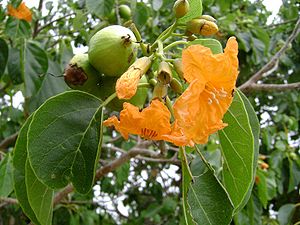
| Flower, fruit | |
Conservation status
| |
 Least Concern (IUCN 3.1)[1] | |
Scientific classification 
| |
| Kingdom: | Plantae |
| Clade: | Tracheophytes |
| Clade: | Angiosperms |
| Clade: | Eudicots |
| Clade: | Asterids |
| Order: | Boraginales |
| Family: | Boraginaceae |
| Genus: | Cordia |
| Species: | C. subcordata
|
| Binomial name | |
| Cordia subcordata Lam.[2]
| |
Cordia subcordata is a species of flowering tree in the borage family, Boraginaceae, that occurs in eastern Africa, South Asia, Southeast Asia, northern Australia and the Pacific Islands.[2] The plant is known by a variety of names including beach cordia, sea trumpet, and kerosene wood, among others.
Names
Other names for the species include kanawa, tou, kou, mareer, manjak, snottygobbles, glueberry, narrow-leafed bird lime tree, In Java and Madura, it is known as kalimasada, purnamasada, or pramasada; Javanese folklore consider the tree to contain spiritual power.[3] In the Marshall Islands it is known as kono.[4]
Description
C. subcordata grows to 7–10 m (23–33 ft) at maturity, but may be as tall as 15 m (49 ft). It has ovate leaves that are 8–20 cm (3.1–7.9 in) and 5–13 cm (2.0–5.1 in) wide.[5]
Flowers
The tubular flowers of C. subcordata are 2.5–4 cm (0.98–1.57 in) in diameter and form cymes or panicles.[5] Petals are orange and the sepals are pale green. Blooming occurs throughout the year, but most flowers are produced in the spring.[6]
Fruit
C. subcordata produces fruit year round. They are spherical, 2–3 cm (0.79–1.18 in) long, and woody when mature. Each fruit contains four or fewer seeds that are 10–13 mm (0.39–0.51 in) long. The fruit are buoyant and may be carried long distances by ocean currents.[5]
Habitat
C. subcordata is a tree of the coasts, found at elevations from sea level to 30 m (98 ft), but may grow at up to 150 m (490 ft). It grows in areas that receive 1,000–4,000 mm (39–157 in) of annual rainfall. C. subcordata prefers neutral to alkaline soils (pH of 6.1 to 7.4), such as those originating from basalt, limestone, clay, or sand. Allowable soil textures include sand, sandy loam, loam, sandy clay loam, sandy clay, clay loam, and clay.[5]
Uses
The seeds are edible and have been eaten during famine. C. subcordata burns readily, and this led to the nickname of "Kerosene Tree" in Papua New Guinea.[5] The wood of the tree has a specific gravity of 0.45, is soft, durable, easily worked,[6] and resistant to termites. In ancient Hawaiʻi kou wood was used to make ʻumeke (bowls), utensils, and ʻumeke lāʻau (large calabashes) because it did not impart a foul taste to food. ʻUmeke lāʻau were 8–16 litres (2–4 gal) and used to store and ferment poi. The flowers were used to make lei, while a dye for kapa cloth and aho (fishing lines) was derived from the leaves.[5]
In the western Solomon Islands, in Vanuatu, on Waya Island, and in Tonga, it is used for carving. On New Ireland, its wood is always used for the ceremonial entrances to men's houses.[7]
See also
- Domesticated plants and animals of Austronesia
References
- ↑ Oldfield, S. (2019). "Cordia subcordata". IUCN Red List of Threatened Species 2019: e.T33199A67739216. doi:10.2305/IUCN.UK.2019-2.RLTS.T33199A67739216.en. https://www.iucnredlist.org/species/33199/67739216. Retrieved 19 November 2021.
- ↑ 2.0 2.1 {{citation | mode = cs1 | title = Cordia subcordata | work = Germplasm Resources Information Network (GRIN) | url = | publisher = [[Organization:Agricultural Research ServAgricultural Research Service (ARS), United States Department of Agriculture (USDA) | access-date = 2010-03-02 }}
- ↑ Bosbouwproefstation (1936). Korte mededeelingen - Cordia Subcordata. Cornell University. p. 107. https://books.google.com/books?id=vyhJAAAAYAAJ&q=cordia+subcordata+kalimasada. Retrieved 30 May 2015.
- ↑ "Native plants of the Marshalls". RMI Office of Environmental Planning and Policy Coordination. 2 October 2008. http://biormi.org/index.shtml?en/native_plants.shtml.
- ↑ 5.0 5.1 5.2 5.3 5.4 5.5 Friday, J. B.; Dana Okano (April 2006). "Cordia subcordata (kou)". Species Profiles for Pacific Island Agroforestry (The Traditional Tree Initiative). http://www.agroforestry.net/tti/Cordia-kou.pdf. Retrieved 2009-02-21.
- ↑ 6.0 6.1 Allen, James A. (2003-01-01). "Cordia subcordata Lam." (PDF). Tropical Tree Seed Manual. Reforestation, Nurseries & Genetics Resources. http://www.rngr.net/Publications/ttsm/Folder.2003-07-11.4726/PDF.2004-01-12.0613/file.
- ↑ Pawley, Andrew; Osmond, Meredith (eds). 2008. The lexicon of Proto Oceanic: The culture and environment of ancestral Oceanic society . Volume 3: Plants . Pacific Linguistics 599. Canberra: Pacific Linguistics, Australian National University.
External links
- "Cordia subcordata". FloraBase. Western Australian Government Department of Parks and Wildlife. https://florabase.dpaw.wa.gov.au/browse/profile/.
See also Wikidata entry Q675926.
 |  |
Categories: [Cordia]
↧ Download as ZWI file | Last modified: 07/09/2022 10:51:32 | 2 views
☰ Source: https://handwiki.org/wiki/Biology:Cordia_subcordata | License: CC BY-SA 3.0
 ZWI signed:
 KSF
KSF