Small Island Developing States
 From Handwiki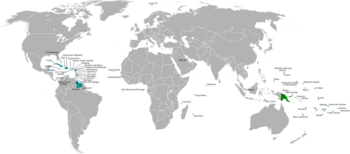
The Small Island Developing States (SIDS) are a grouping of developing countries which are small island countries and tend to share similar sustainable development challenges. These include small but growing populations, limited resources, remoteness, susceptibility to natural disasters, vulnerability to external shocks, excessive dependence on international trade, and fragile environments. Their growth and development are also held back by high communication, energy and transportation costs, irregular international transport volumes, disproportionately expensive public administration and infrastructure due to their small size, and little to no opportunity to create economies of scale. They consist of some of the most vulnerable countries to anthropogenic climate change.
The SIDS were first recognized as a distinct group of developing countries at the United Nations Conference on Environment and Development in June 1992. The Barbados Programme of Action was produced in 1994 to assist the SIDS in their sustainable development efforts. The United Nations Office of the High Representative for the Least Developed Countries, Landlocked Developing Countries and Small Island Developing States (UN-OHRLLS) represents the group of states.[1]
List of SIDS
As of 2023, the United Nations Office of the High Representative for the Least Developed Countries, Landlocked Developing Countries and Small Island Developing States (UN-OHRLLS) lists 57 such nations (39 sovereign states and 18 dependent territories).[2] These nations are grouped into three geographical regions: the Caribbean;[3] the Pacific;[4] and Africa, Indian Ocean, Mediterranean and South China Sea (AIMS),[5] including 18 Associate Members of the United Nations Regional Commissions. Each of these regions has a regional cooperation body: the Caribbean Community, the Pacific Islands Forum, and the Indian Ocean Commission respectively, which many SIDS are members or associate members of. In addition, most (but not all) SIDS are members of the Alliance of Small Island States (AOSIS), which performs lobbying and negotiating functions for the SIDS within the United Nations System.
| Caribbean | Pacific | Africa, Indian Ocean, Mediterranean and South China Sea (AIMS) |
|---|---|---|
 Anguilla[lower-alpha 1][lower-alpha 2][lower-alpha 3] Anguilla[lower-alpha 1][lower-alpha 2][lower-alpha 3]
|
Template:ASA[lower-alpha 4][lower-alpha 5][lower-alpha 3] |  Cape Verde[lower-alpha 5] Cape Verde[lower-alpha 5]
|
 Antigua and Barbuda Antigua and Barbuda
|
 Cook Islands[lower-alpha 3] Cook Islands[lower-alpha 3]
|
 Comoros[lower-alpha 6] Comoros[lower-alpha 6]
|
 Aruba[lower-alpha 7][lower-alpha 8][lower-alpha 3] Aruba[lower-alpha 7][lower-alpha 8][lower-alpha 3]
|
 Fiji Fiji
|
 Guinea-Bissau[lower-alpha 6][lower-alpha 5][lower-alpha 9] Guinea-Bissau[lower-alpha 6][lower-alpha 5][lower-alpha 9]
|
 Bahamas Bahamas
|
 French Polynesia[lower-alpha 1][lower-alpha 2][lower-alpha 3] French Polynesia[lower-alpha 1][lower-alpha 2][lower-alpha 3]
|
 Maldives[lower-alpha 8] Maldives[lower-alpha 8]
|
 Barbados Barbados
|
 Guam[lower-alpha 4][lower-alpha 5][lower-alpha 3] Guam[lower-alpha 4][lower-alpha 5][lower-alpha 3]
|
 Mauritius Mauritius
|
| Template:BIZ[lower-alpha 9] |  Kiribati[lower-alpha 6] Kiribati[lower-alpha 6]
|
 São Tomé and Príncipe[lower-alpha 6][lower-alpha 5] São Tomé and Príncipe[lower-alpha 6][lower-alpha 5]
|
 Bermuda[lower-alpha 3] Bermuda[lower-alpha 3]
|
 Marshall Islands Marshall Islands
|
 Seychelles Seychelles
|
 British Virgin Islands[lower-alpha 1][lower-alpha 2][lower-alpha 3] British Virgin Islands[lower-alpha 1][lower-alpha 2][lower-alpha 3]
|
 Micronesia Micronesia
|
 Singapore[lower-alpha 5] Singapore[lower-alpha 5]
|
 Cayman Islands[lower-alpha 3] Cayman Islands[lower-alpha 3]
|
 Nauru Nauru
|
|
 Cuba[lower-alpha 5] Cuba[lower-alpha 5]
|
 New Caledonia[lower-alpha 1][lower-alpha 2][lower-alpha 3] New Caledonia[lower-alpha 1][lower-alpha 2][lower-alpha 3]
|
|
 Curaçao[lower-alpha 3] Curaçao[lower-alpha 3]
|
 Niue[lower-alpha 3] Niue[lower-alpha 3]
|
|
 Dominica Dominica
|
 Northern Mariana Islands[lower-alpha 1][lower-alpha 5][lower-alpha 3] Northern Mariana Islands[lower-alpha 1][lower-alpha 5][lower-alpha 3]
|
|
 Dominican Republic[lower-alpha 8] Dominican Republic[lower-alpha 8]
|
 Palau Palau
|
|
 Papua New Guinea Papua New Guinea
|
||
_variant.svg.png) Guadeloupe[lower-alpha 10] Guadeloupe[lower-alpha 10]
|
||
 Guyana[lower-alpha 9] Guyana[lower-alpha 9]
|
 Solomon Islands[lower-alpha 6] Solomon Islands[lower-alpha 6]
|
|
 Haiti[lower-alpha 6] Haiti[lower-alpha 6]
|
 Timor-Leste[lower-alpha 6][lower-alpha 1][lower-alpha 8] Timor-Leste[lower-alpha 6][lower-alpha 1][lower-alpha 8]
|
|
 Jamaica Jamaica
|
||
 Martinique[lower-alpha 10] Martinique[lower-alpha 10]
|
 Tuvalu[lower-alpha 6] Tuvalu[lower-alpha 6]
|
|
 Montserrat[lower-alpha 1][lower-alpha 3] Montserrat[lower-alpha 1][lower-alpha 3]
|
 Vanuatu Vanuatu
|
|
| Template:PUR[lower-alpha 1][lower-alpha 8][lower-alpha 3] | ||
 Saint Lucia Saint Lucia
|
||
 Sint Maarten[lower-alpha 3] Sint Maarten[lower-alpha 3]
|
||
 Suriname[lower-alpha 9] Suriname[lower-alpha 9]
|
||
 Turks and Caicos Islands[lower-alpha 3] Turks and Caicos Islands[lower-alpha 3]
|
||
 U.S. Virgin Islands[lower-alpha 4][lower-alpha 5][lower-alpha 3] U.S. Virgin Islands[lower-alpha 4][lower-alpha 5][lower-alpha 3]
|
Impacts of climate change
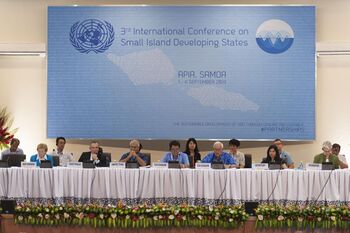
The SIDS are some of the regions most vulnerable to anthropogenic climate change. Due to their oceanic environment, SIDS are especially vulnerable to the marine effects of climate change like sea level rise, ocean acidification, marine heatwaves, and the increase in cyclone intensity. Changing precipitation patterns could also cause droughts. Many citizens of SIDS live near a coastline, meaning that they have a high risk exposure to the effects of marine climate change. Additional climate change vulnerability comes through their economies: many SIDS have economies that are based on natural resources, such as ecotourism, fishing, or agriculture. Phenomena like sea level rise, coastal erosion, and severe storms have the potential to severely impact their economies.[7]
Sustainable Development Goals
Small island development states are mentioned in several of the Sustainable Development Goals.[8] For example, Target 7 of Sustainable Development Goal 14 ("Life below Water") states: "By 2030, increase the economic benefits to small island developing States and least developed countries from the sustainable use of marine resources, including through sustainable management of fisheries, aquaculture and tourism".[9]
Notes
- ↑ 1.0 1.1 1.2 1.3 1.4 1.5 1.6 1.7 Neither member nor observer of the Alliance of Small Island States
- ↑ 2.0 2.1 2.2 2.3 Associate member of regional cooperation body
- ↑ 3.00 3.01 3.02 3.03 3.04 3.05 3.06 3.07 3.08 3.09 3.10 3.11 3.12 3.13 3.14 3.15 3.16 3.17 Dependent territories
- ↑ 4.0 4.1 4.2 Observer of the Alliance of Small Island States
- ↑ 5.0 5.1 5.2 5.3 5.4 5.5 5.6 5.7 5.8 Neither member nor observer of regional cooperation body
- ↑ 6.0 6.1 6.2 6.3 6.4 6.5 6.6 6.7 Also a least developed country
- ↑ Observer of the Alliance of Small States as part of the Netherlands Antilles
- ↑ 8.0 8.1 8.2 8.3 8.4 Observer of regional cooperation body
- ↑ 9.0 9.1 9.2 9.3 Belize, Guinea-Bissau, Guyana, and Suriname are included even though they are not island countries. This may be because they are low-lying coastal countries whose economies are dependent on a small number of activities. Their classification as SIDS is controversial.[6]
- ↑ 10.0 10.1 Overseas departments and regions of France
See also
- 2010 United Nations Climate Change Conference
- Organisation of African, Caribbean and Pacific States (OACPS)
- Group of 77
- Islands First (environmental organization)
- Landlocked developing countries
- List of island countries
References
- ↑ "Office of the High Representative for the Least Developed Countries, Landlocked Developing Countries and Small Island Developing States |" (in en). https://www.un.org/ohrlls/.
- ↑ "List of SIDS | Office of the High Representative for the Least Developed Countries, Landlocked Developing Countries and Small Island Developing States". https://www.un.org/ohrlls/content/list-sids.
- ↑ "The Caribbean". UN Department of Economic and Social Affairs. http://sustainabledevelopment.un.org/index.php?menu=1522.
- ↑ "The Pacific". UN Department of Economic and Social Affairs. http://sustainabledevelopment.un.org/index.php?menu=1523.
- ↑ "The AIMS". UN Department of Economic and Social Affairs. http://sustainabledevelopment.un.org/index.php?menu=1521.
- ↑ "What makes a SIDS a SIDS – UNCTAD Development and Globalization: Facts and Figures 2021". https://dgff2021.unctad.org/unctad-and-the-sids/.
- ↑ Thomas, Adelle; Baptiste, April; Martyr-Koller, Rosanne; Pringle, Patrick; Rhiney, Kevon (2020-10-17). "Climate Change and Small Island Developing States" (in en). Annual Review of Environment and Resources 45 (1): 1–27. doi:10.1146/annurev-environ-012320-083355. ISSN 1543-5938.
- ↑ United Nations (2017) Resolution adopted by the General Assembly on 6 July 2017, Work of the Statistical Commission pertaining to the 2030 Agenda for Sustainable Development (A/RES/71/313)
- ↑ United Nations (2017) Resolution adopted by the General Assembly on 6 July 2017, Work of the Statistical Commission pertaining to the 2030 Agenda for Sustainable Development (A/RES/71/313)
External links
- About SIDS, United Nations Office of the High Representative for the Least Developed Countries, Landlocked Developing Countries and Small Island Developing States
- List of SIDS United Nations, Office of the High Representative for the Least Developed Countries, Landlocked Developing Countries and Small Island Developing States
- United Nations Mandates and Resolutions on SIDS
- AOSIS Members, Alliance of Small Island States
- Chris Becker, International Monetary Fund, 'Small Island States in the Pacific: the Tyranny of Distance?'
 |  |
Categories: [Geography]
↧ Download as ZWI file | Last modified: 07/15/2024 18:40:47 | 3 views
☰ Source: https://handwiki.org/wiki/Earth:Small_Island_Developing_States | License: CC BY-SA 3.0
 KSF
KSF