September 22, 2023
 From Ballotpedia
Welcome to the Friday, September 22, Brew.
By: Samuel Wonacott
Here’s what’s in store for you as you start your day:
- Democrats regain narrow majority of Pennsylvania House of Representatives
- The next Republican presidential primary debate is Sept. 27
- #FridayTrivia: How many U.S. Representatives have retired on average each year from 2000 to 2022?
Democrats regain narrow majority of Pennsylvania House of Representatives
On Sept. 19, Lindsay Powell (D) defeated Erin Connolly Autenreith (R) 65.1% to 34.7% in the special election for Pennsylvania House of Representatives District 21. Powell’s victory in that district, which includes northern parts of Pittsburgh, means Democrats will regain a narrow majority in the chamber— ending two months of deadlock in which it was split 101-101 between Republicans and Democrats.
The special election was called after Sara Innamorato (D) resigned on July 19 to run for Allegheny County Executive. Democrats previously had a 102-101 majority.
Fifty-one state legislative special elections have been scheduled in 19 states this year.
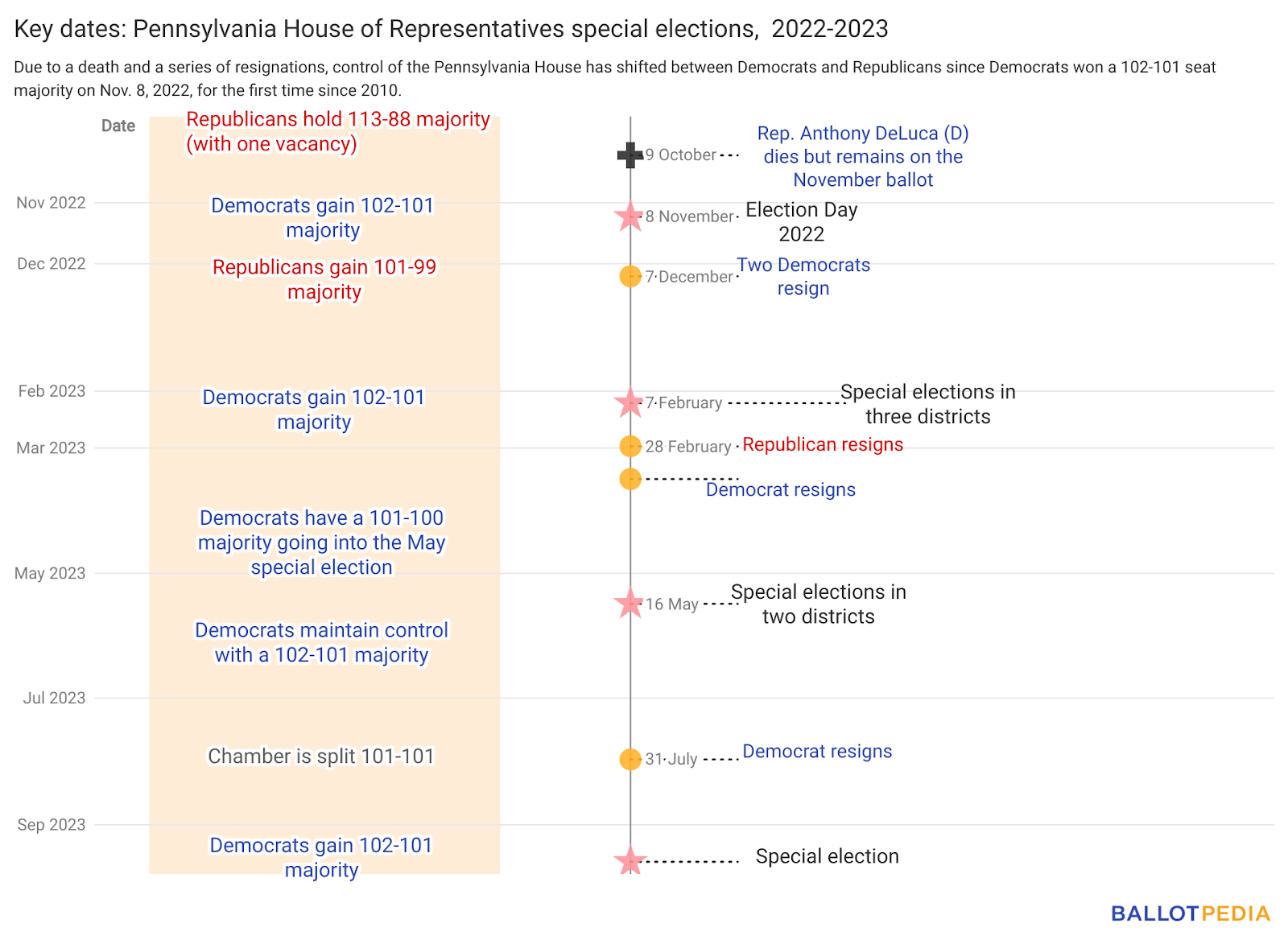
Control of the chamber has shifted between Republicans and Democrats since November 2022 thanks to a series of vacancies and special elections. Let’s review how we got here:
- On Nov. 8, 2022, Democrats won a 102-101 House majority—their first time controlling the chamber since 2010. However, three of the districts Democrats won were guaranteed to become vacant at the start of the next legislative session due to a death and two resignations, giving Republicans a 101-99 majority. Special elections for all three districts were scheduled for February 2023.
- On Jan. 3, the House voted 115-85 to elect Mark Rozzi (D) as speaker. All Democrats and 16 Republicans voted for Rozzi.
- Democrats won all three special elections on Feb. 7, giving them a 102-101 majority. On Feb. 28, Rozzi stepped down as speaker. Rozzi said he resigned because he had accomplished what he had planned to do. Rozzi said he wanted to make way for Joanna McClinton (D) to be elected the first female speaker. McClinton was elected speaker on Feb. 28 with support from all 102 Democrats and no Republicans.
- A Democrat and a Republican resigned on Feb. 28 and March 16, respectively, triggering May 16 special elections and giving Democrats a 101-100 majority.
- On May 16, a Republican won one special election and a Democrat won the other. Democrats returned to a 102-101 majority.
- Innamorato resigned on July 31, leaving control of the chamber split 101-101 between both parties.
Pennsylvania currently has a divided government—Democrats control the governorship and Republicans have a 28-22 majority in the state Senate.
Another special election is likely on the horizon in the House. On May 13, state Rep. John Galloway (D) won a primary to replace outgoing Judge Jan Vislosky on the Bucks County Magisterial District trial court. He was cross-filed as a Republican and a Democrat, and isn’t likely to face a competitor in the November general election unless an independent enters the race. If Galloway wins the general election, he’d be sworn into office in January. Galloway said he would remain in the House until then.
Narrow chamber majorities sometimes force members of both parties to form coalitions or enter into power-sharing agreements—such as when some Republicans in the Pennsylvania House joined Democrats to elect Rozzi, a Democrat, speaker on Jan. 3. We keep tabs on such instances of unique chamber leadership arrangements. Other recent examples include:
- Ohio: On Jan. 3, 2023, the chamber's 32 Democrats joined with 22 Republicans to elect Jason Stephens (R) as speaker. The other 43 Republicans in the chamber voted for Derek Merrin (R). Ohio has a Republican trifecta.
- Alaska: In the 2022 elections, Republicans won 21 seats and Democrats won 19 in the House. On Jan. 19, the chamber elected Rep. Cathy Tilton (R) as speaker on a 26-14 vote. After the vote, Tilton said the chamber's majority would consist of 19 Republicans, two Democrats, and two independents. Following the 2022 elections, all nine Democrats and eight of 11 Republicans in the Senate announced they would form a bipartisan governing coalition. The coalition said it would support Gary Stevens (R) as senate president and Cathy Giessel (R) as majority leader. Alaska has a divided government.
Click below to learn more about Pennsylvania’s House special elections.
The next Republican presidential primary debate is Sept. 27
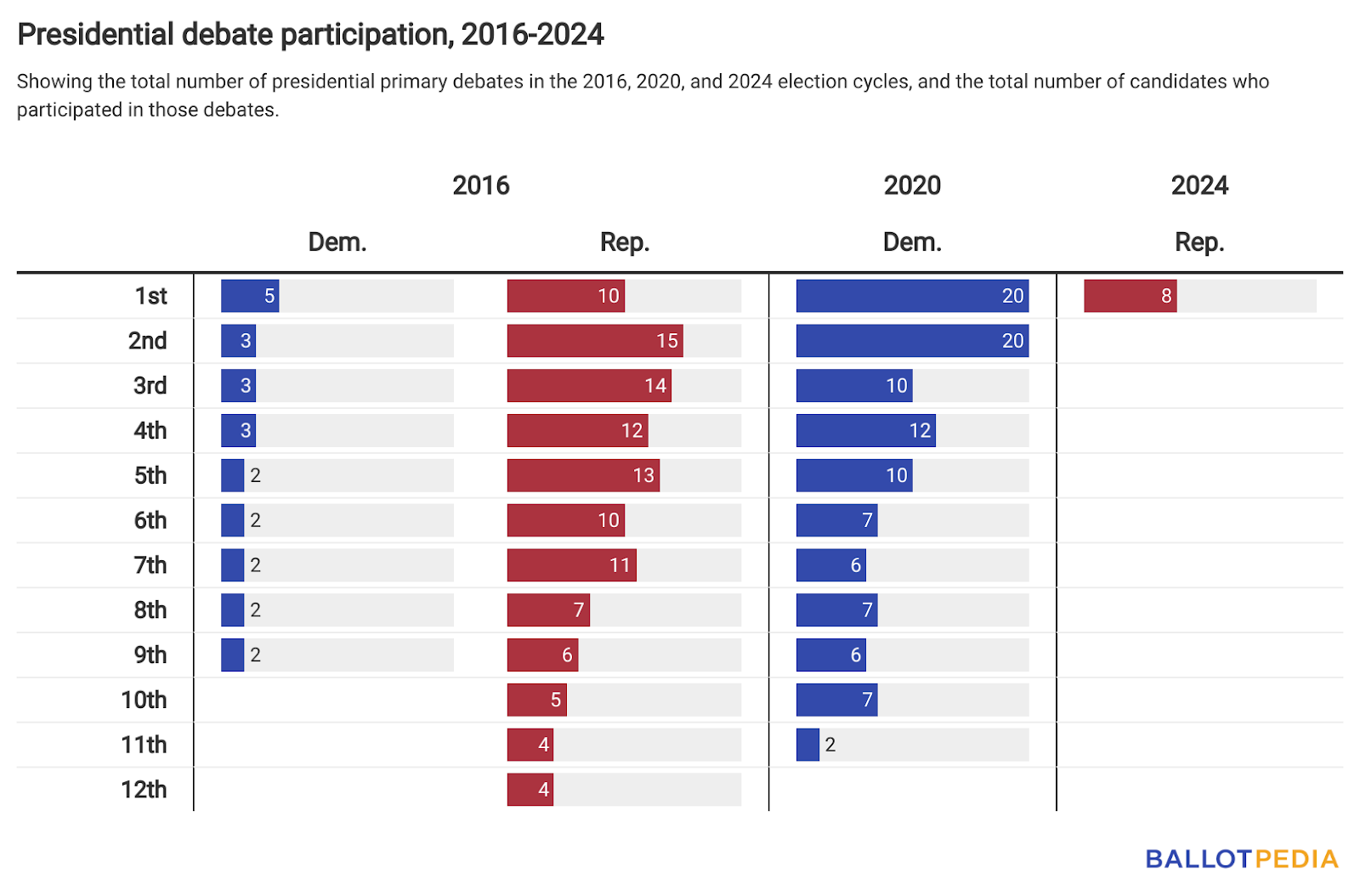
This Wednesday, Sept. 27, Republican presidential hopefuls will gather for the second 2024 primary debate. The Republican Party held the first debate on Aug. 23 in Milwaukee, Wisconsin. Eight candidates met the polling and fundraising thresholds and signed several Republican National Committee pledges to qualify.
Notably, former President Donald Trump (R), who leads the candidates in polling, did not participate, opting instead to appear on Tucker Carlson’s online show, Tucker on X.
Read our coverage of the first debate, including candidate summaries, here.
Here’s what to know about the second debate.
Where is the debate being held?
Candidates will meet in Simi Valley, California, at the Ronald Reagan Presidential Library.
What are the criteria for qualifying?
The debate qualifying deadline is Sept. 25—two days before the event. To qualify, candidates must:
- Receive 3% support or more in two national polls, or 3% support in one national poll and two early state polls—Iowa, New Hampshire, South Carolina, and/or Nevada.
- Provide verifiable evidence that they have 50,000 unique campaign donors, with at least 200 unique donors from 20 different states or territories.
- Sign pledges agreeing to support the eventual party nominee, share data with the Republican National Committee (RNC), and only participate in RNC-sanctioned debates for the rest of the cycle.
Which candidates have qualified?
Candidates still have time to qualify, but as of this writing, six candidates have met the thresholds mentioned above:
The following candidates appeared in the first debate but have not yet qualified for the second:
Will Trump debate?
Trump has said he will not participate in the second debate. He will give a speech in Detroit that evening.
Where can I watch the debate?
Fox News, Univision, and Rumble will broadcast the debate live.
Click below to read more about the second Republican presidential primary debate.
#FridayTrivia: How many U.S. Representatives have retired on average each year from 2000 to 2022?
In the Thursday Brew, we looked at U.S. House retirements in recent election cycles. On Sept. 18, U.S. Rep. Jennifer Wexton (D-Va.) became the 14th U.S. House member not to seek re-election in 2024—less than the average at this point in 2022, 2020, and 2018.
How many U.S. House incumbents did we say have retired on average between 2000 and 2002?
Categories: [Daily Brew, September, 2023] [Daily Brew, 2023] [On-site newsletters]
↧ Download as ZWI file | Last modified: 12/26/2025 07:09:19 | 21 views
☰ Source: https://ballotpedia.org/Daily_Brew:_September_22,_2023 | License: CC BY-SA 3.0
 KSF
KSF