Warner Chappell Music, Inc. V. Nealy
 From Ballotpedia

- Justices
- CASES BY TERM
- Supreme Court cases, October term 2025-2026
- Supreme Court cases, October term 2024-2025
- Supreme Court cases, October term 2023-2024
- Supreme Court cases, October term 2022-2023
- Supreme Court cases, October term 2021-2022
- Supreme Court cases, October term 2020-2021
- Supreme Court cases, October term 2019-2020
- Supreme Court cases, October term 2018-2019
- Supreme Court cases, October term 2017-2018
- Supreme Court cases, October term 2016-2017
- Supreme Court cases, October term 2015-2016
- All earlier cases
- HISTORY OF THE COURT
- Recent vacancies


 | |
| Warner Chappell Music, Inc. v. Nealy | |
| Term: 2023 | |
| Important Dates | |
| Argued: February 21, 2024 Decided: May 9, 2024 | |
| Outcome | |
| affirmed | |
| Vote | |
| 6-3 | |
| Majority | |
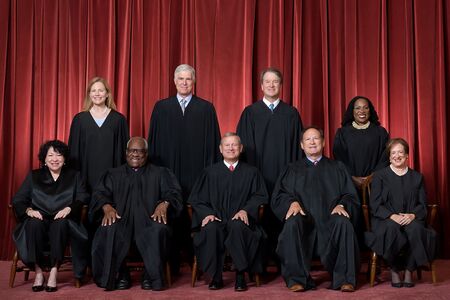
| Chief Justice John Roberts • Sonia Sotomayor • Elena Kagan • Brett Kavanaugh • Amy Coney Barrett • Ketanji Brown Jackson | |
| Dissenting | |
| Neil Gorsuch • Clarence Thomas • Samuel Alito | |
Warner Chappell Music, Inc. v. Nealy is a case that was decided by the Supreme Court of the United States on May 9, 2024, during the court's October 2023-2024 term. The case was argued before the Supreme Court of the United States on February 21, 2024.
The case came on a writ of certiorari to the United States Court of Appeals for the 11th Circuit. To review the lower court's opinion, click here.
Timeline[edit]
The following timeline details key events in this case:
- February 21, 2024: The U.S. Supreme Court heard oral argument.
- September 29, 2023: The U.S. Supreme Court agreed to hear the case.
- May 3, 2023: Warner Chappell Music, Inc., et al. appealed to the U.S. Supreme Court.
- February 27, 2023: The United States Court of Appeals for the Eleventh Circuit held that the certified question regarding first impression of the Copyright Act's statute of limitations was answered.[2]
Background[edit]
On appeal from the United States District Court for the Southern District of Florida, the United States Court of Appeals for the 11th Circuit answered a question of first impression concerning the Copyright Act's three-year statute of limitations.[2][3]
Sherman Nealy and Music Specialist, Inc. ("Nealy") sued Warner Chappell Music, Inc. and Artist Publishing Group, LLC ("Warner") in the U.S. District Court for the Southern District of Florida for copyright infringement and sought damages. The alleged infringment occurred more than three years prior to their filing. Warner alleged that Nealy could not seek damages as a result of the U.S. Supreme Court's ruling in Petrella v. Metro-Goldwyn-Mayer (2014) prohibits such relief after the three year statute of limitations. Nealy responded that Warner's argument did not hold up under the Copyright Act and was based on an incorrect reading of Petrella's timeliness claims related to a separate time accrual rule.[2][3]
The Southern District of Florida certified the following question for interlocutory appeal:[2][3]
| “ | Whether damages in this copyright action are limited to a three-year lookback period as calculated from the date of the filing of the complaint.[4] | ” |
The Eleventh Circuit ruled in favor of Nealy, holding, "when a copyright plaintiff has a timely claim under the discovery accrual rule for infringement that occurred more than three years before the lawsuit was filed, the plaintiff may recover damages for that infringement."[2][3]
Warren filed a petition for a writ of certiorari with the U.S. Supreme Court on May 3, 2023, and the court agreed to hear arguments in the case on September 29, 2023.
Question presented[edit]
The petitioner presented the following question to the court:[1]
Questions presented:
|
Oral argument[edit]
Audio[edit]
Audio of oral argument:[5]
Transcript[edit]
Transcript of oral argument:[6]
Outcome[edit]
In a 6-3 opinion, the court affirmed the judgment of the United States Court of Appeals for the Eleventh Circuit, holding that the Copyright Act allows a copyright owner to obtain monetary relief for any timely infringement claim, no matter when the infringement occurred. Justice Elena Kagan delivered the opinion of the court.[7]
Opinion[edit]
In the court's majority opinion, Justice Elena Kagan wrote:[7]
| “ |
The Copyright Act’s statute of limitations provides that a copyright owner must bring an infringement claim within three years of its accrual. See 17 U. S. C. §507(b). In this case, we assume without deciding that a claim is timely under that provision if brought within three years of when the plaintiff discovered an infringement, no matter when the infringement happened. We then consider whether a claim satisfying that rule is subject to another time-based limit— this one, preventing the recovery of damages for any infringement that occurred more than three years before a lawsuit’s filing. We hold that no such limit on damages exists. The Copyright Act entitles a copyright owner to recover damages for any timely claim.[4] |
” |
| —Justice Elena Kagan | ||
Dissenting opinion[edit]
Justice Neil Gorsuch filed a dissenting opinion, joined by Justices Clarence Thomas and Samuel Alito.
In his dissent, Justice Gorsuch wrote:[7]
| “ |
The Court discusses how a discovery rule of accrual should operate under the Copyright Act. But in doing so it sidesteps the logically antecedent question whether the Act has room for such a rule. Rather than address that question, the Court takes care to emphasize that its resolution must await a future case. The trouble is, the Act almost certainly does not tolerate a discovery rule. And that fact promises soon enough to make anything we might say today about the rule’s operational details a dead letter.[4] |
” |
| —Justice Neil Gorsuch | ||
Text of the opinion[edit]
Read the full opinion here.
October term 2023-2024[edit]
The Supreme Court began hearing cases for the term on October 2, 2023. The court's yearly term begins on the first Monday in October and lasts until the first Monday in October the following year. The court generally releases the majority of its decisions in mid-June.[8]
See also[edit]
External links[edit]

- Search Google News for this topic
- U.S. Supreme Court docket file - Warner Chappell Music, Inc. v. Nealy (petitions, motions, briefs, opinions, and attorneys)
- SCOTUSblog case file for Warner Chappell Music, Inc. v. Nealy
Footnotes[edit]
- ↑ 1.0 1.1 U.S. Supreme Court, "No. 22-1078," accessed October 4, 2023
- ↑ 2.0 2.1 2.2 2.3 2.4 U.S. Court of Appeals for the 11th Circuit, Nealy v. Warner Chappell Music, Inc., decided February 27, 2023
- ↑ 3.0 3.1 3.2 3.3 U.S. Supreme Court, "Warner Chappell Music, Inc. v. Nealy ON PETITION FOR A WRIT OF CERTIORARI," filed May 3, 2023
- ↑ 4.0 4.1 4.2 4.3 Note: This text is quoted verbatim from the original source. Any inconsistencies are attributable to the original source.
- ↑ Supreme Court of the United States, "Oral Argument - Audio," argued February 21, 2024
- ↑ Supreme Court of the United States, "Oral Argument - Transcript," argued February 21, 2024
- ↑ 7.0 7.1 7.2 U.S. Supreme Court, "Warner Chappell Music, Inc. v. Nealy," accessed May 9, 2024
- ↑ SupremeCourt.gov, "The Supreme Court at Work: The Term and Caseload," accessed January 24, 2022

| |||||||||||
Categories: [United States Supreme Court] [SCOTUS OT 2023] [Pending SCOTUS cases]
↧ Download as ZWI file | Last modified: 04/28/2025 21:14:35 | 5 views
☰ Source: https://ballotpedia.org/Warner_Chappell_Music,_Inc._v._Nealy | License: CC BY-SA 3.0
 KSF
KSF