| Administrative State
|
|
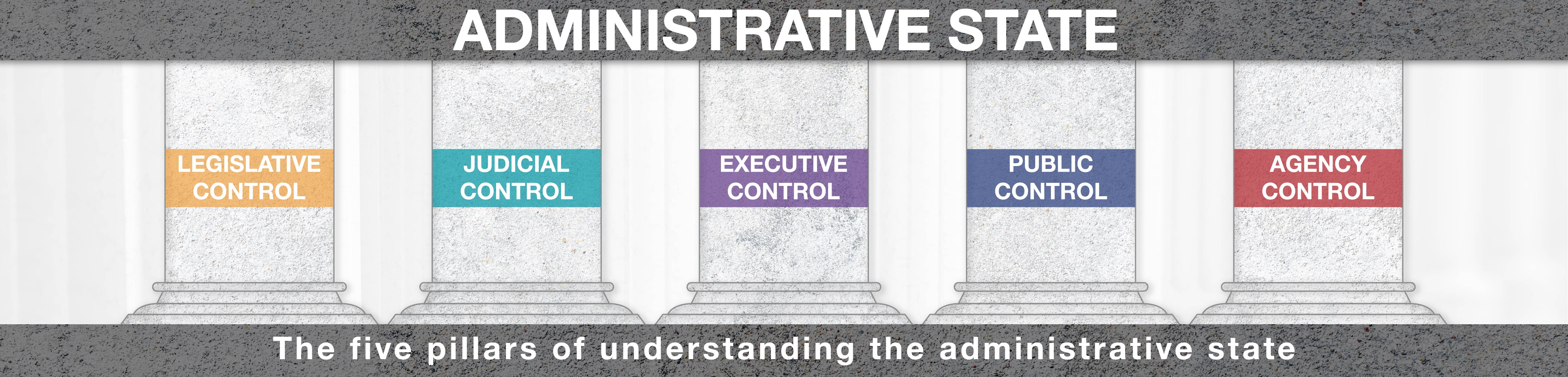
| Five Pillars of the Administrative State
|
• Nondelegation • Judicial deference • Executive control • Procedural rights • Agency dynamics
|
| Click here for more coverage of the administrative state on Ballotpedia
|
May 19, 2020
President Donald Trump (R) on May 19 issued an executive order aimed at providing regulatory relief to spur economic recovery from the coronavirus pandemic. In addition to targeted regulatory actions, the order also contains provisions that seek to promote economic recovery by safeguarding procedural rights and ensuring fairness in agency adjudication and enforcement.
The order puts forth what it deems a set of "principles of fairness in administrative enforcement and adjudication" and directs agencies to comply with the principles where appropriate as part of their pandemic response efforts. The principles include broad standards of promptness, fairness, and transparency in adjudication and enforcement proceedings as well as more specific procedural due process protections, such as requiring that adjudication be free from government coercion and that agency adjudicators be independent of enforcement staff. These principles build on Trump’s October 2019 Executive Order 13892, which aimed to curb what the order referred to as administrative abuses by requiring agencies to provide the public with fair notice of regulations.
“[President Trump] knows that what will jump-start the economy is not Big Government, but the American people,” said White House Office of Information and Regulatory Affairs Administrator Paul Ray in The Washington Times. “That’s why this president is fighting the economic emergency by returning even more liberty to the people.”
Some critics of the order expressed concern that agencies would respond by suspending regulatory enforcement altogether. “That’s the part that gives me the greatest concern, the idea of nonenforcement and telling agencies without any real basis or explanation that more lax enforcement will help us economically,” said Project on Government Oversight senior policy analyst Sean Moulton in The Hill.
Agency adjudication aims to resolve a dispute either between a federal agency and a private party or between two private parties. While some administrative law scholars claim that agency adjudication satisfies constitutional due process, others argue that certain adjudication procedures violate due process protections, such as the appearance of partiality in favor of agencies that results from the use of non-independent adjudicators.
See also[edit]
- Ballotpedia's administrative state coverage
- Adjudication
- Federal administrative adjudicators
- Executive order
External links[edit]
- Search Google News for this topic
[edit]
| The Administrative State |
|---|
| | Main | The Administrative State Project main page • Administrative State Project Index • Glossary of administrative state terms • Quotes about the administrative state • Administrative state • Rulemaking • Deference • Adjudication • Nondelegation doctrine • Ballotpedia's administrative state legislation tracker |  | | | Reporting | Changes to the Federal Register • Completed OIRA review of federal administrative agency rules • Federal agency rules repealed under the Congressional Review Act • Historical additions to the Federal Register, 1936-2016 | | | Laws | Administrative Procedure Act • Antiquities Act • Civil Service Reform Act • Clayton Antitrust Act • Communications Act of 1934 • Congressional Review Act • Electronic Freedom of Information Act • Federal Food, Drug, and Cosmetic Act of 1938 • Federal Housekeeping Statute • Federal Reserve Act • Federal Trade Commission Act of 1914 • Freedom of Information Act • Government in the Sunshine Act • Independent Offices Appropriations Act of 1952 • Information Quality Act • Interstate Commerce Act • National Labor Relations Act • Paperwork Reduction Act • Pendleton Act • Privacy Act of 1974 • Regulatory Flexibility Act • REINS Act • REINS Act (Wisconsin) • Securities Act of 1933 • Securities Exchange Act of 1934 • Sherman Antitrust Act • Small Business Regulatory Enforcement Fairness Act • Truth in Regulating Act • Unfunded Mandates Reform Act | | | Cases | Abbott Laboratories v. Gardner • A.L.A. Schechter Poultry Corp. v. United States • Association of Data Processing Service Organizations v. Camp • Auer v. Robbins • Chevron v. Natural Resources Defense Council • Citizens to Preserve Overton Park v. Volpe • Federal Trade Commission (FTC) v. Standard Oil Company of California • Field v. Clark • Food and Drug Administration v. Brown and Williamson Tobacco Corporation • Humphrey's Executor v. United States • Immigration and Naturalization Service (INS) v. Chadha • J.W. Hampton Jr. & Company v. United States • Lucia v. SEC • Marshall v. Barlow's • Massachusetts v. Environmental Protection Agency • Mistretta v. United States • National Federation of Independent Business (NFIB) v. Sebelius • National Labor Relations Board v. Noel Canning Company • National Labor Relations Board v. Sears, Roebuck & Co. • Panama Refining Co. v. Ryan • Securities and Exchange Commission v. Chenery Corporation • Skidmore v. Swift & Co. • United States v. Lopez • United States v. Western Pacific Railroad Co. • Universal Camera Corporation v. National Labor Relations Board • Vermont Yankee Nuclear Power Corp. v. Natural Resources Defense Council • Wayman v. Southard • Weyerhaeuser Company v. United States Fish and Wildlife Service • Whitman v. American Trucking Associations • Wickard v. Filburn • Wiener v. United States | | | Terms | Adjudication (administrative state) • Administrative judge • Administrative law • Administrative law judge • Administrative state • Arbitrary-or-capricious test • Auer deference • Barrier to entry • Bootleggers and Baptists • Chevron deference (doctrine) • Civil servant • Civil service • Code of Federal Regulations • Codify (administrative state) • Comment period • Compliance costs • Congressional Record • Coordination (administrative state) • Deference (administrative state) • Direct and indirect costs (administrative state) • Enabling statute • Ex parte communication (administrative state) • Executive agency • Federal law • Federal Register • Federalism • Final rule • Formal rulemaking • Formalism (law) • Functionalism (law) • Guidance (administrative state) • Hybrid rulemaking • Incorporation by reference • Independent federal agency • Informal rulemaking • Joint resolution of disapproval (administrative state) • Major rule • Negotiated rulemaking • Nondelegation doctrine • OIRA prompt letter • Organic statute • Pragmatism (law) • Precautionary principle • Promulgate • Proposed rule • Publication rulemaking • Regulatory budget • Regulatory capture • Regulatory dark matter • Regulatory impact analysis • Regulatory policy officer • Regulatory reform officer • Regulatory review • Rent seeking • Retrospective regulatory review • Risk assessment (administrative state) • Rulemaking • Separation of powers • Significant regulatory action • Skidmore deference • Statutory authority • Substantive law and procedural law • Sue and settle • Sunset provision • Unified Agenda of Federal Regulatory and Deregulatory Actions • United States Code • United States Statutes at Large | | | Bibliography |
- "Administrative Law - The 20th Century Bequeaths an 'Illegitimate Exotic' in Full and Terrifying Flower" by Stephen P. Dresch (2000)
- "Confronting the Administrative Threat" by Philip Hamburger and Tony Mills (2017)
- "Constitutionalism after the New Deal" by Cass R. Sunstein (1987)
- Federalist No. 23 by Alexander Hamilton (1787)
- "From Administrative State to Constitutional Government" by Joseph Postell (2012)
- "Interring the Nondelegation Doctrine" by Eric A. Posner and Adrian Vermeule (2002)
- "Rulemaking as Legislating" by Kathryn Watts (2015)
- "The Checks & Balances of the Regulatory State" by Paul R. Verkuil (2016)
- "The Myth of the Nondelegation Doctrine" by Keith E. Whittington and Jason Iuliano (2017)
- "The Progressive Origins of the Administrative State: Wilson, Goodnow, and Landis" by Ronald J. Pestritto (2007)
- "The Rise and Rise of the Administrative State" by Gary Lawson (1994)
- "The Study of Administration" by Woodrow Wilson (1887)
- "The Threat to Liberty" by Steven F. Hayward (2017)
- "Why the Modern Administrative State Is Inconsistent with the Rule of Law" by Richard A. Epstein (2008)
| | | Agencies | Administrative Conference of the United States • United States Civil Service Commission • U.S. Government Accountability Office • U.S. Office of Information and Regulatory Affairs • U.S. Office of Management and Budget |
|
| Ballotpedia |
|---|
| | About | Overview • What people are saying • Support Ballotpedia • Contact • Contribute • Job opportunities
| | | Executive: Leslie Graves, President • Gwen Beattie, Chief Operating Officer
Communications: Alison Graves • Carley Allensworth • Abigail Campbell • Sarah Groat • Nathaniel Harwood • Dillon Redmond • Erica Shumaker
External Relations: Ashley Fleming • Hannah Nelson • Katy Noble
Operations: Meghann Olshefski • Amanda Herbert • Mandy Morris • Caroline Presnell • Kelly Rindfleisch
Policy: Michael Leland • Jon Dunn • Amy Handlin • Jimmy McAllister • Annelise Reinwald • Emma Soukup • William Vogel
Content Strategy: Josh Altic
Tech: Matt Latourelle • Ryan Burch • Kirsten Corrao • Beth Dellea • Travis Eden • Tate Kamish • Margaret Kearney • Eric Lotto • Joseph Sanchez • Mary Susmitha
Contributors: Scott Rasmussen
| | | Editorial Content | Geoff Pallay, Director of Editorial Content and Editor-in-Chief • Ken Carbullido, Vice President of Election Product and Technology Strategy • Norm Leahy, Senior Editor • Daniel Anderson, Managing Editor • Ryan Byrne, Managing Editor • Cory Eucalitto, Managing Editor • Mandy Gillip, Managing Editor • Doug Kronaizl, Local Elections Project Manager • Jaclyn Beran • Marielle Bricker • Joseph Brusgard • Emma Burlingame • Kelly Coyle • Thomas Ellis • Frank Festa • Nicole Fisher • Brianna Hosea • Joseph Greaney • Thomas Grobben • Jaime Healy-Plotkin • Tyler King • Glorie Martinez • Nathan Maxwell • Ellie Mikus • Jackie Mitchell • Ellen Morrissey • Mackenzie Murphy • Kaley Platek • Samantha Post • Adam Powell • Ethan Rice • Spencer Richardson • Victoria Rose • Briana Ryan • Myj Saintyl • Maddy Salucka • Maddie Sinclair Johnson • Abbey Smith • Alexis Thacker • Janie Valentine • Joel Williams • Samuel Wonacott • Trenton Woodcox • Mercedes Yanora |
|