Phosphorine
 From Handwiki
| |||
| Names | |||
|---|---|---|---|
| Preferred IUPAC name
Phosphinine[1] | |||
| Other names
Phosphabenzene
| |||
| Identifiers | |||
CAS Number
|
| ||
3D model (JSmol)
|
| ||
| ChemSpider |
| ||
| MeSH | Phosphinine | ||
PubChem CID
|
| ||
InChI
| |||
SMILES
| |||
| Properties | |||
Chemical formula
|
C5H5P | ||
| Molar mass | 96.069 g·mol−1 | ||
| Related compounds | |||
Related -ines
|
Arsabenzene Pyridine | ||
Related compounds
|
Phosphole | ||
Except where otherwise noted, data are given for materials in their standard state (at 25 °C [77 °F], 100 kPa). | |||
 verify (what is verify (what is   ?) ?)
| |||
| Infobox references | |||

- PairSizeSet
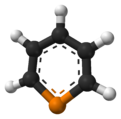
Phosphorine (IUPAC name: phosphinine) is a heavier element analog of pyridine, containing a phosphorus atom instead of an aza- moiety. It is also called phosphabenzene and belongs to the phosphaalkene class. It is a colorless liquid that is mainly of interest in research.
Phosphorine is an air-sensitive oil[2] but is otherwise stable when handled using air-free techniques (however, substituted derivatives can often be handled under air without risk of decomposition).[3][4] In contrast, silabenzene, a related heavy-element analogue of benzene, is not only air- and moisture-sensitive but also thermally unstable without extensive steric protection.
History
The first phosphorine to be isolated is 2,4,6-triphenylphosphorine. It was synthesized by Gottfried Märkl in 1966 by condensation of the corresponding pyrylium salt and phosphine or its equivalent ( P(CH2OH)3 and P(SiMe3)3).[3]
500px|Synthesis of Triphenylphosphabenzene
The (unsubstituted) parent phosphorine was reported by Arthur J. Ashe III in 1971.[2][5] Ring-opening approaches have been developed from phospholes.[6]
Structure, bonding, and properties
Structural studies by electron diffraction reveal that phosphorine is a planar aromatic compound with 88% of aromaticity of that of benzene. Potentially relevant to its high aromaticity are the well matched electronegativities of phosphorus (2.1) and carbon (2.5). The P-C bond length is 173 pm and the C-C bond lengths center around 140 pm and show little variation.[7]
 Bond lengths and angles of benzene, pyridine, phosphorine, arsabenzene, stibabenzene and bismabenzene |
Although phosphorine and pyridine are structurally similar, phosphorines are far less basic. The pKa's of C5H5PH+ and C5H5NH+ are respectively -16.1 and 5.2.[6] Methyl lithium adds to phosphorus in phosphorine whereas it adds to the 2-position of pyridine.[8]
Phosphorine undergoes electrophilic substitution reactions like ordinary aromatic compounds: bromination, acylation, and so on.
Coordination chemistry
Coordination complexes bearing phosphorine as a [ligand] are known. Phosphorines can bind to metals through phosphorus center. Complexes of the diphospha analogue of 2,2'-bipyridine are known. Phosphorines also form pi-complexes, illustrated by V(η6-C5H5P)2.[6]
See also
- 6-membered aromatic rings with one carbon replaced by another group:borabenzene, silabenzene, germabenzene, stannabenzene, pyridine, phosphorine, arsabenzene, stibabenzene, bismabenzene, pyrylium, thiopyrylium, selenopyrylium, telluropyrylium
References
- ↑ "CHAPTER P-1. General Principles, Rules, and Conventions". Nomenclature of Organic Chemistry : IUPAC Recommendations and Preferred Names 2013 (Blue Book). Cambridge: The Royal Society of Chemistry. 2014. p. 47. doi:10.1039/9781849733069-00001. ISBN 978-0-85404-182-4.
- ↑ 2.0 2.1 Ashe, A. J. (1971). "Phosphabenzene and Arsabenzene". Journal of the American Chemical Society 93 (13): 3293–3295. doi:10.1021/ja00742a038.
- ↑ 3.0 3.1 G. Märkl, 2,4,6-Triphenylphosphabenzol in Angewandte Chemie 78, 907–908 (1966)
- ↑ Newland, R. J.; Wyatt, M. F.; Wingad, R. L.; Mansell, S. M. (2017). "A ruthenium( ii ) bis(phosphinophosphinine) complex as a precatalyst for transfer-hydrogenation and hydrogen-borrowing reactions" (in en). Dalton Transactions 46 (19): 6172–6176. doi:10.1039/C7DT01022B. ISSN 1477-9226. PMID 28436519.
- ↑ Greenwood, Norman N.; Earnshaw, Alan (1997). Chemistry of the Elements (2nd ed.). Butterworth-Heinemann. p. 544. ISBN 978-0-08-037941-8.
- ↑ 6.0 6.1 6.2 François Mathey "Phosphorus Heterocycles" in Modern Heterocyclic Chemistry, First Edition, edited by Julio Alvarez-Builla, Juan Jose Vaquero, José Barluenga, Wiley-VCH, Weinheim, 2011. doi:10.1002/9783527637737.ch23.
- ↑ László Nyulászi "Aromaticity of Phosphorus Heterocycles" Chem. Rev., 2001, volume 101, pp 1229–1246. doi:10.1021/cr990321x
- ↑ Ashe III, Arthur J.; Smith, Timothy W. "The reaction of phosphabenzene, arsabenzene and stibabenzene with methyllithium." Tetrahedron Letters 1977, volume 18, pp. 407-410. doi:10.1016/S0040-4039(01)92651-6
- Quin, L. D. (2000). A Guide to Organophosphorus Chemistry. Wiley-Interscience. ISBN 978-0-471-31824-8.
External links
 |  |
Categories: [Phosphorus heterocycles] [Six-membered rings]
↧ Download as ZWI file | Last modified: 04/16/2022 00:48:10 | 2 views
☰ Source: https://handwiki.org/wiki/Chemistry:Phosphorine | License: CC BY-SA 3.0
 ZWI signed:
 KSF
KSF