Economic Importance Of Bacteria
 From Handwiki
 Bacteria are economically important as these microorganisms are used by humans for many purposes. The beneficial uses of bacteria include the production of traditional foods such as fudge, yogurt, cheese, and vinegar. Microbes are also important in agriculture for the compost and fertilizer production. Bacteria are used in genetic engineering and genetic changes.
Useful bacteria
Food processing
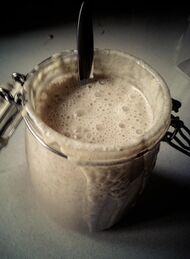
Sourdough bread is made to rise by fermentation, with a leaven that consists of bacteria, often combined with wild yeast enzymes.[1] The milk-souring bacterial genus Lactobacillus is used to make yogurt and cheese. Bacteria are also used to form organic acids in pickles and vinegar.[2]
Biotechnology
Biotechnology involves the use of microorganisms including bacteria in the manufacturing and services industries. These include chemical manufacturing such as ethanol, acetone, organic acid, enzymes, and perfumes. Bacteria are important in the production of many dietary supplements and pharmaceuticals. For example, Escherichia coli is used for commercial preparation of riboflavin and vitamin K.[3] E. coli is also used to produce D-amino acids such as D-p-hydroxyphenylglycine, an important intermediate for synthesis of the antibiotic amoxicillin.[4]
Genetic engineering
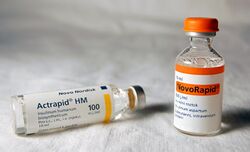
Genetic engineering is the manipulation of gene. It is also called recombinant DNA technology. In genetic engineering, pieces of DNA (genes) are introduced into a host by a variety of techniques, one of the earliest being the use of a virus vector. The foreign DNA becomes a permanent feature of the host, and is replicated and passed on to daughter cells along with the rest of its DNA.[5] Bacterial cells are transformed and used in production of commercially important products. Examples include production of human insulin (used to treat diabetes)[6] and human growth hormone (somatotrophin used to treat pituitary dwarfism).[7]
Fibre retting
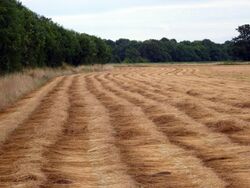
Bacteria such as Clostridium butyricum are used to separate fibres of jute, hemp and flax in the process of retting. The plants are immersed in water and when they swell, inoculated with bacteria which hydrolyze pectic substances of the cell walls and separate the fibres. Alternatively, the plants are spread out on the ground and ret naturally because dew provides moisture. These separated fibres are used to make ropes, sacks etc.[8]
Pest control
Bacteria can also be used in the place of pesticides in biological pest control. This commonly uses Bacillus thuringiensis (BT), a Gram-positive, soil-dwelling bacterium. This bacterium is used as a Lepidopteran-specific insecticide under trade names such as Dipel and Thuricide. Because of their specificity, these pesticides are regarded as environmentally friendly, with little effect on humans, wildlife, pollinators, or other beneficial insects.[9]
Bioremediation
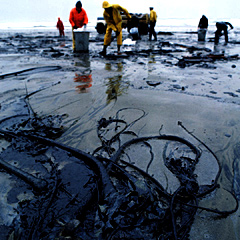
Bacteria can be used to remove pollutants from contaminated water, soil and subsurface material.[10][11] During the Mega Borg Oil Spill, for example, 100 pounds of bacteria were sprayed over an acre of the oil slick to break down the hydrocarbons present into more benign by-products.[12]
Digestion
Bacteria living in the gut of cattle, horses and other herbivores, for example Ruminococcus spp., help to digest cellulose by secreting the enzyme cellulase.[13] This is how herbivores are able to get the energy they need from grass and other plants.[14]
Also, Escherichia coli, part of the intestinal microbiota of humans and other herbivorous animals, converts consumed food into vitamin K2. This is absorbed in the colon and, in animal models, is sufficient to meet their daily requirement of the vitamin.[15]
Leather tanning
Bacteria helps purify animal hides to make them easy, clean, and fit to use.
Medicines
Bacteria are used to create multiple antibiotics such as Streptomycin from the bacteria streptococcus. Bacteria can also be used to create vaccines to prevent several diseases.
Harmful bacteria
Some bacteria are harmful and act either as disease-causing agents (pathogens) both in plants and animals, or may play a role in food spoilage.
Agents of disease
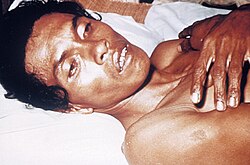
Bacteria cause a wide range of diseases in humans and other animals. These include superficial infections (e.g. impetigo),[16] systemic infections (e.g. typhoid fever),[17] acute infections (e.g. cholera)[18] and chronic infections (e.g. tuberculosis).[19]
Plant diseases caused by bacteria are commercially important worldwide for agriculture. Besides bacterial pathogens that are already established in many areas, there are many instances of pathogens moving to new geographic areas or even the emergence of new pathogen variants. In addition, bacterial plant pathogens are difficult to control because of the shortage of chemical control agents for bacteria.[20]
Food spoilage
Saprotrophic bacteria attack and decompose organic matter. This characteristic has posed a problem to mankind as food such as stored grains, meat, fish, vegetable and fruits are attacked by saprotrophic bacteria and spoiled. Similarly milk and products are easily contaminated by bacteria and spoiled.[21]
References
- ↑ Gadsby, P; Weeks, E. "The Biology of... Sourdough". Discover Magazine. http://discovermagazine.com/2003/sep/featscienceof.
- ↑ McGee, H (2004). On Food and Cooking: The Science and Lore of the Kitchen. New York: Scribner, pp. 291–296. ISBN:0-684-80001-2.
- ↑ Astrologist, VB (1997). Modern Biology. Pitambar Publishing. p. 11. ISBN 978-81-209-0442-2. https://books.google.com/books?id=E_ooNitL-pkC&pg=SA11-PA50.
- ↑ Liese, A; Filho, MV (1999). "Production of fine chemicals using biocatalysis". Current Opinion in Biotechnology 10 (6): 595–603. doi:10.1016/S0958-1669(99)00040-3. PMID 10600695.
- ↑ "How does GM differ from conventional plant breeding?" (in en-gb). https://royalsociety.org/topics-policy/projects/gm-plants/how-does-gm-differ-from-conventional-plant-breeding/.
- ↑ Tof I (1994). "Recombinant DNA technology in the synthesis of human insulin". Little Tree Publishing. http://www.littletree.com.au/dna.htm.
- ↑ "First Successful Bacterial Production of Human Growth Hormone Announced". Genetech. https://www.gene.com/media/press-releases/4161/1979-07-11/first-successful-bacterial-production-of.
- ↑ Rastogi, VB (1997). Modern Biology. Pitambar Publishing. p. 11. ISBN 978-81-209-0442-2. https://books.google.com/books?id=E_ooNitL-pkC&pg=SA11-PA50.
- ↑ "Bacillus thuringiensis crystal proteins that target nematodes". Proceedings of the National Academy of Sciences of the United States of America 100 (5): 2760–5. 2003. doi:10.1073/pnas.0538072100. PMID 12598644. Bibcode: 2003PNAS..100.2760W.
- ↑ Kasai, Y (2002). "Predominant Growth of Alcanivorax Strains in Oil-contaminated and Nutrient-supplemented Sea Water". Environmental Microbiology 4 (3): 141–47. doi:10.1046/j.1462-2920.2002.00275.x. PMID 12000314.
- ↑ "Oil and natural gas eating bacteria to clear-up spills". www.oilandgastechnology.net. April 30, 2014. http://www.oilandgastechnology.net/health-safety-environment-news/oil-natural-gas-eating-bacteria-clear-spills.
- ↑ Compilation. "Oil-eating microbes used to curb supertanker spill." St. Petersburg Times 16 June 1990, sec. NATIONAL: 3A.Lexis Nexis. Web. 21 Jan. 2014.
- ↑ La Reau, AJ; Suen, G (2018). "The Ruminococci: key symbionts of the gut ecosystem". Journal of Microbiology 56 (3): 199–208. doi:10.1007/s12275-018-8024-4. PMID 29492877.
- ↑ "What is cellulose?". BBC. https://www.bbc.co.uk/bitesize/articles/z2d2gdm.
- ↑ "Biosynthesis of vitamin K (menaquinone) in bacteria". Microbiological Reviews 46 (3): 241–80. 1982. doi:10.1128/mr.46.3.241-280.1982. PMID 6127606.
- ↑ Ibrahim, F; Khan, T; Pujalte, GG (2015). "Bacterial Skin Infections.". Primary Care 42 (4): 485–99. doi:10.1016/j.pop.2015.08.001. PMID 26612370.
- ↑ "Typhoid Fever". https://www.cdc.gov/typhoid-fever/.
- ↑ "Cholera vaccines: WHO position paper". Wkly. Epidemiol. Rec. 85 (13): 117–128. March 26, 2010. PMID 20349546. https://www.who.int/wer/2010/wer8513.pdf.
- ↑ "Tuberculosis". https://www.who.int/en/news-room/fact-sheets/detail/tuberculosis.
- ↑ Jackson, RW, ed (2009). Plant Pathogenic Bacteria: Genomics and Molecular Biology. Caister Academic Press. ISBN 978-1-904455-37-0.
- ↑ "What is Food Spoilage?" (in en-us). 2016-03-08. https://www.foodsafety.gov/blog/2016/02/what-is-food-spoilage.html.
 |
Categories: [Bacteria and humans] [Biotechnology]
↧ Download as ZWI file | Last modified: 03/18/2025 12:27:34 | 2 views
☰ Source: https://handwiki.org/wiki/Biology:Economic_importance_of_bacteria | License: CC BY-SA 3.0
 KSF
KSF