Azepine
 From Handwiki
| |||
| Names | |||
|---|---|---|---|
| IUPAC name
Azepine
| |||
| Other names
Azacycloheptatriene
| |||
| Identifiers | |||
CAS Number
|
| ||
3D model (JSmol)
|
| ||
| ChemSpider |
| ||
PubChem CID
|
| ||
InChI
| |||
SMILES
| |||
| Properties | |||
Chemical formula
|
C6H7N | ||
| Molar mass | 93.129 g·mol−1 | ||
Except where otherwise noted, data are given for materials in their standard state (at 25 °C [77 °F], 100 kPa). | |||
 verify (what is verify (what is   ?) ?)
| |||
| Infobox references | |||

Tracking categories (test):
- PairSizeSet
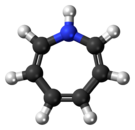
Azepines are unsaturated heterocycles of seven atoms, with a nitrogen replacing a carbon at one position.[1][2]
See also
- Azepane
- Benzazepines
- Diazepine
- Oxepin
- Borepin
References
 |  |
- ↑ Smith, Jason A.; Molesworth, Peter P.; Hyland, Christopher J. T.; Ryan, John H. (2011-01-01), Gribble, Gordon; Joule, John A., eds. (in en), Chapter 7 - Seven-Membered Rings, Progress in Heterocyclic Chemistry, 22, Elsevier, pp. 491–536, doi:10.1016/S0959-6380(11)22016-6, ISBN 9780080966854, https://www.sciencedirect.com/science/article/pii/S0959638011220166, retrieved 2023-01-05
- ↑ Császár, Attila G.; Demaison, Jean; Rudolph, Heinz Dieter (2015-03-05). "Equilibrium structures of three-, four-, five-, six-, and seven-membered unsaturated N-containing heterocycles". The Journal of Physical Chemistry A 119 (9): 1731–1746. doi:10.1021/jp5084168. ISSN 1520-5215. PMID 25340501. Bibcode: 2015JPCA..119.1731C. https://pubmed.ncbi.nlm.nih.gov/25340501/.
Categories: [Azepines]
↧ Download as ZWI file | Last modified: 09/29/2024 14:24:08 | 4 views
☰ Source: https://handwiki.org/wiki/Chemistry:Azepine | License: CC BY-SA 3.0
✘
ZWI is not signed. [what is this?]
ZWI viewer
by the  KSF
KSF
KSF