Dimorphism (Crystallography)
 From Handwiki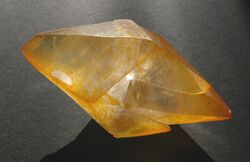
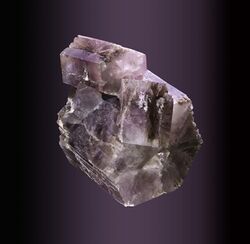
Dimorphism is the property of some minerals to exist in two different crystal systems, while still having the same chemical formula. Examples include CaCO3, which exists as trigonal calcite or orthorhombic aragonite. A mineral's dimorph is the mineral that it is dimorphic with.[1][2] Dimorphism is not to be confused with allotropy, which refers to a difference in crystal structure of pure elements.
Trimorphism & Polymorphism
Trimorphism is the term used when a mineral has a total of three dimorphs,[3] while the term polymorphism is used when there are four or more. Silica, SiO2, is a good example, being found in nature as quartz, tridymite, cristobalite, coesite, and stishovite.[4] Pleomorphism is a synonym of polymorphism.[4]
See also
- Dimorphism (Wiktionary)
- Isomorphism (crystallography)
- Polymorphism (materials science)
References
- ↑ "Definition of dimorphism - mindat.org glossary". http://www.mindat.org/glossary/dimorphism.
- ↑ "Dimorphous - Minerals.net Glossary of Terms". http://www.minerals.net/mineral_glossary/dimorphous.aspx.
- ↑ "Definition of trimorphism - mindat.org glossary". http://www.mindat.org/glossary/trimorphism.
- ↑ 4.0 4.1 "Definition of polymorphism - mindat.org glossary". http://www.mindat.org/glossary/polymorphism.
 |
Categories: [Mineralogy] [Crystallography]
↧ Download as ZWI file | Last modified: 03/27/2024 20:08:27 | 23 views
☰ Source: https://handwiki.org/wiki/Physics:Dimorphism_(crystallography) | License: CC BY-SA 3.0
 KSF
KSF