Global Flood
 From Rationalwiki
| Rescued from the Global Flood |

|
| Twelve of the clean kind |
“”Just sit right back and you'll a hear a tale, a tale of a fateful trip — that started from this tropic port, aboard this tiny ship…
|
| —Apologies to that awesome sitcom creator, Sherwood Schwartz. |
The global flood is a (fairly self-descriptive) catastrophic mythical event recounted in the book of Genesis. The narrative in the scripture tells the story of a great flooding of the entire antediluvian (pre-Flood) world, in which every last human and animal died, except for the ones saved on the Ark, a vessel constructed at God's command by Noah. The flood, according to the Bible, was brought on because every person in the whole world — except eight people God chose — was wicked and needed to be killed. The type of wickedness is left unclear so believers are free to develop imaginative ideas.[1] The narrative does not specify if very young children, babies (or even the unborn!), and almost all the world's animals were killed because they were wicked or if they were just collateral damage (Genesis 6:8).
The majority of modern biblical scholars interpret the flood story allegorically; for example, they see it as a lesson of God's mercy toward the faithful (Noah and his family). To be fair, his mercy was pretty thin on the ground for every other human on the planet. Fundamentalists, on the other hand, insist on the literal historicity of the flood account — because if this was made up, then the historicity of the rest of the Bible is in doubt. From this assertion, the entire "science" of flood geology has evolved. As a result, the global flood and the supposed geological facts to back it up are an integral part of young earth creationism and "creation science".
Many other flood myths have existed throughout history in many cultures, but most of these likely arose independently, as virtually all of them originated in societies that resided near regularly flooding bodies of water. Generally the myth of the global flood refers to the one of Noah and the Ark in Judeo-Christian mythology.
Physical scale[edit]

The story of a global flood occurs as a common myth in many cultures. Some speculate that such myths originate in real historical floods, possibly in the Caspian region, which is known to have been prone to epic floods, and which lies in the right region for Biblical legends (not too far from Ararat). While the myth is best explained by a large but still localised flood, Biblical literalists portray the global flood as covering the whole of the Earth so that no dry land could be found anywhere on the planet. This would be possible only if accompanied by extreme erosion that had flattened most of the land so that there were no mountains rising above the floodwaters.
But the literalist Young-Earth timescale of around 6000 years rules out this possibility. Thus the scale of the mythological flood should be considered given the current land-mass of the Earth. This has some interesting implications if we assume that the Deluge really happened.
How global is global?[edit]
Genesis chapters 6 to 9 relates that the archetypal flood covered the whole eretz — sometimes translated from Biblical Hebrew as "earth" or "Earth". But…
the connotation which the English word "earth" has may not be quite the same as the Hebrew connotation of eretz. Of the usages of eretz, it is translated "land" 1,458 times and "earth" 677 times. In at least 100 occurrences where it is translated earth, it could just as easily be translated "land."[2]
As in English, Hebrew eretz can apply to land (Eretz Israel, Iceland), the third planet from the Sun, and soil. (The similarities of the words earth and Eretz are mere coincidence. English earth is a proven cognate of Dutch aard and German Erde, but any similarity between two words in English and Hebrew are either coincidence or the result of unlikely borrowings). The confusion between meanings of either word that looks like Earth is to be expected among people who do not know whereof they speak and write, as is shown in the overwhelming bulk of "young-earth creationism" drivel.
So some doubt exists as to whether the Global Flood inundated an entire planet — or just the "known world" of some land where the mountains may not have rivaled Everest.
Volume of water[edit]
Assuming that there was no magical transformation of the landscape between the time of the flood and the present day — a reasonable assumption considering the time frame — the floodwaters would have to raise the sea level to the height of Mount Everest, at least, in line with the Biblical description stating that the waters came up higher than the highest mountains. This is around 8.84 km above current sea-level. Since the volume of land is small compared to the total volume of water that would be required for such a flood (oceans cover 71% of the Earth's surface and the average height of land is only about 800 metres), an easy calculation shows that the amount of water needed to achieve this would be at least 4.5 billion cubic kilometres. The current volume of the Earth's oceans combined is estimated at only 1.3 billion cubic kilometres. This raises the question of where that much water came from, and more importantly, where did it all go?
The volume-of-water problem seems to diminish when one recalls that the Earth of the authors/compilers of the literal Bible consisted of a flat area covered by a dome-shaped structure called "the heavens".[3][4] There remains the problem of how something (a global flood, perhaps?) turned a small flat Earth under a dome into today's spheroid planet in a vast universe…
Peer-reviewed research published in New Scientist in 2014 suggests "A reservoir of water three times the volume of all the oceans has been discovered deep beneath the Earth's surface."[5] Though the "water" would be in the form of hydrates (water bound in to rock), not a subsurface ocean.[5] We await further research on whether this approximately 4 billion cubic kilometres of water actually exists.
Precipitation[edit]

The conventional flood story states that the flood waters came from rain that lasted 40 days and 40 nights (Genesis 7:12).[note 1] Rain appears when the atmosphere can no longer support water in the vapor phase and it becomes saturated. Normally, the atmosphere is on the brink of saturation, and the variations in temperature and pressure caused by weather fronts are capable of altering the threshold at which precipitation will form quite easily. What about the amount of water vapor suspended in air needed for the 4.5 billion cubic kilometers of water needed for the global flood? The water vapor currently in the air is only around 2 to 3 percent on average, with a maximum of 4% limited by temperature and pressure.[6] The change in atmospheric conditions required to support enough vapor for 112 million cubic kilometers of rain per day — about 120,000 times more than the current daily rainfall worldwide[7] — would have rendered the air unbreathable.
Indeed, the atmosphere really couldn't sustain that much water even under the most extreme temperature and pressure conditions the planet can produce. If the conditions were right for that much water to be in the atmosphere, humans and virtually every other animal would have drowned through the simple act of breathing, as well as turning the earth into the equivalent of a pressure cooker with atmospheric pressure at nearly a thousand psi instead of the standard 14.7 or so that we have today. In fact, the pressure would have to be at least a thousand atmospheres to fit the 15 kilograms of water per cubic meter required to produce that much rain, which is 1) greater than the pressure at the bottom of the ocean and 2) enough to crush a human so five of them would fit in a soda can. Barring the goddidit escape hatch (a tried and tested fallback for creationists everywhere), this is impossible.
Hydroplate "theory" and other nonsense[edit]
More recent theories have seen creationists try to get around this by either placing the water underground, positing an ice or vapor canopy above the atmosphere, water being contained in sealed chambers, or by having comets bring the water. This is despite the Bible not really describing the flood as such — in fact, they have to make a very loose interpretation of the firmament noted in Genesis for this to work. They still ignore several factors, however. When placing the water beneath the Earth, the only viable method for releasing it is as steam,[8] which proceeds to sterilize the planet regardless of whether or not one is in a giant wooden boat. Furthermore, the force required to lift that much rock through more rock at a rate of around 15 km a day would literally break the planet.
This also gave rise to Lunar bukkake theory, whereby this action causes water to be thrown up, out of the Earth's gravitational pull (breaking conservation of momentum in the process) and causing the craters on the Moon and other parts of the Solar System. Aside from having no physically possible method to exist in the first place, an ice or vapor canopy would convert all of its orbital potential energy into kinetic energy when it collapsed, thereby poaching Noah and all the critters like eggs. Cometary impacts on the order needed to provide the water would have been many times the energy of the K-Pg Extinction event, making the resultant flood unnecessary in wiping out life on the planet.
Hydroplate theory is a pseudoscientific attempt to explain where the water required for the purported flood came from. Notably, it ignores the equally important question of where all the water went afterwards. Answers in Genesis attempts to handwave both issues via the claim that much less water was required than it might appear, as all the land we know today was *ahem* in fact raised out of the oceans, rendering the flood moot if not technically causing the waters to recede.[9]
Issues with the Ark[edit]
Central to the myth of the global flood is the story of Noah and his Ark. Indeed, the Ark plays as much of an important role in the story of the flood as the water and flood itself — and is equally, if not more, unfeasible than the flooding. The general outline states that God warns Noah of the impending catastrophe and instructs him to spend years building a great Ark to save animals from extinction. The Ark rides the waters for the duration of the flood while everything else, including the fish (not very good swimmers, apparently!), drowns. As a result, only Noah's family and two of every animal (Or fourteen, depending on which biblical story you believe) survive the flood and, despite the genetic bottleneck this would have caused, the world is happily repopulated.
Gathering the animals[edit]

There are two versions of this story. In Genesis 6:19-21, God tells Noah to bring in two of every animal on the Earth. But then in Genesis 7:2-3, God tells Noah that he is to bring seven of every clean animal[note 2] and two of every unclean animal onto the Ark. (The "clean" and "unclean" distinction would have been defined along the rules of what is or isn't kosher). The flood story most often taught in Sunday School is the first version, that two of every "kind" of animal were present on Noah's Ark (and omitting the second version).[10]
This poses an incredible, most likely unsolvable, logistical problem. Noah would have never been able to travel all over the world and gather up every animal he needed on his Ark. Even if he didn't have to, and God just made the animals set out randomly for Mesopotamia, it still wouldn't have worked. Some animals would have had to make incredible journeys all the way from places like South America and Australia.[11] This is impossible; most creatures would have faced insurmountable difficulties getting to the ark. In addition, millions of species fitting into a single wooden boat would completely defy reality.
Some animals can't swim which would make a journey from lands not connected to Mesopotamia impossible.[12] Other animals move so slowly they would have died before they got to the Ark. Creatures like dodo birds, that came from sheltered habitats and had never had to deal with predation before, would have been preyed upon mercilessly by superior predators such as wolves and the great cats. Some animals, like koalas, require special diets only found in certain places in the world, and if they had left the habitat where their food grew, they would have starved to death.[12] And there are millions of species in the world, mostly arthropods.
Why are aquatic animals including fish, sponges, and corals left out of the equation? Is it assumed they'll have a good time in the flood, even though they won't? Did Noah collect them all? Or just a few thousand, which speciated absurdly quickly in five thousand years? This would be an amusing claim from people who frequently assert that evolution couldn't possibly happen fast enough to explain the emergence of new forms over millions of years.
Knowing which animals were "clean"[edit]
According to Genesis chapter 7, Noah had to take seven couples of clean beasts and just two of unclean beasts. (Genesis 7:2-3) (contradicting Genesis 6 which orders to take just one couple of each beast on the Earth) But the animals were not categorized before Moses and his law (Leviticus 11; Deuteronomy 14). How was Noah able to know this more over 1200 years earlier? (According to biblical chronology, the Great Flood occurred around 2400 BCE, and the law was given around 1200 BCE.) And if this distinction was given by God to Noah (a creationist claim), why didn't it survive after him, before Moses, and was only followed by Noah?
Caring for the animals[edit]

Caring for the animals on Noah's ark would also have been impossible. Simply feeding them would have been more than Noah and his family could have managed. However, the lions, tigers and bears (oh my!) would have had their pick of any number of (now extinct) species (and even each other!) when the Noah clan was tardy in bringing the grub below decks. And just what did they feed all those voracious carnivores if they had to keep pairs of all the other animals alive? Did Noah invent the deep-freeze?[13]
Aquatic species survival[edit]
There was no marine life on the ark, so each observable aquatic species that we see today, according to the flood myth, had to have survived the 376[14] days of the flood. This is extremely unlikely, as a complete flooding of the Earth would produce such drastic ecological changes that most aquatic species would die off.[15]
Since most fish are sensitive to changes in water salinity, when the rising saltwater oceans mixed with the freshwater lakes and rivers (and rain!), both fresh water and salt water species would have died.[16] The extreme turbulence would have also killed fish that stayed near the ocean floor; small fish that live on reefs would have been repeatedly pounded against rocks and mud.[17] And many fish would have choked to death on sediment stirred up by the flood as well.[15]
Fresh-water fish existed both before and after the Flood, so to save them in accordance with God's directive to save mating pairs of all creatures, Noah would have had to travel around the world and collect fresh water fish (which in Biblical parlance includes such invertebrates as mussels and crabs), take them safely to the site of his Ark, build a sophisticated aquarium (with glass or metal walls) and such technology as aerators. Frogs might have been taken, too. Lots of luck on that, as no mention is made of Noah using metal or glass in any part of his Ark. He would have also had to return fresh-water creatures to the places whence they came at the appropriate time (after the salt disappeared, but while he still had access to fresh-water lakes, rivers, and ponds.
Integrity of Noah's Ark[edit]
During the great flood, Noah's Ark would have faced the most brutal weather in the history of the world. A "study" by Answers in Genesis asserts that the Ark could have withstood waves of up to 30 meters high without overturning.[18] Waves in modern ocean storms can reach heights of up to 31 meters.[19] With the entire world flooded, we would be likely to have seen waves of a much greater magnitude. With an unlimited fetch, waves could possibly have reached miles in height.[20] However, it seems likely that a wooden vessel, even of the most conservative of estimates (though still larger than most, if not all, ships in the height of the wooden saily thing era) in size, would not have been able to survive for long at sea, certainly not for 40 days, or perhaps even 4, as the timbers would have warped, water leaked in, and sunk the damn thing, saving us a lot of trouble. God may have been slightly embarrassed, though.
Things that happened during the Great Flood[edit]

The 3rd millennium BCE spans the Early to Middle Bronze Age. It represents a period of time in which imperialism, or the desire to conquer, grew to prominence, in the city-states of the Middle East, but also throughout Eurasia, with Indo-European expansion to Anatolia, Europe and Central Asia. The civilization of Ancient Egypt rises to a peak with the Old Kingdom. World population is estimated to have doubled in the course of the millennium, to some 30 million people.
Overview[edit]
The previous millennium had seen the emergence of advanced, urbanized civilizations, new bronze metallurgy extending the productivity of agricultural work, and highly developed ways of communication in the form of writing. In the 3rd millennium BCE, the growth of these riches, both intellectually and physically, became a source of contention on a political stage, and rulers sought the accumulation of more wealth and more power. Along with this came the first appearances of mega-architecture, imperialism, organized absolutism and internal revolution.
The civilizations of Sumer and Akkad in Mesopotamia became a collection of volatile city-states in which warfare was common. Uninterrupted conflicts drained all available resources, energies and populations. In this millennium, larger empires succeeded the last, and conquerors grew in stature until the great Sargon of Akkad made a bunch of tedious videos pushed his empire to the whole of Mesopotamia and beyond. It would not be surpassed in size until Assyrian times 1500 years later.
In the Old Kingdom of Egypt, the idea of absolute ambition was further defined by conquerors. Military expeditions were sent throughout the kingdom to bring back thousands of slaves at a time. The Egyptian pyramids were constructed during this millennium and would remain the tallest and largest human constructions for thousands of years. Also in Egypt, pharaohs began to posture themselves as living Gods made of an essence different from that of other human beings. Even in Europe, which was still largely neolithic during the same period of time, the builders of megaliths were constructing giant monuments of their own. In the Near East and the Occident during the 3rd millennium BCE, limits were being pushed by architects and rulers.
Towards the close of the millennium, Egypt became the stage of the first popular revolution recorded in history. After lengthy wars, the Sumerians recognized the benefits of unification into a stable form of national government and became a relatively peaceful, well-organized, complex technocratic state called the 3rd dynasty of Ur. This dynasty was later to become involved with a wave of nomadic invaders known as the Amorites, who were to play a major role in the region during the following centuries.
Events[edit]

- Syria: Foundation of the city of Mari (2900 BCE)[21]
- Iraq: Creation of the Kingdom of Elam[22]
- Germination of the bristlecone pine tree "Methuselah" about 2700 BCE, the oldest known living tree[23]
- Founding of Lagash in Sumeria[24]
- Golden age of Ur in Mesopotamia. (2474–2398 BCE)[25]
- Ancient Egypt's Old Kingdom period (2600 BCE –2100 BCE)[26]
- Unified Indus Valley Civilisation (2600 BCE)[27]
- Indo-Europeans first invade Greece (2300 century BCE)
- Megalithic, Corded Ware culture and the Beaker people flourish in Europe.
- Mid- to late 3rd millennium, Hellenic immigration to the Greek mainland.
Environmental changes[edit]
- Major migration of Central Saharans into West Africa possibly due to climate change starting in 4th millennium BCE.
Significant persons[edit]

- Djoser, king of Egypt, commissions the Step Pyramid at Saqqara.[28]
- Gilgamesh, fifth king of the 1st Dynasty of Uruk, immortalized in the world's first literary work The Epic of Gilgamesh (ca. 2600 century BCE)
- Khufu, king of Egypt, builder of the Great Pyramid of Giza[29]
- Urukagina, king of Lagash, creates the first known judicial code. (24th century BCE)[30]
- Lugalsaggizi, king of Uruk and Umma conquers Lagash (2371–2347 BCE)[31]
- Sargon the Great, founder of the empire of Akkad and Sumeria (2371–2316 BCE middle chronology)[32]
- Ur-Nammu founder of the 3rd dynasty of Ur (2112–2095 BCE middle chronology)[33]
- The Three August Ones and the Five Emperors of China
Cultures[edit]
- Old Elamite period (ca. 2700–1600 BCE)
- Corded Ware culture (also Battle-axe culture, or Single Grave culture)
- Late Maikop culture
- Late Vinca culture
- Late Funnelbeaker culture
- Baden culture
- Globular Amphora culture
- Early Beaker culture
- Yamna culture, Catacomb culture, likely loci of Indo-European Satemization.
- The Sintashta-Petrovka-Arkaim culture emerges from the Catacomb culture from about 2200 BCE, likely locus of Proto-Indo-Iranian.
- Old Copper Complex of the Great Lakes region.
- According to historical linguistics, the Proto-Algonquians would've lived around this time period.
- Early to Middle Minoan civilization.
- Not counting the Proto-Indo-Europeans, whom lived around 4000 BCE, nearly 2000 years before the supposed flood ever took place.
Inventions, discoveries, introductions[edit]
- Pottery developed in the Americas (3000 BCE)[34]
- The Chinese record a comet
- Building of the Great Pyramid of Giza (2600 BCE)
- Sails used on ships (2000 BCE)
- First ziggurats built in Sumeria
- Near East civilizations enter Bronze Age around 3000 BCE
- Oldest known medicine wheel constructed in the Americas
- Bronze and metallurgy introduced to Ireland.
- The chariot emerges in Central Asia just before 2000 BCE
Cultural landmarks[edit]
- Completion of the Great Pyramid of Giza
- Completion of the first phase of the Stonehenge monument in England
- Era of the Buena Vista pyramid / observatory in Peru
Fragile geological formations[edit]
The global flood, had it occurred, would have destroyed many geological formations. If you look at pictures of the ocean floor, you will notice there are very few rocks piled up in columns. A study done by several creation "scientists" puts the ocean speed at varying between 40 and 80 meters a second.[35] Rock pillars are unable to survive currents this fast. Even oceanic currents of normal speeds would have destroyed some of the more fragile specimens that are in existence today.
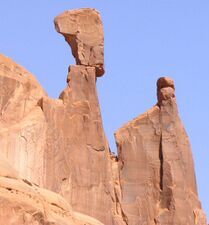
Queen Nefertiti Rock in Arches National Park, Utah.
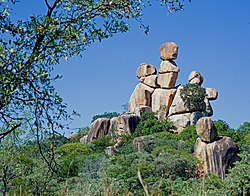
The Balancing Rocks
 of Matopos National Park, Zimbabwe.
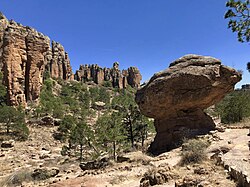
A fragile formation in Mexico's Sierra de Órganos National Park


Fossil layers[edit]


When faced with the existence of literally millions of annual geological layers deposited one on top of the other in the Earth, many young Earth creationists (YECs) insist that it was the Global Flood that deposited these layers.
How was the fossil record sorted in an order convenient for evolution if they were laid down in the turmoil of a single flood? That is usually dismissed with a hand wave by saying the animals quickly sorted each other out based on their ability to compete for the shrinking high ground.
It overlooks an important issue: Since fossil layers were really constructed over millions of years, there was sufficient time to accumulate a consistent layer of corpses from many many generations of animals over wide areas. You could dig up a layer of trilobite fossils in Boise, for example, and it would have the same density of trilobite fossils as the same layer in Kansas City. So if you read the Noah story back into this observation, the antediluvian world must have been wall-to-wall trilobites, not to mention all the other animals in the other layers. In fact, there must have been far more animals than the biosphere could reasonably be expected to support, all because YECs compress a billion years of fossil building into a few weeks.
The explanation also fails to take into account fossilized plants, which show the same type of order as animal fossils, and which are not noted for their ability to flee rising floodwaters.[citation NOT needed] Repeating series of layers within coal measures indicate cycles of sedimentation rather than being laid down as part of one single event. The huge Carboniferous limestone strata, which consist of the remains of innumerable marine shells, require long periods of clean water. Any flood would have mixed the remains with silt and sand to give us the grey cliffs of Dover rather than the white ones we see today.
It also fails to explain why fossil layers form hard cutoffs, rather than statistical tendencies. Where are the weak or injured "climbers" lower down in the fossil record? One would expect individual animals within a species to have different physical capabilities, and so would settle at different levels, but this is never observed: any given species' fossils are found within a very narrow band in the fossil record, and never before or after.
Post-flood animal survival[edit]

After the flood, the animals on the ark would have faced extreme difficulties. Populations of less than 20 members are almost certainly doomed to extinction.[36] After the ark, there would have been 2 of most animals and 7[note 3] of a few select mammals plus 14 of all birds.[37] These animals would have faced some of the harshest conditions the world has ever known. A flood of 376 days[38] would have killed all plant life, while ocean currents between 40 to 80 meters per second would have swept everything away and buried the earth under a layer of sediment.[35] That's not even considering how long it would have taken the waters to recede. Because the entire planet is now water, the floodwater can't drain anywhere, and can only be removed with evaporation. Based on the 2mm/day evaporation rate of water, it would have taken 4 billion and 420 million days for the floodwaters to all evaporate. If the earth is covered in water for 12.1 million years, everything we know and love as an animal is most definitely dead, including Noah.[39]
The post-flood herbivores would have had absolutely nothing to eat; most of them would have starved to death. Creationists claim that the great flood deposited meters of sediment all over the earth.[40] Seeds heavier than silt particles would have been the first to settle, buried far deeper than the few inches of depth that seeds need to sprout.[20] The few seeds that did get buried close enough to the surface to sprout would not provide nearly enough vegetation to sustain every herbivore on the ark, even if they survived the yearlong immersion in brackish water. Many animals feed on large trees or their fruit, so these would have to fast a long time after the flood ended.[note 4]
The carnivores and omnivores on Noah's Ark would have a viable source of food, for a while at least: the other animals on the ark. The carnivores and the omnivores would have quickly eaten all the herbivores and then within a couple of months would turned on each other (The carnage!) and also eventually have starved to death. The creationist explanations for this make no sense; they claim that carnivores ate corpses, fungi, and even vegetables! Animals will rarely eat corpses more than a month old. The claim that these animals would have gladly eaten corpses that were over a year old and most likely buried under meters of sediment is beyond reason. Most carnivores are unable to eat vegetables (if it were then it would already be a part of their natural diet and thus they wouldn't be carnivores in the first place), and fungi do not grow too prolifically in the Middle East.
After the floodwaters subsided, the animals would have had severe trouble finding fresh water and would have died of dehydration. The flood would have salinated the soil, so all water runoff would have had high concentrations of salt. Most animals, unless they are specially adapted, cannot and will not drink salt water.[41]
The survivors of the ark would also have faced extreme difficulties breeding. The flood would have destroyed the structures necessary for reproduction. Avian species like the eagle require high trees to make their nests in.[42] These would not exist for many years after the flood, by which time the reproductive fitness of the birds would have deteriorated, leading to the extinction of that kind.
Post-flood plant survival[edit]
In line with the usual bias that people totally forget about non-animals when it comes to talking about life (i.e., Plantae, Fungi, Protista, Archaea, Bacteria, or whatever the current version of taxonomical structure says), no one thinks what happens to the plants? Apart from the context of feeding the animals, plants are almost completely ignored. This might be hand-waved, as the story concludes with Noah sending out a dove to search for land. It subsequently returned with an olive branch (Genesis 8:10), as if somehow the plants had all miraculously survived and the water left no mark as it drained away (one of the massive plot holes in the Genesis story). Often enough, plants do survive intense flooding, and flood plains may even benefit from it. However, with the massive turbulence, excessive sediment, the 8.84 km depth of water[note 5] that would have blocked out all sunlight to the dry land (which would now be infused with salt deposits), and the year-long duration of the flood, this simply doesn't work. Everything would have been completely wiped out.
After this, many species of non-animal life would go extinct as at no point in the story is Noah concerned with preserving seeds, cultivating bacteria or keeping specimens of fungi. Assuming he was, and that this was just left out of the Bible for some reason, then that only heaps more work onto an already hilariously implausible task. Plant life would undoubtedly have been eradicated along with animal life on Earth, so the only hope for any future plant life would have been from any seeds that had survived. Seeds of land plants tend to spontaneously germinate in water and, without good soil to embed in, die pretty quickly. Aquatic plants have mixed results when their seeds are stored in water: while they are certainly in the right environment, many do not remain viable after more than 6-7 months soaking in water without germinating — so how could they possibly have survived the flood?[43]
Even then, assuming that seeds survived, the conditions would almost certainly not have been amenable for the regrowth of vegetation. The masses of silt and debris would have been fairly uniform across the world — the flood was global, remember? — yet different plants have adapted for different conditions and different soil types. In order to reproduce and spread, many plants need a symbiotic relationship with animals or insects for pollination and seed dispersal. Often this can be remarkably specific, with only one species of plant working with one species of insect. While some plant species can pollinate and disperse seed just with the wind, an environment reduced to only a few individuals spread across the entire planet, in hostile conditions, is hardly conducive to this.
In short, the problems with the animals are actually the least of the problems with the flood story. Plants are the first rung of the trophic scale, directly photosynthesising solar energy into food, and as a byproduct are what convert choking carbon dioxide into breathable oxygen. Without the ability to sustain a full plant-based biosphere throughout the flood, Noah's task would be futile!
Re-population[edit]

The global flood story requires that only eight people were left alive in 2349 BCE, given the standard Ussher chronology.[44] Beside the fact that three brothers and their wives were said to be the ancestors of everyone alive today (and up to 7 for every "kind" of animal on the planet), this simply does not allow enough time for humans or animals to repopulate the earth given reasonable population growth rates.[45] In 2000 BCE, only 350 years after the flood, the population of the world was 27 million.[46] To go from a population of eight to a population of 27 million in 350 years would require an average annual population growth rate of 4.4%[note 6] — which is only slightly short of the highest birth rates in the world today.[47] However, birth rate and population growth aren't the same thing, and such a high birth rate implies reasons for people to have lots of children very young. The countries with the highest birth rates today have high rates of infectious disease and death, low life expectancy, and political instability, with a median age of 15 and a population growth rate well below the birth rate. This does not much resemble the society of superhumanly-long-lived fathers of nations claimed to have lived over that interval, but stable societies where children can be reliably expected to reach adulthood tend to have much lower birthrates.
A worse problem is the requirement for three couples to produce enough descendents in just a century to build the Tower of Babel.[44] Since the Tower was more threatening to God than things like the Great Pyramid (which had a workforce of some 30,000 people[48]), it would reasonably have to be at least as large a project. Multiplying the population 5,000-fold in 100 years to produce enough workers would take an annual growth rate of around 9%. This is near the edge of what is biologically possible for humans, and would require most women to spend most of their reproductive years pregnant, particularly their early years. It would still require rather low infant and mother mortality, which is beyond the means of bronze-age technology, and it would produce a society with a median age of around seven years, with each adult having several young children to care for. This wouldn't seem to be very conducive to megastructure-building.
An even more severe problem is that sexually reproducing species reduced to a population of eight individuals often experiences a catastrophic (and almost certainly extinguishing) genetic bottleneck; and the more rapid the re-expansion of this population, the more intense the inbreeding and the greater the rate of propagation of harmful recessive traits. Only in the extremely implausible case in which all six individuals happened to have no or very few harmful recessive traits might there be a possibility of repopulation without serious consequences to the species' survival — but this case would not explain the existence of known recessive genetic disorders. Considering these disorders and other polymorphisms, there are too many alleles in modern humans to possibly be accounted as the heritage of six individuals, who could at most pass on twelve versions of a particular gene. Genetic studies have actually revealed the presence of a genetic bottleneck in human prehistory[49][50] but that scenario is about 66,000 years too early and at least 2,000 people too populous for the Flood narrative.
The Americas[edit]
Throwing out a few of the more extreme aspects of the flood, there are still some problems. Even if the flood only covered the tallest Near-East mountains, like Mt. Ararat, that still amounted to a flood that was 5100 meters (17,000 feet) above mean sea-level, which would cover all the Americas except for certain peaks in the Andes and Alaska, and there would have been little time for all those people to prepare a year's worth of food and migrate to the high ground under conditions that would dump 5100 meters of water in 40 days. So the Americas would have been completely depopulated. Since the flood is a supposedly recent event, there would have been no land bridge between Russia and Alaska[51] to bring in fresh ancestors of the Native American people we have today. Unless of course Noah stopped by the Americas (and possibly Australia with a similar argument) to station an unnamed son and a similarly unnamed daughter-in-law over there, which pretty much make Noah the discoverer of the New World and probably the first person to circumnavigate the earth 3000 years before Ferdinand Magellan did.
Japan[edit]
Interestingly, some 19th century Japanese scholars, most notably Hirata Atsutane and Motoori Norinaga, used the global flood legends of other parts of the world to argue for the supremacy of the Japanese gods and Japanese people, who have no flood story.[52] They claimed that the fact that Japan experienced no flood showed that it was both the highest point on Earth and, combined with other factors, also the 'centre', insofar as the surface of a globe has one, making it the closest place on Earth to the realm of the gods. This to them demonstrated the veracity of the Japanese creation myth, in which Japan comes first and foremost.
Rainbow[edit]

In Genesis 8, shortly after the flood, God created a covenant with man saying that he will never again send a flood to kill all life. To seal this covenant, the Bible claims God created the rainbow, implying that there never was a rainbow before the flood.[53] To the ancient Hebrew authors of this narrative, who were completely ignorant of modern science and believed the rainbow to be a physical object, this would have seemed perfectly plausible, but under the scrutiny of modern science this idea makes no sense. There are only three possible scenarios that create an environment where rainbows would not form.
- There was no rain.
- The Biblical text states that a dew would water the ground each morning. This would imply that it did not rain within the time frame of the narrative. A scientific manner to test this assertion would be to prove or disprove the arising implications such statement would have.
- There was no sunlight.
- The overwhelming share of terrestrial life is dependent on sunlight; in this scenario, all this life would obviously have died. The remaining few species of microbes that get their energy from hydrothermal vents would have been killed by the turbulence.
- Light did not refract.
- If light did not refract, sight would be impossible. It is light refracting in the lens of the eye that allows sight by focusing the light onto the retina.[54]
The only other possibility would be that, somehow, God managed to make it so that light did refract, just not through water. How this is at all possible is anybody's guess.
Other oddities in the narrative[edit]
Number of animals[edit]
The Bible is contradictory about the number of animals Noah had to take.[55] Genesis 6 states quite clearly that Noah had to take two of every sort including two of the fowls:
- And of every living thing of all flesh, two of every sort shalt thou bring into the ark, to keep them alive with thee; they shall be male and female. Of fowls after their kind, and of cattle after their kind, of every creeping thing of the earth after his kind, two of every sort shall come unto thee, to keep them alive. (Genesis 6:19-20)
Genesis 7 agrees partly with Genesis 6 but it says that, instead of two of the fowls, Noah was to take seven of the fowls:
- Of every clean beast thou shalt take to thee by sevens, the male and his female: and of beasts that are not clean by two, the male and his female. Of fowls also of the air by sevens, the male and the female; to keep seed alive upon the face of all the earth. (Genesis 7:2-3)
Sons of God[edit]
The first two verses in Genesis 6:1-2 contradict 2000 years of church teaching as well as the Bible itself.
- And it came to pass, when men began to multiply on the face of the earth, and daughters were born unto them, That the sons of God saw the daughters of men that they were fair; and they took them wives of all which they chose.
The "Contemporary English Version" of the Bible describes the sons of god as "supernatural beings" (Genesis 6:4), but this is a disingenuous translation, as the Hebrew clearly says, "בני האלהים" / "בְּנֵ֤י הָֽאֱלֹהִים֙" / "bənê hā’ĕlōhîm" / "the sons of Elohim" / "the sons of God/ the gods".[56]
Human lifespan[edit]
- Main article: Biblical longevity
After God has seen how wicked humanity is, he decrees an upper limit on the age of humans.
- "...their days will be a hundred and twenty years."[57]
This statement is contradicted by Noah living 350 more years after the flood (Genesis 9:28). Although he and any other exceptions (Genesis 11:11-32) may have been grandfathered in. While the 120 years figure is often touted as the rough maximum age for humans, modern humans have been documented as living slightly more than 120 years. Specifically the record is held by Jeanne Calment, who died aged 122.[58] This record is likely to be broken in the future as more people than ever are living beyond 100.
The exact meaning of "their days will be 120 years" is disputed. The New Living Translation translated it as "their normal lifespan will be no more than 120 years". Perhaps coincidentally, this translation came out in 1996, when Jeanne Calment had recently celebrated her 121st birthday. This is perhaps a biblical error if it intends to mean an upper limit, but if so, the error probably isn't clear-cut enough to pin Christians down on it.
Giants[edit]
The Bible claims that before and after the flood there were "giants."
- Genesis 6:4 There were giants in the earth in those days;
- Numbers 13:33 And there we saw the giants, the sons of Anak
The giants described in the Bible were intelligent and could talk, so they would not have been classified as animals. This means that Noah would not have taken them on the Ark.[59] There is also the problem of their size; the giants described in the Bible make other people look like "grasshoppers" according to Numbers, although this may be a little metaphorical — as is much of the Bible in case literalists didn't get the point already. The Book of Amos found in the Hebrew Bible describes them as "whose height is as the height of the cedar trees," trees that grow up to 60 metres in height.[60] 1 Samuel 17:4 describes Goliath as "six cubits and a span", around 10 feet (3 meters).[61] The remains of such giants or any other ape/humanoid of that sort of size have yet to be discovered, although it hasn't stopped people jumping on this meme and falling for some interesting hoaxes.[62] The tallest humans recorded are all under 9 feet (even Robert Wadlow, although his growth had showed no signs of slowing down at the time of his premature death), and are usually tall due to a genetic or hormonal abnormality and in many cases suffer debilitating illnesses because of this and die young. A race or tribe of such excessively tall people is unlikely to exist. Other books are more modest, and Benaiah is described as 7-1/2 feet, which is more in keeping with known sizes of tall people who are still strongly built and still physically able, such as professional wrestlers and rugby players.
Continuity of ancient civilizations[edit]
In the 4th millennium BCE, several ancient civilizations — notably Ancient Egypt and the Indus Valley — had existed, and continued to exist, without any sign of total extinction from a global flood. Egypt has a continuous written history going back to about 3100 BCE, (plus archaeological evidence of continuous habitation going back to 9000 BCE — see also Young Earth Creationism) and the only floods they talked about were the annual flood of the Nile River which irrigated their crops.
Why bother?[edit]
Another slightly odd thing is the weirdly over-complicated solution which God decided he needed to kill everybody and everything, or why he even needed to in the first place. Getting an ark built, bringing the animals, caring for them, rearranging the geology of the planet, finding/creating (and later disposing of) all that water, getting the animals something to eat after the water went away, etc. It's a massively overly-complicated solution for an omnipotent being. A whole series of magical acts great and small which he would have needed to micromanage when all he needed to do was wave an arm (or whatever appendage He waves when casting spells) and make the people he didn't like die or disappear or whatever. Whither omnipotence?
If God is truly all-powerful, all-knowing, and all-loving — as good creationists would want us to believe — why is the flood even necessary in the first place? We're told it's because the world had become so "utterly sinful" (of course, it's never defined in what way they were sinful, or how they were supposed to know that they "were sinful" or even what "sin" even was at that point. That little nugget of info doesn't come until Exodus and even then only to his special snowflake tribe of people). For now, let's ignore the fact that the biblical "final solution" didn't even really accomplish much of anything (something an all-knowing god should have known) and people still sinned after that, or the fact that if it did come down to "kill everybody," there are far more efficient ways to go about this (pandemic, radiation burst, mass suicidal tendencies brought about by a marathon of The Jackie Gleason Show, simply stabbing/shooting, simply deleting from existence a-la "Thanos Snap", etc.) Instead, let's concentrate on the act itself. By definition, an all-loving god should seek to find the most humane solution possible to any problem which benefits the most people in the evenest way possible. An all-knowing god (who, by definition, also knows everything there is to know about human psychology, sociology, etc. that there is to know; after all, he invented it) would know all there is to know about how to convince people to see your point of view and the most effective means of crowd organizing. And an all-powerful god would by definition have no obstacle that could prevent him from carrying out this goal.
In short: if such a being existed, surely he/she/it could, would, and should come up with a far better solution to the problem of "Everyone's sinning, and I don't like it!" beyond simply "Fucking Delete Everything!!". And there are more effective and simple methods of "Fucking Delete Everything!!", such as "instantly delete from existence", instead of making overcomplicated schemes what have same (or worse) result.
So we're left with a god that supposedly is all-knowing, all-powerful, and omnibenevolent, yet violates all three by being utterly incompetent, powerless to stop sin in its tracks, and needlessly cruel by not utilizing a humane solution and using grossly overcomplicated method. This demonstrates the narrative problems of a god who is essentially the most powerful and most shilled character in all of literature (as opposed to the Greek gods, who all had limitations, flaws, and singular roles) and using him as a Deus ex machina. As soon as you throw around Goddidit, it welcomes aboard a whole slew of plot holes, and that's one animal no one wants along for the ride.
Absence of microorganisms[edit]
Notably absent from the description of Noah's Ark are bacteria, protozoans, algae, fungi, plankton, and archaea. How did he take the millions of types of microbes along? It seems that lots of types of microbes have been found, and there is no mention of the creation of microbes that don't already live in animals harmlessly after the tale of Noah. While we probably shouldn't fault God for not wanting to give the ancient world a document that would basically amount to instructions on how to mass produce biological WMDs, many microbes have very specific needs that could not have possibly been provided in the bronze/iron age. These include refrigeration, incubation, high pressure and low pressure environments, incredibly diverse food substances (many which can't share the same space because some are toxic to others), diverse gas or fluid environments (again exclusive to each other, such as for aerobes and anaerobes). Providing such reliable and diverse environments would take… well… pretty much a whole planet not covered in broth.
In addition, quite a few of these organisms (as well as various other non-microscopic ones) live in humans, which would require Noah and his merry crew to spend the entire voyage infested with various horrific products of nature, the combination of which would have almost certainly killed them. Creationists attempt to explain this away by claiming that parasites are "degenerate" organisms and proof of the Fall, which ignores that they are among the most highly adapted creatures in existence. Also, we're not talking about the Fall here; Noah came centuries after it, so even if parasites were caused by the Fall, Noah and his crew would still have to deal with them. Like the claim that "there were fewer animals back then", claiming all parasitic organisms came about after the flood would require that evolutionary adaptation not only exists, but happens so incredibly quickly it should be readily observable in the lab.
A previous flood[edit]
Some apologists, in their tradition of looking for hidden clues in the text of Genesis, even if it's more than likely its authors did not put them or even thought someone would search such narrative for those, have claimed God from Genesis 1:2 onwards is rebuilding everything after having brought a perfect world into existence in Genesis 1:1, that presumably got corrupted and flooded in the interval between those two verses[63]. Others have elaborated further such idea, showing in the process their astounding ignorance of even the most basic science, claiming the first Flood would have been sent in the Miocene, ten million years ago (presumably referring to the flooding of the Mediterranean basin as noted further down) attempting to destroy Satan and his fallen angels which would have rebelled and gone down to Earth before Genesis 1:1 while the second, Biblical one, would correspond to Pangaea's breakup during the times of Noah. The implications of these ideas and what they tell of those who propose them are left for the reader to ponder.
Real and unreal "great floods"[edit]
Several real "great floods" are thought to have occurred in prehistory, including the flooding of the Mediterranean basin, forming the Mediterranean sea, and the breaching of the Bosporus strait, which resulted in the Black Sea increasing to three times its original size,[64] and flooding several shoreline communities whose foundations can still be seen today. These may have been the root of the stories of great floods which pervade Middle Eastern culture, and have had an effect as far north as Scandinavia (whose myths may also include a folk memory of the ice ages). Megafloods associated with the breaking of ice dams as the last ice age was ending have also occurred[65] and evidence from the North Sea shows that a massive tsunami ca. 8200 BCE inundated the low lying areas known as Doggerland.[66]
Isaac Asimov posited a hypothesis that a large meteorite struck the Persian Gulf and created a tsunami that washed over the lowlands and killed a lot of people.[67] This is feasible, and it is the sort of thing that could be verified by geologists.
Bruce Masse, an environmental archaeologist at Los Alamos National Laboratory, hypothesizes that more comets and meteors than we know have hit Earth throughout its history. In 2005 a group of geologists, astronomers, and archaeologists formed the Holocene Impact Working Group to find evidence of a mega-tsunami in the last 11,000 years.[68] Masse hypothesizes a 3-mile (4.8-kilometer) wide comet crashed into the ocean off the coast of what is now Madagascar 5000 years ago. Such an event would have caused (182.8-meter) high tsunamis and massive hurricanes spawned when super heated water vapor and aerosol particulates shot into jet streams. This would have then been followed by a week of darkness caused by material expelled into the atmosphere.[69]
Despite all this, there is no evidence for a global flood wiping out most of humanity a few thousand years ago.
“”The archaeological record of 5,000 years ago would be replete with Pompeii-style ruins — the remains of thousands of towns, villages and cities, all wiped out by flood waters, simultaneously. [Archaeology would show cultural development with a discontinuity as everything was wiped out and Noah's descendants had to restart] … It would appear that the near annihilation of the human race, if it happened, left no imprint on the archaeological record anywhere.
|
| —Ken L Feder[70][71] |
Biblical archaeology[edit]
“”In terms of archaeology, no indisputable evidence for a worldwide flood has yet been uncovered.
|
| —Eric H. Cline, Biblical Archaeology: A Very Short Introduction[72]
|
Professor of Ancient History and Archaeology Eric H. Cline, author of Biblical Archaeology: A Very Short Introduction (published by Oxford University Press and winner of the 2011 Biblical Archaeology Society's "Best Popular Book on Archaeology"),[73] argues that, from his viewpoint (which embodies the mainstream scholarly consensus), any claim given up to the present day of evidence for a global flood amounts to textbook pseudoarchaeology, commenting:[74]
A good example of the difficulties involved in finding archaeological evidence for events depicted in the early portions of the Hebrew Bible, and for the opportunities that this provides to the pseudo-archaeologists is that of the Flood and Noah's Ark, as described in the book of Genesis.
In 1929, the British archaeologist Leonard Woolley
On a larger scale, there is geological evidence that in the not too distant past, certainly by the time that humans occupied areas of the Near East and Asia Minor, extensive flooding sometimes occurred over a wider area. In 1997, William Ryan and Walter Pitman, two geologists at Columbia University, presented data documenting such an event in the area of the Black Sea around 7,500 years ago, when the sea broke through its barriers and flooded a large area in Turkey and perhaps farther south. These events
Sumerian, Akkadian and Babylonian versions[edit]
“”The Noah thing is probably a mixture of stories about a flood that really happened on the Euphrates river about a 125 miles south-east of present day Baghdad. Every spring the Euphrates floods, but according to archaeologists, one June around 2900 BC there was a six day storm and the river rose another 22 feet. The river overflowed the levies and a lot of people got killed. One of the survivors was a local Sumerian king named Ziusudra.
He resourcefully commandeered a commercial barge loaded with merchandise and rode the flood downstream, into the Persian Gulf, where he finally ran aground. Thankful to be alive, Ziusudra offered a sacrifice in a hilltop temple. That's it. Big flood, boat full of goods, happy landing on a hilltop. And we have geologic and archaeological evidence to support that. No surprise that at least six other cultures in the region had flood stories like Noah. But see what happens when you abandon the faith world and pretend to use science to prove your bullshit myths? There's always a real scientist willing to check your facts. |
| —Penn Jillette[75] |
The oldest flood myth was mentioned in the Epic of Gilgamesh, written before the Bible — shockingly enough, because everyone knows the Bible has never been derivative of proto-pagan religions. The premise is that some circle jerk of gods want to cause a flood, and a hero called Utnapishtim builds a big wooden boat, loads "all the beasts and animals of the field" onto it, boards it and merrily cruises through a raging storm until everyone has drowned. Clearly, there are no similarities to the biblical story. Other than both stories being from the same geographic region, both being about God(s) asking a man to build a wooden boat because there's going to be flood, the God(s) giving the dimensions of the boat, the God(s) saying to save the animals, the God(s) flooding the world, the release of the bird to search for land, and the claim that the people are "as the God(s)", they are completely different.
Other myths[edit]
Lots of civilizations have flood myths too, but there is a huge variety of stories, suggesting there is no common origin and even if there was a global flood, each civilization was repopulated by its own guys in their own way rather than Noah doing it all.
Greece[edit]
Ancient Greek mythology has at least three floods (although Plato mentions more), and the destruction of the world by other means. The first flood was in the reign of Ogyges, a legendary king of Attica; some versions restrict it to Attica while others have it more general.[76] The most famous, and closest to Noah, saw Deucalion and Pyrrha survive on a wooden chest and repopulate the world by throwing stones that transform into people. Finally the legend of Dardanus includes another flood in the vicinity of the Dardanelles.[77] Plato, who had an active imagination, also invented or at least popularised the myth of Atlantis being destroyed by a flood.
Celts[edit]
The Celts of Britain and Brittany had many myths of lost lands, but all much smaller-scale: see Atlantis#Other sunken lands.
Aztecs[edit]
An Aztec myth starts like the Noachian flood with a married couple, Nata/Note and Nena, being warned. They climb into a hollow tree. Then everybody else is turned into fish, and Nata and Nena eat the fish and are turned into dogs.[78]
China[edit]
China too has various myths and legends. In one the gods Gonggong and Zhuanxu fought a battle causing China, or possibly the world (which was pretty much China to the Chinese) to be flooded; there was also a dragon and a giant turtle which are omitted by Abrahamic religions.[79] There is another legend connected to emperor Yu or Yao which appears more historical and may refer to a genuine flooding of the Yellow River around 1900 BCE; it was fixed by a combination of conventional flood control measures and magic soil.[80] This is not how Noah did it.
See also[edit]
External links[edit]
- Skeptic Report — The whole silly Flood story
- God and science — Rapid Post-Flood Speciation: A Critique of the Young-Earth Model A godbothering "analysis"
- NonStampCollector — Noah's Ark A humourous look at the absurdities of Noah's operation if the story is literal.
Notes[edit]
- ↑ In Biblical Hebrew, "40" days or years is often a metaphor meaning "a long time", much as we say something might happen "once in a million years".
- ↑ Or seven males and seven females; this is unclear and debated.
- ↑ Or, as noted before, possibly 14.
- ↑ Like, several decades, while those trees sprouted, grew, and matured.
- ↑ Assuming the pre-flood world mountains weren't more leveled out
- ↑ Assuming an exponential growth rate as a model, 8 × 1.044350 = 28 million. This model would not necessarily hold for the first few generations, however.
References[edit]
- ↑ Dennis Hollingsworth, et al. v. Kristin M. Perry, et al. Brief of Wesboro Baptist Church as Amicus Curiae in Support of Neither Party Suggesting Reversal by Marjorie J. Phelps of Westboro Baptist Church, amicus curiae (2000) The Supreme Court of the United States (archived from March 19, 2013).
- ↑ "The Mediterranean Flood" by Glenn R. Morton (1997) Perspectives on Science and Christian Faith: Journal of the American Scientific Affiliation 49:238-239. "Throughout the English translations of Gen. 6-9, the Hebrew word eretz is translated 'earth'. This is unfortunate, as the connotation which the English word 'earth' has may not be quite the same as the Hebrew connotation of eretz. Of the usages of eretz, it is translated 'land' 1,458 times and 'earth' 677 times. In at least 100 occurrences where it is translated earth, it could just as easily be translated 'land.'"
- ↑ Worlds Of Their Own: A Brief History of Misguided Ideas: Creationism, Flat-Earthism, Energy Scams, and the Velikovsky Affair by Robert J. Schadewald (2008). Xlibris. ISBN 1436304350. "The Babylonians believed that the universe consists of a reasonably flat Earth surrounded by water, with the whole covered by a huge dome. […] The essence of the Babylonian cosmology was adopted by the ancient Hebrews, and it underlies the text of the Bible. […] Nowhere does the Bible explicitly mention the Earth's shape, but it is a flat-earth book from beginning to end." (page 95).
- ↑ Flat Earth: The History of an Infamous Idea by Christine Garwood (2008). Thomas Dunne Books (2008). ISBN 0312382081. "In terms of cosmology and creation, the Old Testament owes much to Mesopotamian mythology […] [I]t had been claimed that the Bible presents a reasonably clear and consistent view of a tiered universe based on the Sumero-Babylonian model. In this system, the cosmos consists of the vault of heaven (shamayim), or 'firmament', containing the sun, moon and stars (Genesis 1:14-17). The Bible teaches that these heavenly bodies move across the stationary earth (Psalm 19:1-7), while the firmament rests on pillars or mountains (Job 26:11) rooted in the flat earth below. […] The earth, which is generally depicted as an immovable disc or 'circle' (Job 26:10) supported on water (Psalm 24:2) or in empty space (Job 26:7) is bordered by a protective barrier, probably a mountain range."
- ↑ 5.0 5.1 Massive 'ocean' discovered towards Earth's core by Andy Goghlan (12 June 2014) New Scientist.
- ↑ Meteorologist, Jeff Haby — Atmospheric water vapour
- ↑ Answers.com — How much rain falls on the planet in one day
- ↑ Due to the heat from the Earth's mantle
- ↑ Chapter 10. Was There Really a Noah's Ark & Flood? by Ken Ham & Tim Lovett (October 11, 2007) Answers in Genesis. See section "Where did all the water go?"
- ↑ Noah's Ark All About…
- ↑ Claim 4 — Noah's Ark
- ↑ 12.0 12.1 Problems with a Global Flood by Mark Isaak (November 16, 1998) 2nd ed. The Talk Origins Archive.
- ↑ Genesis 1:29-30: And God said, Behold, I have given you every herb bearing seed, which is upon the face of all the earth, and every tree, in the which is the fruit of a tree yielding seed; to you it shall be for meat.
And to every beast of the earth, and to every fowl of the air, and to every thing that creepeth upon the earth, wherein there is life, I have given every green herb for meat: and it was so.
Apparently there were no carnivores before the flood. - ↑ How Long Did It Take for Noah to Build the Ark? by Bodie Hodge (June 1, 2010) Answers in Genesis.
- ↑ 15.0 15.1 A critical look at Noah's voyage, from the Internet Archive
- ↑ Problems with a Global Flood: 8. Species Survival and Post-Flood Ecology by Mark Isaak (November 16, 1998) 2nd ed. The Talk Origins Archive.
- ↑ Fish Cause Problems for the Global Flood by G.R. Morton (1998). Archive copy at the Wayback Machine
- ↑ Safety Investigation of Noah’s Ark in a Seaway by D. Gon et al. (April 1, 1994) Answers in Genesis.
- ↑ Biggest Wave: Lituya Bay Mega Tsunami Extreme Science.
- ↑ 20.0 20.1 The Impossible Voyage of Noah's Ark by Robert A. Moore (1983). Creation/Evolution Journal 4(1):1-43.
- ↑ See the Wikipedia article on Mari, Syria.
- ↑ See the Wikipedia article on Elam.
- ↑ See the Wikipedia article on Methuselah (tree).
- ↑ See the Wikipedia article on Lagash.
- ↑ See the Wikipedia article on Ur.
- ↑ See the Wikipedia article on Old Kingdom of Egypt.
- ↑ See the Wikipedia article on Indus Valley Civilisation.
- ↑ See the Wikipedia article on Djoser.
- ↑ See the Wikipedia article on Khufu.
- ↑ See the Wikipedia article on Urukagina.
- ↑ See the Wikipedia article on Lugal-zage-si.
- ↑ See the Wikipedia article on Sargon of Akkad.
- ↑ See the Wikipedia article on Ur-Nammu.
- ↑ See the Wikipedia article on Ceramics of indigenous peoples of the Americas.
- ↑ 35.0 35.1 Patterns of Ocean Circulation over the Continents During Noah's Flood by John R. Baumgardner & Daniel W. Barnette. Presented at the Third International Conference on Creationism, Pittsburgh, Pennsylvania, July 18–23, 1994. Published in: Proceedings of the Third International Conference on Creationism, R. E. Walsh (Ed.), pp. 77–86, 1994.
- ↑ The contribution of population and community biology to conservation science by Simberloff, Daniel (1988) Annual Review of Ecology and Systematics 19: 473-511.
- ↑ How BIG was Noah's Ark? Bible Study.
- ↑ How Long Did It Take for Noah to Build the Ark? by Bodie Hodge (June 1, 2010) Answers in Genesis.
- ↑ ESTIMATES OF WATER REQUIREMENTS
- ↑ Three Sisters: evidence for Noah's Flood by Tas Walker (2003) '"Creation Magazine. Archive copy at the Wayback Machine
- ↑ Ocean Water: Salinity Science & Technology Focus, Office of Naval Research (archived from April 4, 2014).
- ↑ See the Wikipedia article on Eagle.
- ↑ Storage and germination of seeds of aquatic plants by W. C. Muenscher (1936) Agr. Exp. Sta. Bul. 652, pp. 1-17.
- ↑ 44.0 44.1 Time line of the Bible Answers in Genesis (archived from November 4, 2011).
- ↑ The Whole Silly Flood Story by R. J. Riggins. Things Creationists Hate (archived from August 4, 2001).
- ↑ World Population Growth History Chart by Vaughn Aubuchon
- ↑ Country Comparison: Birth Order CIA World Fact Book
- ↑ Who Built the Pyramids? (02.04.97) Nova.
- ↑ When humans faced extinction by David Whitehouse (9 June, 2003, 17:35 GMT 18:35) BBC.
- ↑ See the Wikipedia article on Toba catastrophe theory.
- ↑ See the Wikipedia article on Beringia.
- ↑ Through Japanese Eyes by Richard H. Minear & Leon E. Clark (1994). A Cite Book, 3rd ed. ISBN 0938960369. page 61.
- ↑ Taking Back the Rainbow by Ken Ham (March 27, 2007) Answers in Genesis.
- ↑ The first Rainbow? — Noah's ark is mythology and nothing more (February 16, 2007 ) Geek Speak.
- ↑ Internal Contradictions in the Bible, Archive copy at the Wayback Machine
- ↑ Tanach (Hebrew): Genesis (Bereshit) Chapter 6 Internet Sacred Texts Archive.
- ↑ Genesis 6:3 (NIV)
- ↑ Oldest human beings by Louis Epstein (Last update: 1 April 2017).
- ↑ Noah's flood:Global or local?
- ↑ Amos 2:9 in the Complete Jewish Bible:
And I destroyed the Amorites from before them, whose height is as the height of the cedar trees, and they are as strong as oaks, and I destroyed his fruit from above and his roots from below.
- ↑ Giants in the Bible The Skeptic's Annotated Bible.
- ↑ Giant Skeletons Found in Middle East? Tall Tale or Tall People? by David Emery (Updated August 20, 2016) ThoughtCo.
- ↑ Gap theory
- ↑ The Truth Behind Noah's Flood by Jacqueline S. Mitchell (2002). Scientific American Frontiers (archived from June 7, 2002).
- ↑ Myster of the Megaflood Nova.
- ↑ The catastrophic final flooding of Doggerland by the Storegga Slide tsunami by Bernhard Weninger et al. (2008) Documenta Praehistorica 35:1-24 (archived from February 1, 2014).
- ↑ Introduction — Bang! by Isaac Asimov. Introduction to the book The Fire Came: The Riddle of the Great Siberian Explosion by John Baxter & Thomas Atkins (1976) Doubleday. ISBN 038511396X (archived from July 29, 2014).
- ↑ Did a Comet Cause the Great Flood? The universal human myth may be the first example of disaster reporting (November 2007) Discover.
- ↑ Was there really a great flood? by Maria Trimarchi (14 July 2008) HowStuffWorks.com
- ↑ The Ark: Could Noah's Tale Be True? by Benjamin Radford (March 28, 2014 09:18am ET) Live Science.
- ↑ Encyclopedia of Dubious Archaeology: From Atlantis to the Walam Olum by Kenneth Feder (2010). Greenwood. ISBN 0313379181. page 196.
- ↑ Biblical Archaeology: A Very Short Introduction by Eric H. Cline (2009) Oxford University Press. ISBN 0195342631. page 74.
- ↑ Dr. Eric Cline Wins 2011 Biblical Archaeology Society Publication Award — Best Popular Book on Archaeology
- ↑ Biblical Archaeology: A Very Short Introduction (2009), ISBN 0195342631, page 72-73.
- ↑ Penn & Teller: Bullshit!, S02E01, The Bible — Fact or Fiction
- ↑ See the Wikipedia article on Ogyges.
- ↑ See the Wikipedia article on List of flood myths.
- ↑ A Flood of Myths and Stories, PBS Independent Lens
- ↑ See the Wikipedia article on Nüwa.
- ↑ See the Wikipedia article on Great Flood (China).
Categories: [Global flood] [Creationist claims] [Old Testament] [Pseudohistory] [Silly "Earth" theories]
↧ Download as ZWI file | Last modified: 04/19/2025 11:23:34 | 29 views
☰ Source: https://rationalwiki.org/wiki/Global_flood | License: CC BY-SA 3.0
 KSF
KSF