February 17, 2020
 From Ballotpedia

Explore the legislation, litigation, and advocacy surrounding nonprofit donor disclosure with The Disclosure Digest, a Ballotpedia newsletter.
Under federal law, nonprofits are generally not required to disclose to the public information about their donors. State laws, however, may require such disclosure. Some say expanded donor disclosure provisions minimize the potential for fraud and establish public accountability. Meanwhile, others say that disclosing to the public information about donors violates privacy rights and can inhibit charitable activity.
Federal judge will uphold San Francisco donor disclosure rules[edit]
On Feb. 14, Judge Charles Breyer, of the U.S. District Court for the Northern District of California, said he would uphold most provisions of a San Francisco ordinance establishing donor disclosure requirements for all committees producing campaign advertisements.
What is at issue? On Nov. 5, 2019, San Francisco voters approved Proposition F, establishing the following donor disclosure requirements for all committees producing campaign advertisements supporting or opposing any candidate for city office or any city ballot initiative:
- Printed advertisements must include a disclaimer with the names and contribution amounts of the committee's top three donors.
- Audio and video advertisements must include a spoken disclaimer at the beginning of the advertisement listing the committee's top three donors.
- In any case where a top-three contributor is a secondary independent committee, the advertisement (print, audio, or video) must also disclose the identities of the top two donors to the secondary committee.
These requirements apply to contributors who give $5,000 or more to a committee.
Who are the parties to the suit? The plaintiffs are "Yes on Prop B," a committee advocating for the passage of a bond issue to fund earthquake safety and emergency services in San Francisco, and its treasurer, Todd David. The defendant is the consolidated city and county government of San Francisco.
What are the plaintiffs’ allegations? The plaintiffs allege the disclosure requirements violate their First Amendment rights “by requiring their core political speech to carry disclaimers that will consume significant portions of those communications and in some cases entirely consume those communications.” The plaintiffs had asked the court to bar enforcement of the rules: “The new disclaimer rules effectively drown out plaintiffs’ message on their selected forms of communication, making their participation in the March election infeasible unless the new disclaimer rules are enjoined.”
What did Breyer say? Breyer said, "[The ordinance] is geared to making sure that when voters exercise their franchise, they have as good an understanding … that it's all right out there." While Breyer said he would uphold most of the ordinance's requirements, he will issue a partial injunction against its disclosure requirements for small-print and short-length advertisements. Breyer said the disclosure requirements for these advertisements would "clearly just overwhelm the message," violating the producers' First Amendment rights.
It is unclear when Breyer will issue a formal order and full opinion. The Proposition B election is scheduled for March 3. As of Feb. 17, the plaintiffs have not indicated whether they intend to appeal Breyer's decision.
Case information: Breyer was appointed to the court by President Bill Clinton (D). The case name and number are Yes on Prop B v. San Francisco, 3:20-cv-00630-CRB.
What we're reading[edit]
- Courthouse News Service, "Judge Set to OK Bulk of San Francisco Political Ad Disclosure Rules," Feb. 14, 2020
- JDSupra, "IRS holds public hearing on donor disclosure requirements," Feb. 14, 2020
- Nonprofit Quarterly, "Religious Nonprofits Evade IRS Disclosure Rules by Claiming 'Church' Status," Jan. 21, 2020
The big picture[edit]
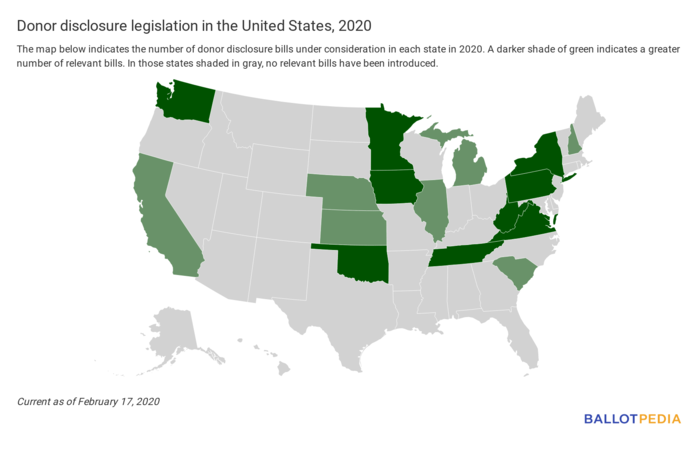
Number of relevant bills by state: We're currently tracking 41 pieces of legislation dealing with donor disclosure. On the map below, a darker shade of green indicates a greater number of relevant bills. Click here for a complete list of all the bills we're tracking.
Number of relevant bills by current legislative status[edit]

Number of relevant bills by partisan status of sponsor(s)[edit]

Recent legislative actions[edit]
Below is a complete list of legislative actions taken on relevant bills since our last issue. Bills are listed in alphabetical order, first by state then by bill number.
- Minnesota HF2050: This bill would amend the definitions of express advocacy and electioneering communication and revise disclosure requirements.
- House Government Operations Committee hearing scheduled Feb. 13.
- Democratic sponsors.
- New Hampshire HB1525: This bill would alter the definition of a political advocacy organization for the purposes of campaign finance reporting.
- House Election Law Committee work session rescheduled from Feb. 12 to Feb. 18.
- Bipartisan sponsors.
- Tennessee HB2396: This bill would prohibit public agencies from requiring 501(c) entities to furnish them with personal information about donors.
- Referred to House Constitutional Protections and Sentencing Sub-committee Feb. 11.
- Republican sponsors.
- Tennessee HB2665: This bill would prohibit public agencies from requiring 501(c) entities to furnish them with personal information about donors.
- Referred to House Constitutional Protections and Sentencing Sub-committee Feb. 11.
- Republican sponsors.
- Virginia HB849: This bill would subject political campaign communications made via online platforms to the same disclosure requirements currently applied to print media, television, and radio advertisements.
- Senate Privileges and Elections Committee hearing scheduled Feb. 18.
- Democratic sponsors.
- Virginia SB979: This bill extends the applicability of the state's campaign finance disclosure act to candidates for directors or soil and water conservation districts.
- Referred to House Privileges and Elections Committee Feb. 13.
- Republican sponsors.
See also[edit]
| |||||||

Categories: [The Disclosure Digest - 2020] [News] [Donor disclosure tracking]
↧ Download as ZWI file | Last modified: 03/07/2026 21:49:09 | 2 views
☰ Source: https://ballotpedia.org/The_Disclosure_Digest:_February_17,_2020 | License: CC BY-SA 3.0
 KSF
KSF