Hindu Texts
 From Handwiki
 | Part of a series on |
| Hindu scriptures and texts |
|---|
 |
|
| Related Hindu texts |
Hindu texts or Hindu scriptures are manuscripts and voluminous historical literature which are related to any of the diverse traditions within Hinduism. Some of the major Hindu texts include the Vedas, the Upanishads, and the Itihasa. Scholars hesitate in defining the term "Hindu scriptures" given the diverse nature of Hinduism,[1][2] but many list the Agamas as Hindu scriptures,[1][2][3] and Dominic Goodall includes Bhagavata Purana and Yajnavalkya Smriti in the list of Hindu scriptures as well.[1]
History
There are two historic classifications of Hindu texts: Shruti– that which is heard,[4] and Smriti – that which is remembered.[5] The Shruti texts refer to the body of most authoritative and ancient religious texts, believed to be eternal knowledge authored neither by human nor divine agent but transmitted by sages (rishis). These comprise the central canon of Hinduism.[4][6] It includes the four Vedas including its four types of embedded texts – the Samhitas, the Brahmanas, the Aranyakas and the Upanishads.[7] Of the Shrutis, the Upanishads alone are widely influential among Hindus, considered scriptures par excellence of Hinduism, and their central ideas have continued to influence its thoughts and traditions.[8][9]
The Smriti texts are a specific body of Hindu texts attributed to an author,[7] as a derivative work they are considered less authoritative than Shruti in Hinduism.[5] The Smriti literature is a vast corpus of diverse texts, and includes but is not limited to Vedāngas, the Hindu epics (such as the Mahabharat and Ramayan), the Sutras and Shastras, the texts of Hindu philosophies, the Puranas, the Kāvya or poetical literature, the Bhasyas, and numerous Nibandhas (digests) covering politics, ethics, culture, arts and society.[10][11]
Many ancient Hindu texts were composed in Sanskrit and other regional Indian languages. In modern times, most ancient texts have been translated into other Indian languages and some in non-Indian languages.[1] Prior to the start of the common era, the Hindu texts were composed orally, then memorized and transmitted orally, from one generation to the next, for more than a millennia before they were written down into manuscripts.[12][13] This verbal tradition of preserving and transmitting Hindu texts, from one generation to next, continued into the modern era.[12][13]
जलाद्रक्षेत्तैलाद्रक्षेद्रक्षेच्छिथिलबन्धनात् |
मूर्खहस्ते न मां दद्यादिति वदति पुस्तकम् ||
'Save me from water,
protect me from oil,
and from loose binding,
And do not give me into the hands of fools!'
says the manuscript.
—Anonymous verse frequently found
at the end of Sanskrit manuscripts[14]
Vedas
_Manuscript_LACMA_M.71.1.33.jpg)
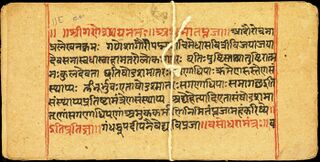
The four Vedas (Rig Veda, Sama Veda, Yajur Veda, and Atharva Veda) are a large body of Hindu texts originating from the Vedic period in northern India, the Rig Veda being composed c. 1200 BCE, and its Samhita and Brahmanas complete before about 800 BCE.[15] Composed in Vedic Sanskrit hymns, the texts constitute the oldest layer of Sanskrit literature and the oldest scriptures of Hinduism.[16][17][18] Hindus consider the Vedas to be timeless revelation,[15] apauruṣeya, which means "not of a man, superhuman"[19] and "impersonal, authorless".[20][21][22] The knowledge in the Vedas is believed in Hinduism to be eternal, uncreated, neither authored by human nor by divine source, but seen, heard and transmitted by sages.[6]
Vedas are also called shruti ("what is heard") literature,[23] distinguishing them from other religious texts, which are called Script error: The function "transl" does not exist. ("what is remembered"). The Veda, for orthodox Indian theologians, are considered revelations, some way or other the work of the Deity.[citation needed] In the Hindu Epic the Mahabharata, the creation of Vedas is credited to the deity responsible for creation, Brahma.[24]
There are four Vedas: the Rigveda, the Yajurveda, the Samaveda and the Atharvaveda.[25][26] Each Veda has been subclassified into four major text types – the Samhitas (mantras and benedictions), the Aranyakas (text on rituals, ceremonies, sacrifices and symbolic-sacrifices), the Brahmanas (commentaries on rituals, ceremonies and sacrifices), and the Upanishads (text discussing meditation, philosophy and spiritual knowledge).[25][27][28]
Upanishads
The Upanishads are a collection of Hindu texts which contain the central philosophical concepts of Hinduism.[8][note 1] The Upanishads are the foundation of Hindu philosophical thought and its diverse traditions.[9][29]
The Upanishads are commonly referred to as Vedānta, interpreted to mean either the "last chapters, parts of the Veda" or "the object, the highest purpose of the Veda".[30] The concepts of Brahman (Ultimate Reality) and Ātman (Soul, Self) are central ideas in all the Upanishads,[31][32] and "Know your Ātman" their thematic focus.[32] The central ideas of the Upanishads have had a lasting influence on Hindu philosophy.[8][9]
More than 200 Upanishads are known, of which ten are the oldest and most important and are referred to as the mukhya (main) or principal Upanishads.[33][34] The ten mukhya Upanishads are: Isha, Kena, Katha, Prashna, Mundaka, Mandukya, Taittiriya, Aitareya, Chandogya, and Brihadaranyaka.[35] The mukhya Upanishads are found mostly in the concluding part of the Brahmanas and Aranyakas[36] and were, for centuries, memorized by each generation and passed down verbally. The early Upanishads all predate the Common Era, some in all likelihood pre-Buddhist (6th century BCE),[37] down to the Maurya period.[38] Of the remainder, some 95 Upanishads are part of the Muktika canon, composed from about the start of common era through medieval Hinduism. New Upanishads, beyond the 108 in the Muktika canon, continued being composed through the early modern and modern era, though often dealing with subjects unconnected to Hinduism.[39][40]
Smriti
Smriti is the classification of literature which includes various scriptures and Itihasas (epics like the Ramayana and Mahabharata), Harivamsa Puranas, Agamas and Darshanas. This genre of texts includes the Sutras and Shastras of the six schools of Hindu philosophy: Samkhya, Yoga, Nyaya, Vaisheshika, Mimamsa and Vedanta.[41][42]
The Sutras and Shastras texts were compilations of technical or specialized knowledge in a defined area. The earliest are dated to later half of the 1st millennium BCE. The Dharma-shastras (law books), derivatives of the Dharma-sutras. Other examples were bhautikashastra "physics", rasayanashastra "chemistry", jīvashastra "biology", vastushastra "architectural science", shilpashastra "science of sculpture", arthashastra "economics" and nītishastra "political science".[43] It also includes Tantras and Agama literature.[44]
Puranas
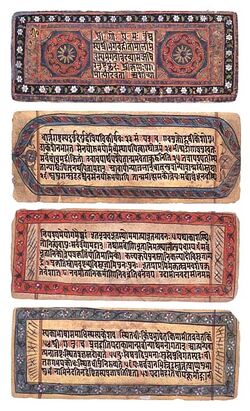
The Puranas are a vast genre of Hindu texts that encyclopedically cover a wide range of topics, particularly legends and other traditional lore.[45] Composed primarily in Sanskrit, but also in regional languages,[46][47] several of these texts are named after major Hindu deities such as Vishnu, Shiva, and Devi.[48][49]
The Puranic literature is encyclopedic,[50] and it includes diverse topics such as cosmogony, cosmology, genealogies of gods, goddesses, kings, heroes, sages, and demigods, folk tales, pilgrimages, temples, medicine, astronomy, grammar, mineralogy, humor, love stories, as well as theology and philosophy.[45][47][48] The content is diverse across the Puranas, and each Purana has survived in numerous manuscripts which are themselves voluminous and comprehensive. The Hindu Puranas are anonymous texts and likely the work of many authors over the centuries; in contrast, most Jaina Puranas can be dated and their authors assigned.[46]
There are 18 Maha Puranas (Great Puranas) and 18 Upa Puranas (Minor Puranas),[51] with over 400,000 verses.[45] The Puranas do not enjoy the authority of a scripture in Hinduism,[51] but are considered a Smriti.[52] These Hindu texts have been influential in the Hindu culture, inspiring major national and regional annual festivals of Hinduism.[53] The Bhagavata Purana has been among the most celebrated and popular text in the Puranic genre.[54][55]
Other Hindu texts
Hindu texts for specific fields, in Sanskrit and other regional languages, have been reviewed as follows:
| Field | Reviewer | Reference |
|---|---|---|
| Agriculture and food | Gyula Wojtilla | [56] |
| Architecture | P Acharya, B Dagens |
[57][58] |
| Devotionalism | Karen Pechelis | [59] |
| Drama, dance and performance arts | AB Keith, Rachel Baumer and James Brandon, Mohan Khokar |
[60][61][62] |
| Education, school system | Hartmut Scharfe | [63] |
| Epics | John Brockington | [64] |
| Gnomic and didactic literature | Ludwik Sternbach | [65] |
| Grammar | Hartmut Scharfe | [66] |
| Law and jurisprudence | J Duncan M Derrett | [67] |
| Lexicography | Claus Vogel | [68] |
| Mathematics and exact sciences | Kim Plofker David Pingree |
[69][70] |
| Medicine | MS Valiathan, Kenneth Zysk |
[71][72] |
| Music | Emmie te Nijenhuis, Lewis Rowell |
[73][74] |
| Mythology | Ludo Rocher | [75] |
| Philosophy | Karl Potter | [76] |
| Poetics | Edwin Gerow, Siegfried Lienhard | [77] |
| Gender and Sex | Johann Jakob Meyer | [78] |
| State craft, politics | Patrick Olivelle | [79] |
| Tantrism, Agamas | Teun Goudriaan | [80] |
| Temples, Sculpture | Stella Kramrisch | [81] |
| Scriptures (Vedas and Upanishads) | Jan Gonda | [82] |
Historical significance
The Hindu scriptures provide the early documented history of arts and science forms in India such as music, dance, sculptures, architecture, astronomy, science, mathematics, medicine and wellness. Valmiki's Ramayana (500 BCE to 100 BCE) mentions music and singing by Gandharvas, dance by Apsaras such as Urvashi, Rambha, Menaka, Tilottama Panchāpsaras, and by Ravana's wives who excelling in nrityageeta or "singing and dancing" and nritavaditra or "playing musical instruments").[83] The evidence of earliest dance related texts are in Natasutras, which are mentioned in the text of Panini, the sage who wrote the classic on Sanskrit grammar, and who is dated to about 500 BCE.[84][85] This performance arts related Sutra text is mentioned in other late Vedic texts, as are two scholars names Shilalin (IAST: Śilālin) and Krishashva (Kṛśaśva), credited to be pioneers in the studies of ancient drama, singing, dance and Sanskrit compositions for these arts.[84][86] Richmond et al. estimate the Natasutras to have been composed around 600 BCE, whose complete manuscript has not survived into the modern age.[85][84]
See also
- Rigveda
- Yajurveda
- Samaveda
- Indian epic poetry
- Hindu eschatology
- List of Hindu texts
- List of historic Indian texts
- Sutra
- Prasthanatrayi
- Sanskrit literature
- Sanskrit-related topics
- Timeline of Hindu texts
Notes
- ↑ These include rebirth, karma, moksha, ascetic techniques and renunciation.[8]
References
- ↑ 1.0 1.1 1.2 1.3 Dominic Goodall (1996), Hindu Scriptures, University of California Press, ISBN:978-0-520-20778-3, p. ix–xliii
- ↑ 2.0 2.1 Klaus Klostermaier (2007), A Survey of Hinduism: Third Edition, State University of New York Press, ISBN:978-0-7914-7082-4, pp. 46–52, 76–77
- ↑ RC Zaehner (1992), Hindu Scriptures, Penguin Random House, ISBN:978-0-679-41078-2, pages 1–11 and Preface
- ↑ 4.0 4.1 James Lochtefeld (2002), "Shruti", The Illustrated Encyclopedia of Hinduism, Vol. 2: N–Z, Rosen Publishing. ISBN:978-0-8239-3179-8, page 645
- ↑ 5.0 5.1 James Lochtefeld (2002), "Smrti", The Illustrated Encyclopedia of Hinduism, Vol. 2: N–Z, Rosen Publishing, ISBN:978-0-8239-3179-8, pp. 656–657
- ↑ 6.0 6.1 Ramdas Lamb (2002). Rapt in the Name: The Ramnamis, Ramnam, and Untouchable Religion in Central India. State University of New York Press. pp. 183–185. ISBN 978-0-7914-5386-5. https://books.google.com/books?id=Dv1nxyOTgN0C&pg=PA183.
- ↑ 7.0 7.1 Wendy Doniger O'Flaherty (1988), Textual Sources for the Study of Hinduism, Manchester University Press, ISBN:0-7190-1867-6, pp. 2–3
- ↑ 8.0 8.1 8.2 8.3 , p. 3, https://books.google.com/books?id=WJGL2tUm6P4C&pg=PR23,+"Even though theoretically the whole of vedic corpus is accepted as revealed truth [shruti], in reality it is the Upanishads that have continued to influence the life and thought of the various religious traditions that we have come to call Hindu. Upanishads are the scriptures par excellence of Hinduism", Wikidata Q108771870.
- ↑ 9.0 9.1 9.2 Wendy Doniger (1990), Textual Sources for the Study of Hinduism, 1st Edition, University of Chicago Press, ISBN:978-0-226-61847-0, pp. 2–3; Quote: "The Upanishads supply the basis of later Hindu philosophy; they alone of the Vedic corpus are widely known and quoted by most well-educated Hindus, and their central ideas have also become a part of the spiritual arsenal of rank-and-file Hindus."
- ↑ Purushottama Bilimoria (2011), The idea of Hindu law, Journal of Oriental Society of Australia, Vol. 43, pp. 103–130
- ↑ Roy Perrett (1998), Hindu Ethics: A Philosophical Study, University of Hawaii Press, ISBN:978-0-8248-2085-5, pp. 16–18
- ↑ 12.0 12.1 Michael Witzel, "Vedas and Upaniṣads", in: Flood, Gavin, ed. (2003), The Blackwell Companion to Hinduism, Blackwell Publishing Ltd., ISBN:1-4051-3251-5, pp. 68–71
- ↑ 13.0 13.1 William Graham (1993), Beyond the Written Word: Oral Aspects of Scripture in the History of Religion, Cambridge University Press, ISBN:978-0-521-44820-8, pp. 67–77
- ↑ Sanskrit Manuscripts Project, A Collection, Cambridge Digital Library, University of Cambridge
- ↑ 15.0 15.1 Gavin D. Flood (1996). An Introduction to Hinduism. Cambridge University Press. pp. 35–39. ISBN 978-0-521-43878-0. https://archive.org/details/anintroductiontohinduismgavinfloodd.oupseeotherbooks_355_z.
- ↑ see e.g. MacDonell 2004, pp. 29–39; Sanskrit literature (2003) in Philip's Encyclopedia. Accessed 2007-08-09
- ↑ see e.g. Radhakrishnan & Moore 1957, p. 3; Witzel, Michael, "Vedas and Script error: The function "transl" does not exist.", in: Flood 2003, p. 68; MacDonell 2004, pp. 29–39; Sanskrit literature (2003) in Philip's Encyclopedia. Accessed 2007-08-09
- ↑ Sanujit Ghose (2011). "Religious Developments in Ancient India" in Ancient History Encyclopedia.
- ↑ Vaman Shivaram Apte, The Practical Sanskrit-English Dictionary, see apauruSeya
- ↑ D Sharma, Classical Indian Philosophy: A Reader, Columbia University Press, pp. 196–197
- ↑ Jan Westerhoff (2009), Nagarjuna's Madhyamaka: A Philosophical Introduction, Oxford University Press, ISBN:978-0-19-538496-3, page 290
- ↑ Warren Lee Todd (2013), The Ethics of Śaṅkara and Śāntideva: A Selfless Response to an Illusory World, ISBN:978-1-4094-6681-9, p. 128
- ↑ Apte 1965, p. 887
- ↑ Seer of the Fifth Veda: Kr̥ṣṇa Dvaipāyana Vyāsa in the Mahābhārata Bruce M. Sullivan, Motilal Banarsidass, pp. 85–86
- ↑ 25.0 25.1 Gavin Flood (1996), An Introduction to Hinduism, Cambridge University Press, ISBN:978-0-521-43878-0, pages 35–39
- ↑ Bloomfield, M. The Atharvaveda and the Gopatha-Brahmana, (Grundriss der Indo-Arischen Philologie und Altertumskunde II.1.b.) Strassburg 1899; Gonda, J. A history of Indian literature: I.1 Vedic literature (Samhitas and Brahmanas); I.2 The Ritual Sutras. Wiesbaden 1975, 1977
- ↑ A Bhattacharya (2006), Hindu Dharma: Introduction to Scriptures and Theology, ISBN:978-0-595-38455-6, pp. 8–14; George M. Williams (2003), Handbook of Hindu Mythology, Oxford University Press, ISBN:978-0-19-533261-2, page 285
- ↑ Jan Gonda (1975), Vedic Literature: (Saṃhitās and Brāhmaṇas), Otto Harrassowitz Verlag, ISBN:978-3-447-01603-2
- ↑ Wiman Dissanayake (1993), Self as Body in Asian Theory and Practice (Editors: Thomas P. Kasulis et al.), State University of New York Press, ISBN:978-0-7914-1080-6, p. 39; Quote: "The Upanishads form the foundations of Hindu philosophical thought and the central theme of the Upanishads is the identity of Atman and Brahman, or the inner self and the cosmic self.";
Michael McDowell and Nathan Brown (2009), World Religions, Penguin, ISBN:978-1-59257-846-7, pp. 208–210 - ↑ Max Muller, The Upanishads, Part 1, Oxford University Press, page LXXXVI footnote 1
- ↑ Mahadevan 1956, p. 59.
- ↑ 32.0 32.1 PT Raju (1985), Structural Depths of Indian Thought, State University of New York Press, ISBN:978-0-88706-139-4, pp. 35–36
- ↑ Stephen Phillips (2009), Yoga, Karma, and Rebirth: A Brief History and Philosophy, Columbia University Press, ISBN:978-0-231-14485-8, Chapter 1
- ↑ E Easwaran (2007), The Upanishads, ISBN:978-1-58638-021-2, pp. 298–299
- ↑ Piparaiya, Ram K. (2003). Ten Upanishads of Four Vedas.. Motilal Banarsidass.
- ↑ Mahadevan 1956, p. 56.
- ↑ , p. 12–14, https://archive.org/details/TheEarlyUpanisads/page/n33/mode/2up, Wikidata Q108772045
- ↑ King & Ācārya 1995, p. 52.
- ↑ Ranade 1926, p. 12.
- ↑ Varghese 2008, p. 101.
- ↑ Andrew Nicholson (2013), Unifying Hinduism: Philosophy and Identity in Indian Intellectual History, Columbia University Press, ISBN:978-0-231-14987-7, pp. 2–5
- ↑ Karl Potter (1991), Presuppositions of India's Philosophies, Motilal Banarsidass, ISBN:978-81-208-0779-2
- ↑ Jan Gonda (1970 through 1987), A History of Indian Literature, Volumes 1 to 7, Otto Harrassowitz Verlag, ISBN:978-3-447-02676-5
- ↑ Teun Goudriaan and Sanjukta Gupta (1981), Hindu Tantric and Śākta Literature, A History of Indian Literature, Volume 2, Otto Harrassowitz Verlag, ISBN:978-3-447-02091-6, pp. 7–14
- ↑ 45.0 45.1 45.2 Greg Bailey (2001), Encyclopedia of Asian Philosophy (Editor: Oliver Leaman), Routledge, ISBN:978-0-415-17281-3, pp. 437–439
- ↑ 46.0 46.1 John Cort (1993), Purana Perennis: Reciprocity and Transformation in Hindu and Jaina Texts (Editor: Wendy Doniger), State University of New York Press, ISBN:978-0-7914-1382-1, pp. 185–204
- ↑ 47.0 47.1 Gregory Bailey (2003), The Study of Hinduism (Editor: Arvind Sharma), The University of South Carolina Press, ISBN:978-1-57003-449-7, pp. 139
- ↑ 48.0 48.1 Ludo Rocher (1986), The Puranas, Otto Harrassowitz Verlag, ISBN:978-3-447-02522-5, pp. 1–5, 12–21
- ↑ Nair, Shantha N. (2008). Echoes of Ancient Indian Wisdom: The Universal Hindu Vision and Its Edifice. Hindology Books. p. 266. ISBN 978-81-223-1020-7. https://books.google.com/books?id=ekehXVP3W8wC&pg=PA266.
- ↑ Merriam-Webster's Encyclopedia of Literature (1995 Edition), Article on Puranas, ISBN:0-877790426, page 915
- ↑ 51.0 51.1 Cornelia Dimmitt (2015), Classical Hindu Mythology: A Reader in the Sanskrit Puranas, Temple University Press, ISBN:978-81-208-3972-4, pp. xii, 4
- ↑ Greg Bailey (2001), Encyclopedia of Asian Philosophy (Editor: Oliver Leaman), Routledge, ISBN:978-0-415-17281-3, p. 503
- ↑ Ludo Rocher (1986), The Puranas, Otto Harrassowitz Verlag, ISBN:978-3-447-02522-5, pp. 12–13, 134–156, 203–210
- ↑ Dominic Goodall (1996), Hindu Scriptures, University of California Press, ISBN:978-0-520-20778-3, page xli
- ↑ Thompson, Richard L. (2007). The Cosmology of the Bhagavata Purana 'Mysteries of the Sacred Universe. Motilal Banarsidass Publishers. p. 10. ISBN 978-81-208-1919-1. https://books.google.com/books?id=3TZmDSr-1msC&pg=PA10.
- ↑ Gyula Wojtilla (2006), History of Kr̥ṣiśāstra, Otto Harrassowitz Verlag, ISBN:978-3-447-05306-8
- ↑ PK Acharya (1946), An Encyclopedia of Hindu Architecture, Oxford University Press, Also see Volumes 1 to 6
- ↑ Bruno Dagens (1995), MAYAMATA : An Indian Treatise on Housing Architecture and Iconography, ISBN:978-81-208-3525-2
- ↑ Karen Pechelis (2014), The Embodiment of Bhakti, Oxford University Press, ISBN:978-0-19-535190-3
- ↑ The Sanskrit Drama, Oxford University Press
- ↑ Rachel Baumer and James Brandon (1993), Sanskrit Drama in Performance, Motilal Banarsidass, ISBN:81-208-0772-3
- ↑ Mohan Khokar (1981), Traditions of Indian Classical Dance, Peter Owen Publishers, ISBN:978-0-7206-0574-7
- ↑ Hartmut Scharfe (2002), Education in Ancient India, BRILL, ISBN:978-90-04-12556-8
- ↑ John Brockington (1998), The Sanskrit Epics, BRILL, ISBN:978-90-04-10260-6
- ↑ Ludwik Sternbach (1974), Subhāṣita: Gnomic and Didactic Literature, Otto Harrassowitz Verlag, ISBN:978-3-447-01546-2
- ↑ Hartmut Scharfe, A history of Indian literature. Vol. 5, Otto Harrassowitz Verlag, ISBN:3-447-01722-8
- ↑ J Duncan M Derrett (1978), Dharmasastra and Juridical Literature: A history of Indian literature (Editor: Jan Gonda), Vol. 4, Otto Harrassowitz Verlag, ISBN:3-447-01519-5
- ↑ Claus Vogel, A history of Indian literature. Vol. 5, Otto Harrassowitz Verlag, ISBN:3-447-01722-8
- ↑ Kim Plofker (2009), Mathematics in India, Princeton University Press, ISBN:978-0-691-12067-6
- ↑ David Pingree, A Census of the Exact Sciences in Sanskrit, Volumes 1 to 5, American Philosophical Society, ISBN:978-0-87169-213-9
- ↑ MS Valiathan, The Legacy of Caraka, Orient Blackswan, ISBN:978-81-250-2505-4
- ↑ Kenneth Zysk, Medicine in the Veda, Motilal Banarsidass, ISBN:978-81-208-1401-1
- ↑ Emmie te Nijenhuis, Musicological literature (A History of Indian literature ; v. 6 : Scientific and technical literature ; Fasc. 1), Otto Harrassowitz Verlag, ISBN:978-3-447-01831-9
- ↑ Lewis Rowell, Music and Musical Thought in Early India, University of Chicago Press, ISBN:0-226-73033-6
- ↑ Ludo Rocher (1986), The Puranas, Otto Harrassowitz Verlag, ISBN:978-3-447-02522-5
- ↑ Karl Potter, The Encyclopedia of Indian Philosophies, Volumes 1 through 27, Motilal Banarsidass, ISBN:81-208-0309-4
- ↑ Edwin Gerow, A history of Indian literature. Vol. 5, Otto Harrassowitz Verlag, ISBN:3-447-01722-8
- ↑ JJ Meyer, Sexual Life in Ancient India, Vol 1 and 2, Oxford University Press, ISBN:978-1-4826-1588-3
- ↑ Patrick Olivelle, King, Governance, and Law in Ancient India, Oxford University Press, ISBN:978-0-19-989182-5
- ↑ Teun Goudriaan, Hindu Tantric and Śākta Literature, Otto Harrassowitz Verlag, ISBN:3-447-02091-1
- ↑ Stella Kramrisch, Hindu Temple, Vol. 1 and 2, Motilal Banarsidass, ISBN:978-81-208-0222-3
- ↑ Jan Gonda (1975), Vedic literature (Saṃhitās and Brāhmaṇas), Otto Harrassowitz Verlag, ISBN:3-447-01603-5
- ↑ Ananda W. P. Guruge, 1991, The Society of the Ramayana, Page 180-200.
- ↑ 84.0 84.1 84.2 Natalia Lidova (1994). Drama and Ritual of Early Hinduism. Motilal Banarsidass. pp. 111–113. ISBN 978-81-208-1234-5. https://books.google.com/books?id=3TKarwqJJP0C.
- ↑ 85.0 85.1 Richmond, Swann & Zarrilli 1993, p. 30.
- ↑ Tarla Mehta 1995, pp. xxiv, xxxi–xxxii, 17.
Bibliography
- Apte, Vaman Shivram (1965). The Practical Sanskrit Dictionary. Delhi: Motilal Banarsidass Publishers. ISBN 81-208-0567-4.
- Deussen, Paul; Bedekar, V.M. (tr.); Palsule (tr.), G.B. (1997). Sixty Upanishads of the Veda, Volume 2. Motilal Banarsidass. ISBN 978-81-208-1467-7.
- The Blackwell companion to Hinduism. Oxford: Blackwell Publ. 2003. ISBN 1-4051-3251-5.
- King, Richard; Ācārya, Gauḍapāda (1995), Early Advaita Vedānta and Buddhism: the Mahāyāna context of the Gauḍapādīya-kārikā, SUNY Press, ISBN 978-0-7914-2513-8
- Collins, Randall (2000). The Sociology of Philosophies: A Global Theory of Intellectual Change. Harvard University Press. ISBN 0-674-00187-7.
- Mahadevan, T. M. P (1956), Sarvepalli Radhakrishnan, ed., History of Philosophy Eastern and Western, George Allen & Unwin Ltd
- MacDonell, Arthur Anthony (2004). A Practical Sanskrit Dictionary. Motilal Banarsidass. ISBN 978-81-208-2000-5.
- Tarla Mehta (1995). Sanskrit Play Production in Ancient India. Motilal Banarsidass. ISBN 978-81-208-1057-0. https://books.google.com/books?id=l7naMj1UxIkC.
- Olivelle, Patrick (1992). The Samnyasa Upanisads. Oxford University Press. ISBN 978-0-19-507045-3.
- Olivelle, Patrick (1998), Upaniṣads, Oxford University Press, ISBN 978-0-19-283576-5
- Radhakrishnan, S.; Moore, C. A. (1957). A Source Book in Indian Philosophy. Princeton, New Jersey: Princeton University Press. ISBN 978-0-691-01958-1. https://archive.org/details/sourcebookinindi00radh.
- Ranade, R. D. (1926), A constructive survey of Upanishadic philosophy, Bharatiya Vidya Bhavan
- Richmond, Farley P.; Swann, Darius L.; Zarrilli, Phillip B. (1993). Indian Theatre: Traditions of Performance. Motilal Banarsidass. ISBN 978-81-208-0981-9. https://books.google.com/books?id=OroCOEqkVg4C.
- Varghese, Alexander P (2008), India : History, Religion, Vision And Contribution To The World, 1, Atlantic Publishers & Distributors, ISBN 978-81-269-0903-2, https://books.google.com/books?id=y7GKwhuea9kC
Further reading
- R.C. Zaehner (1992), Hindu Scriptures, Penguin Random House, ISBN:978-0-679-41078-2
- Dominic Goodall, Hindu Scriptures, University of California Press, ISBN:978-0-520-20778-3
- Jessica Frazier (2014), The Bloomsbury Companion to Hindu studies, Bloomsbury Academic, ISBN:978-1-4725-1151-5
External links
Manuscripts collections (incomplete)
- A handlist of Sanskrit and Prakrit Hindu, Buddhist and Jain Manuscripts held by the Wellcome Library, Volume 1, Compiled by Dominik Wujastyk (Includes subjects such as historic Dictionaries, Drama, Erotics, Ethics, Logic, Poetics, Medicine, Philosophy, etc.)
- A handlist of Sanskrit and Prakrit Hindu, Buddhist and Jain Manuscripts held by the Wellcome Library, Volume 2, Compiled by Dominik Wujastyk (Includes subjects such as historic Dictionaries, Drama, Erotics, Ethics, Logic, Poetics, Medicine, Philosophy, etc.; for complete 6 set collection see ISBN:0-85484-049-4)
- Clay Sanskrit Library publishes Sanskrit literature with downloadable materials.
- The Sacred Books of the Hindus Information
Online resources:
- The British Library: Discovering Sacred Texts - Hinduism
- Sacred-Texts: Hinduism
- Sanskrit Documents Collection: Documents in ITX format of Upanishads, Stotras etc.
- GRETIL: Göttingen Register of Electronic Texts in Indian Languages, a cumulative register of the numerous download sites for electronic texts in Indian languages.
Hindu deities and texts | ||
|---|---|---|
| Gods |
|  |
| Goddesses |
| |
| Other deities |
| |
| Texts |
| |
| ||
Hinduism topics | |||||||||||||||||
|---|---|---|---|---|---|---|---|---|---|---|---|---|---|---|---|---|---|
| |||||||||||||||||
| Philosophy |
|  | |||||||||||||||
| Texts |
| ||||||||||||||||
| Deities |
| ||||||||||||||||
| Practices |
| ||||||||||||||||
| Related |
| ||||||||||||||||
| |||||||||||||||||
 |  |
Categories: [Hindu texts]
↧ Download as ZWI file | Last modified: 05/04/2025 14:23:13 | 8 views
☰ Source: https://handwiki.org/wiki/Religion:Hindu_texts | License: CC BY-SA 3.0
 KSF
KSF