Ludlow Epoch
 From Handwiki
 Short description: 3rd series of the Silurian
| Ludlow | |
|---|---|
| 427.4 ± 0.5 – 423.0 ± 2.3 Ma PreЄ
Є
O
S
D
C
P
T
J
K
Pg
N
↓ | |
| Chronology | |
Silurian graphical timeline -444 — – -442 — – -440 — – -438 — – -436 — – -434 — – -432 — – -430 — – -428 — – -426 — – -424 — – -422 — – -420 — – -418 — Subdivision of the Silurian according to the ICS, as of 2021.[3] Vertical axis scale: millions of years ago. | |
| Etymology | |
| Name formality | Formal |
| Name ratified | 1980[4] |
| Usage information | |
| Celestial body | Earth |
| Regional usage | Global (ICS) |
| Time scale(s) used | ICS Time Scale |
| Definition | |
| Chronological unit | Epoch |
| Stratigraphic unit | Series |
| Time span formality | Formal |
| Lower boundary definition | FAD of the Graptolite Saetograptus (Colonograptus) varians |
| Lower boundary GSSP | Pitch Coppice, Ludlow, United Kingdom [ ⚑ ] 52°21′33″N 2°46′38″W / 52.3592°N 2.7772°W |
| GSSP ratified | 1980[4] |
| Upper boundary definition | FAD of the Graptolite Monograptus parultimus. |
| Upper boundary GSSP | Požáry Section, Prague-Řeporyje, Czech Republic [ ⚑ ] 50°01′40″N 14°19′30″E / 50.0277°N 14.3249°E |
| GSSP ratified | 1984[5][6] |
In the geological timescale, the Ludlow Epoch (from 427.4 ± 0.5 million years ago to 423.0 ± 2.3 million years ago) occurred during the Silurian Period, after the end of the Homerian Age. It is named for the town of Ludlow in Shropshire, England .
The Ludlow Epoch is subdivided into two stages: Gorstian and Ludfordian.
Paleontology
Arthropods
| Arthropods of the Ludlow | ||||
|---|---|---|---|---|
| Taxa | Presence | Location | Description | Images |
| Arctinurus | Wenlock Epoch to Ludlow Epoch | Europe and North America | Large (up to 30 centimetres (12 in)) trilobite | 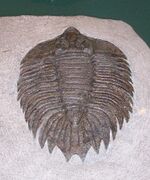 |
See also
- Ludlow Group
References
- ↑ Jeppsson, L.; Calner, M. (2007). "The Silurian Mulde Event and a scenario for secundo—secundo events". Earth and Environmental Science Transactions of the Royal Society of Edinburgh 93 (02): 135–154. doi:10.1017/S0263593300000377.
- ↑ Munnecke, A.; Samtleben, C.; Bickert, T. (2003). "The Ireviken Event in the lower Silurian of Gotland, Sweden-relation to similar Palaeozoic and Proterozoic events". Palaeogeography, Palaeoclimatology, Palaeoecology 195 (1): 99–124. doi:10.1016/S0031-0182(03)00304-3.
- ↑ "Chart/Time Scale". International Commission on Stratigraphy. http://www.stratigraphy.org/index.php/ics-chart-timescale.
- ↑ 4.0 4.1 Holland, C. (1982). "The State of Silurian Stratigraphy". Episodes 1982 (3): 21–23. doi:10.18814/epiiugs/1982/v5i3/004. https://stratigraphy.org/gssps/files/sheinwoodian-ludfordian.pdf. Retrieved 11 December 2020.
- ↑ Lucas, Sepncer (6 November 2018). "The GSSP Method of Chronostratigraphy: A Critical Review". Frontiers in Earth Science 6: 191. doi:10.3389/feart.2018.00191. Bibcode: 2018FrEaS...6..191L.
- ↑ Holland, C. (June 1985). "Series and Stages of the Silurian System". Episodes 8 (2): 101–103. doi:10.18814/epiiugs/1985/v8i2/005. https://timescalefoundation.org/references/Silurian1.pdf. Retrieved 11 December 2020.
 |  |
Categories: [Ludlow epoch] [Silurian geochronology]
↧ Download as ZWI file | Last modified: 03/02/2025 21:46:30 | 5 views
☰ Source: https://handwiki.org/wiki/Earth:Ludlow_Epoch | License: CC BY-SA 3.0
✘
ZWI is not signed. [what is this?]
ZWI viewer
by the  KSF
KSF
KSF