Enthalpy Of Sublimation
 From Handwiki
 Short description: Heat required to change one mole of substance from solid to gas
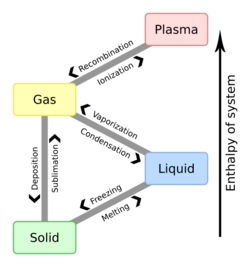
In thermodynamics, the enthalpy of sublimation, or heat of sublimation, is the heat required to sublimate (change from solid to gas) one mole of a substance at a given combination of temperature and pressure, usually standard temperature and pressure (STP). It is equal to the cohesive energy of the solid. For elemental metals, it is also equal to the standard enthalpy of formation of the gaseous metal atoms.[1] The heat of sublimation is usually expressed in kJ/mol, although the less customary kJ/kg is also encountered.
Sublimation enthalpies
| symbol | substances | Sublimation enthalpy (kJ/mol) |
|---|---|---|
| Li | lithium | 159[1] |
| Na | sodium | 107[1] |
| K | potassium | 89[1] |
| Rb | rubidium | 81[1] |
| Cs | caesium | 76[1] |
| Mg | magnesium | 148[1] |
| Ca | calcium | 178[1] |
| Sr | strontium | 164[1] |
| Ba | barium | 180[1] |
| Fe | iron | 416[1] |
| Ni | nickel | 430[1] |
| Cu | copper | 338[1] |
| Zn | zinc | 131[1] |
| Ag | silver | 285[1] |
| W | tungsten | 849[1] |
| Au | gold | 366[1] |
| C | graphite | 717[1] |
| C | diamond | 715[1] |
| Si | silicon | 456[1] |
| Sn | tin | 302[1] |
| Pb | lead | 195[1] |
| I2 | iodine | 62.4[2] |
| C10H8 | naphthalene | 72.9[2] |
| CO2 | carbon dioxide | 25[2] |
See also
- Heat
- Sublimation (chemistry)
- Phase transition
- Clausius-Clapeyron equation
References
- ↑ 1.00 1.01 1.02 1.03 1.04 1.05 1.06 1.07 1.08 1.09 1.10 1.11 1.12 1.13 1.14 1.15 1.16 1.17 1.18 1.19 1.20 1.21 Oxtoby, D. W; Gillis, H.P., Butler, L. J. (2015).Principles of Modern Chemistry, Brooks Cole. Appendix D. ISBN 978-1305079113
- ↑ 2.0 2.1 2.2 Chickos, James S.; Acree, William E. (2002). "Enthalpies of Sublimation of Organic and Organometallic Compounds. 1910–2001" (in en). Journal of Physical and Chemical Reference Data 31 (2): 537–698. doi:10.1063/1.1475333. ISSN 0047-2689. http://aip.scitation.org/doi/10.1063/1.1475333.
States of matter (list) | ||
|---|---|---|
| State |
|  |
| Low energy |
| |
| High energy |
| |
| Other states |
| |
| Transitions |
| |
| Quantities |
| |
| Concepts |
| |
 |  |
Categories: [Enthalpy]
↧ Download as ZWI file | Last modified: 08/26/2024 08:06:10 | 3 views
☰ Source: https://handwiki.org/wiki/Physics:Enthalpy_of_sublimation | License: CC BY-SA 3.0
✘
ZWI is not signed. [what is this?]
ZWI viewer
by the  KSF
KSF
KSF