Exanthem
 From Mdwiki
 | Exanthem | |
|---|---|
| Other names: Exanthema | |
 | |
| Rash seen in rubella | |
 | |
| Specialty | Dermatology |
An exanthem is a widespread rash occurring on the skin.[1][2] An exanthem can be caused by toxins, drugs, or microorganisms, or can result from autoimmune disease.[1]
The term exanthem is from the Greek ἐξάνθημα, exánthēma, 'a breaking out'.[3] It can be contrasted with enanthems which occur inside the body, such as on mucous membranes.
Infectious[edit | edit source]
In 1905, the Russian-French physician Léon Cheinisse (1871-1924), proposed a numbered classification of the six most common childhood exanthems.[4][5][6][7][8]
Of these six "classical" infectious childhood exanthems,[9] four are viral. Numbers were provided in 1905.[10][dead link]
The four viral exanthema have much in common, and are often studied together as a class. They are:
| Name | Number | Virus |
|---|---|---|
| measles (rubeola) | "first disease" | measles virus |
| rubella (German measles) identified in 1881.[11] | "third disease" | rubella virus |
| erythema infectiosum, identified as a distinct condition in 1896.[12] | "fifth disease" | parvovirus B19 |
| roseola infantum | "sixth disease" | HHV-6 and HHV-7 |
Scarlet fever, or "second disease", is associated with the bacterium Streptococcus pyogenes. Fourth disease, also known as "Dukes' disease" is a condition whose existence is not widely accepted today. It was described in 1900 and is postulated to be related to the bacterium Staphylococcus aureus.[11]
In 1979 and 2001 a possible "seventh diease" was postulated following reports of a condition in Japan also referred to as acute febrile infantile mucocutaneous lymph node syndrome (MCLS).[13]
Many other common viruses apart from the ones mentioned above can also produce an exanthem as part of their presentation, though they are not considered part of the classic numbered list:
- Varicella zoster virus (chickenpox or shingles)
- Mumps
- rhinovirus (the common cold)
- unilateral laterothoracic exanthem of childhood
- Some types of viral haemorrhagic fever are also known to produce a systemic rash of this kind during the progression of the disease.
- Tick-borne diseases like Rocky Mountain spotted fever produce a rash that may become extensive enough so as to be classified as exanthemous in as many as 90% of children with the disease.[14]
Additional images[edit | edit source]
-
.jpg)
Exanthem
-
.jpg)
Exanthem
-
.jpg)
Exanthem
-
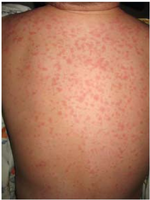
Viral exanthem
.jpg)
.jpg)
.jpg)

See also[edit | edit source]
References[edit | edit source]
- ↑ 1.0 1.1 "Exanthems (reactive rashes) | DermNet NZ". dermnetnz.org. Archived from the original on 14 August 2021. Retrieved 14 May 2022.
- ↑ "Viral exanthems". Primary Care Dermatology Society. Primary Care Dermatology Society. Archived from the original on 5 August 2020. Retrieved 6 December 2022.
- ↑ "Roseola Glossary of Terms with Definitions on MedicineNet.com". Archived from the original on 2008-09-14.
- ↑ "Robert R. Briney. Primary Cutaneous Actinomycosis". Archived from the original on 2019-10-03. Retrieved 2021-03-24.
- ↑ "David M. Morens. Fifth Disease: Still Hazy After All These Years". Archived from the original on 2019-10-03. Retrieved 2021-03-24.
- ↑ "Dictionary of Virology". Archived from the original on 2021-08-28. Retrieved 2021-03-24.
- ↑ "St. Louis Courier of Medicine (1906)". Archived from the original on 2021-08-28. Retrieved 2021-03-24.
- ↑ "Principles and Practice of Clinical Virology". Archived from the original on 2021-08-28. Retrieved 2021-03-24.
- ↑ Bialecki C, Feder HM, Grant-Kels JM (November 1989). "The six classic childhood exanthems: a review and update". J Am Acad Dermatol. 21 (5 Pt 1): 891–903. doi:10.1016/s0190-9622(89)70275-9. PMID 2681288.
- ↑ "fifth disease" at Dorland's Medical Dictionary
- ↑ 11.0 11.1 Weisse ME (January 2001). "The fourth disease, 1900-2000". Lancet. 357 (9252): 299–301. doi:10.1016/S0140-6736(00)03623-0. PMID 11214144.
- ↑ Altman, Lawrence K (November 30, 1982). "THE DOCTOR'S WORLD". The New York Times. Archived from the original on 2018-04-12. Retrieved 2009-11-07.
- ↑ Patel, Mitesh; Charlton, Rodger (2015-07-27). "First to seventh diseases: discarded diagnoses?". BMJ: h3525. doi:10.1136/bmj.h3525. ISSN 1756-1833. Archived from the original on 2021-08-28. Retrieved 2021-03-24.
- ↑ https://www.cdc.gov/mmwr/pdf/r/rr5504.pdf
External links[edit | edit source]
| Classification |
|---|
- Overview Archived 2005-09-17 at the Wayback Machine at About.com
- Definition at MedTerms Archived 2013-12-17 at the Wayback Machine
- Differential diagnosis Archived 2015-09-24 at the Wayback Machine
- Dermatology Quiz Includes photo, diagnosis, and treatment of unilateral laterothoracic exanthem (ULE).
Categories: [Dermatologic terminology]
↧ Download as ZWI file | Last modified: 06/11/2024 11:03:25 | 44 views
☰ Source: https://mdwiki.org/wiki/Exanthem | License: CC BY-SA 3.0
 KSF
KSF