List Of Psychoactive Plants, Fungi, And Animals
 From Handwiki
 Short description: none

Selected phylogeny
This is a list of psychoactive plants, fungi, and animals.
Plants
- Psychoactive plants include, but are not limited to, the following examples:
- Cannabis: cannabinoids
- Tobacco: nicotine and beta-carboline alkaloids
- Coca: cocaine
- Opium Poppy: morphine, codeine, thebaine, papaverine, noscapine, and narceine
- Salvia divinorum: salvinorin A
- Khat: cathine and cathinone
- Kava: kavalactones
- Nutmeg: myristicin
- Nightshade (Solanaceae) plants containing hyoscyamine, atropine, and scopolamine:
- Datura
- Deadly nightshade (Atropa belladonna)
- Henbane (Hyoscyamus niger)
- Mandrake (Mandragora officinarum)
- Other Solanaceae

Peyote
- Psychoactive cacti, which contain mainly mescaline:
- Peyote
- Other Lophophora
- Peruvian Torch cactus
- San Pedro cactus
- Trichocereus macrogonus var. macrogonus (syn. Echinopsis peruviana)
- Trichocereus macrogonus var. pachanoi (syn. Echinopsis pachanoi)
- Other Echinopsis
- Mild stimulant and vasoconstrictor plants that contain mainly caffeine and theobromine:
- Coffee
- Tea (also contains theanine)
- Guarana
- Yerba Mate
- Cocoa
- Kola

Anadenanthera colubrina produces beans used for cebil
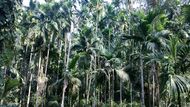
Areca palms in Ponda, India
- Other plants:
- Mimosa hostilis: DMT
- Chacruna: DMT, NMT
- Cebil and Yopo: DMT, 5-MeO-DMT, bufotenin
- Mucuna pruriens
- Morning glory species, notably Hawaiian Baby Woodrose: lysergic acid amide
- Monotropa uniflora: Grayanotoxin (also found in Rhododendron pollen and Mad Honey)
- Iboga: ibogaine, noribogaine, ibogamine, voacangine, 18-methoxycoronaridine
- Ephedra: ephedrine
- Acacia species
- Damiana
- Calea zacatechichi
- Silene capensis
- Valerian
- Areca nut: arecaidine and arecoline
- Kratom: mitragynine, mitraphylline, 7-hydroxymitragynine, raubasine, and corynantheidine
- Rauvolfia serpentina: rauwolscine
- Nymphaea caerulea (Egyptian lotus or blue lotus): apomorphine, nuciferine
- Yohimbe: yohimbine
- Kanna: mesembrine and mesembrenone
- Glaucium flavum (yellow horned poppy, yellow hornpoppy or sea poppy): glaucine
- California poppies: Protopine and Californidine
Fungi
- Psilocybin mushrooms: psilocybin, psilocin, aeruginascin, baeocystin, and norbaeocystin
- Amanita muscaria: ibotenic acid, muscimol, and muscarine
- Dictyonema huaorani: psilocybin, DMT, and 5-MeO-DMT
- Collybia maculata: collybolide[1]
Animals
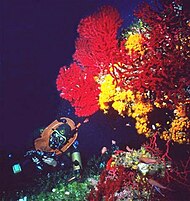
P. clavata (violescent sea-whip)
- Colorado River toad (Sonoran Desert toad or Bufo alvarius): 5-MeO-DMT and bufotenin
- Asiatic toad and certain tree frogs (Osteocephalus taurinus, Osteocephalus oophagus, and Osteocephalus langsdorfii): bufotenin
- Tree frogs belonging to the genus Phyllomedusa, notably P. bicolor: opioid peptides, including deltorphin, deltorphin I, deltorphin II, and dermorphin
- Hallucinogenic fish
- Ocean life containing DMT analogs:
- Smenospongia aurea: 5-Bromo-DMT[2][3]
- Smenospongia echina: 5,6-Dibromo-DMT[2][3]
- Verongula rigida: 5-Bromo-DMT, 5,6-Dibromo-DMT, et al.[2][3]
- Eudistoma fragum: 5-Bromo-DMT[2]
- Paramuricea clavata: DMT, NMT[2]
- Villogorgia rubra: NMT[2]
See also
- List of psychoactive substances and precursor chemicals derived from genetically modified organisms
- List of psychoactive substances derived from artificial fungi biotransformation
- List of substances used in rituals
- Entheogenic drugs and the archaeological record
- List of plants used for smoking
- Medicinal fungi
References
- ↑ Gupta, Achla; Gomes, Ivone; Bobeck, Erin N.; Fakira, Amanda K.; Massaro, Nicholas P.; Sharma, Indrajeet; Cavé, Adrien; Hamm, Heidi E. et al. (24 May 2016). "Collybolide is a novel biased agonist of κ-opioid receptors with potent antipruritic activity". Proceedings of the National Academy of Sciences 113 (21): 6041–6046. doi:10.1073/pnas.1521825113. PMID 27162327. Bibcode: 2016PNAS..113.6041G.
- ↑ 2.0 2.1 2.2 2.3 2.4 2.5 Shulgin, Alexander (1997). TIHKAL: The Continuation. Transform Press. ISBN 9780963009692. https://books.google.com/books?id=jl_ik66IumUC.
- ↑ 3.0 3.1 3.2 "Sea DMT". Vice Magazine. 2013-03-26. https://www.vice.com/en_us/article/znqdve/sea-dmt-000481-v20n3.
 |  |
Categories: [Lists of plants]
↧ Download as ZWI file | Last modified: 07/24/2024 19:21:21 | 6 views
☰ Source: https://handwiki.org/wiki/Biology:List_of_psychoactive_plants,_fungi,_and_animals | License: CC BY-SA 3.0
✘
ZWI is not signed. [what is this?]
ZWI viewer
by the  KSF
KSF
KSF