Official Romanisation Scheme For Taiwanese Hokkien
 From Handwiki
 | Taiwan Minnanyu Luomazi Pinyin Fang'an |
|---|
| Chinese romanization |
|---|
| Mandarin |
| Wu |
| Yue |
| Min |
| Gan |
| Hakka |
| Xiang |
| See also |
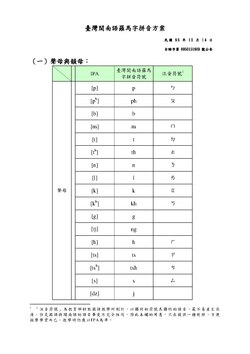
The official romanisation system for Taiwanese Hokkien in Taiwan is locally known as Tâi-uân Lô-má-jī Phing-im Hong-àn or Taiwan Minnanyu Luomazi Pinyin Fang'an,Template:Efn native lang[1] often referred to as Tâi-lô. It is derived from Pe̍h-ōe-jī and since 2006 has been one of the officially promoted phonetic notation system by Taiwan's Ministry of Education.[2] The system is used in the MoE's Dictionary of Frequently-Used Taiwan Minnan. It is nearly identical to Pe̍h-ōe-jī apart from using ts tsh j instead of ch chh j for the fricatives /ts tsʰ dz/, the substitution of o for u in vowel combinations such as oa and oe, the substitution of e for i in eng, using oo instead of o͘, and the substitution of nn for n in nasalized vowels like an and on.
Alphabet
Taiwanese Romanization System uses 16 basic Latin letters (A, B, E, G, H, I, J, K, L, M, N, O, P, S, T, U), 7 digraphs (Kh, Ng, nn, Oo, Ph, Th, Ts) and a trigraph (Tsh). In addition, it uses 6 diacritics to represent tones.
| Capital letter | A | B | E | G | H | I | J | K | Kh | L | M | N | Ng | NN | O | Oo | P | Ph | S | T | Th | Ts | Tsh | U |
|---|---|---|---|---|---|---|---|---|---|---|---|---|---|---|---|---|---|---|---|---|---|---|---|---|
| Lower case | a | b | e | g | h | i | j | k | kh | l | m | n | ng | nn | o | oo | p | ph | s | t | th | ts | tsh | u |
| IPA | Template:IPA-taiwan | Template:IPA-taiwan | Template:IPA-taiwan | Template:IPA-taiwan | Template:IPA-taiwan | Template:IPA-taiwan | Template:IPA-taiwan | Template:IPA-taiwan | Template:IPA-taiwan | Template:IPA-taiwan | Template:IPA-taiwan | Template:IPA-taiwan | Template:IPA-taiwan | Template:IPA-taiwan | Template:IPA-taiwan | Template:IPA-taiwan | Template:IPA-taiwan | Template:IPA-taiwan | Template:IPA-taiwan | Template:IPA-taiwan | Template:IPA-taiwan | Template:IPA-taiwan | Template:IPA-taiwan | Template:IPA-taiwan |
- "nn" is only used after a vowel to express nasalization, so it only appears capitalised in all-caps texts.
- Palatalization occurs when "j, s, ts, tsh" are followed by "i", so "ji, si, tsi, tshi" are sometimes governed as trigraphs and tetragraphs.
- Of the 10 unused basic Latin letters, "R" is sometimes used to express dialectal vowels (somewhat similar to erhua), while the others (C, D, F, Q, V, W, X, Y, Z) are only used in loanwords.
Sample texts
- Tâi-lô
- Pe̍h-uē-jī (PUJ) sī 1 khuán iōng Latin (Lô-má) phìng-im hē-thóng lâi siá Tâi-uân ê gí-giân ê su-bīn bûn-jī. In-uī tong-tshoo sī thuân-kàu-sū ín--jı̍p-lâi ê, sóo-í ia̍h-ū-lâng kā PUJ kiò-tsò Kàu-huē Lô-má-jī, he̍k-tsiá sī kán-tshing Kàu-lô. Put-jî-kò hiān-tāi ê sú-iōng-tsiá bē-tsió m̄-sī kàu-tôo, kàu-tôo mā tsin tsē bē-hiáu PUJ.
- Pe̍h-ōe-jī
- Pe̍h-ōe-jī (POJ) sī 1 khoán iōng Latin (Lô-má) phèng-im hē-thóng lâi siá Tâi-ôan ê gí-giân ê su-bīn bûn-jī. In-ūi tong-chho͘ sī thôan-kàu-sū ín--jı̍p-lâi ê, só͘-í ia̍h-ū-lâng kā POJ kiò-chò Kàu-hōe Lô-má-jī, he̍k-chiá sī kán-chheng Kàu-lô. Put-jî-kò hiān-tāi ê sú-iōng-chiá bē-chió m̄-sī kàu-tô͘, kàu-tô͘ mā chin chē bē-hiáu POJ.
- Hàn-jī
- 白話字(POJ)是1款用Latin(羅馬)拼音系統來寫臺灣的語言的書面文字。因為當初是傳教士引入來的,所以也有人共POJ叫做教會羅馬字,或者是簡稱教羅。不而過現代的使用者袂少毋是教徒,教徒嘛真濟袂曉POJ。
- IPA
- Template:IPA-taiwan
Values
Consonants
| Bilabial | Alveolar | Alveolo-palatal | Velar | Glottal | ||||||
|---|---|---|---|---|---|---|---|---|---|---|
| Voiceless | Voiced | Voiceless | Voiced | Voiceless | Voiced | Voiceless | Voiced | Voiceless | ||
| Nasal | m [m] ㄇ 毛(moo) |
n [n] ㄋ 耐(nāi) |
ng [ŋ] ㄫ 雅(ngá) |
|||||||
| Plosive | Unaspirated | p [p] ㄅ 邊(pian) |
b [b] ㆠ 文(bûn) |
t [t] ㄉ 地(tē) |
k [k] ㄍ 求(kiû) |
g [g] ㆣ 語(gí) |
||||
| Aspirated | ph [pʰ] ㄆ 波(pho) |
th [tʰ] ㄊ 他(thann) |
kh [kʰ] ㄎ 去(khì) |
|||||||
| Affricate | Unaspirated | ts [ts] ㄗ 曾(tsan) |
j [dz] ㆡ 熱(jua̍h) |
tsi [tɕ] ㄐ 尖(tsiam) |
ji [dʑ] ㆢ 入(ji̍p) |
|||||
| Aspirated | tsh [tsʰ] ㄘ 出(tshut) |
tshi [tɕʰ] ㄑ 手(tshiú) |
||||||||
| Fricative | s [s] ㄙ 衫(sann) |
si [ɕ] ㄒ 寫(siá) |
h [h] ㄏ 喜(hí) | |||||||
| Lateral | l [l] ㄌ 柳(liú) |
|||||||||
|
|
Vowels & Rhymes
|
| ||||||||||||||||||||||||||||||||||||||||||||
- o pronounced [ə] ㄜ in general dialect in Kaohsiung and Tainan, [o] ㄛ in Taipei.
- -nn forms the nasal vowels
- There is also syllabic m and ng.
|
| |||||||||||||||||||||||||||||||||||||||||||||||||||||||||||||||||||||||||||||||||||||||||||||||||||||||||||||||||||||||||||||||||||||||||||||||||||||||||||||||||||||||||||||||||||||||||||||||||||||||||||||||||||||||||||||||||||||||||||||||||||||||
- ing pronounced [ɪəŋ], ik pronounced [ɪək̚].
Tones
| Tone No. | 1 | 2 (= 6) | 3 | 4 | 5 | 7 | 8 |
|---|---|---|---|---|---|---|---|
| Name | 陰平 | 上聲 | 陰去 | 陰入 | 陽平 | 陽去 | 陽入 |
| im-pîng | siōng-siann | im-khì | im-ji̍p | iông-pîng | iông-khì | iông-ji̍p | |
| Symbol | None | Acute | Grave | None (-p, -t, -k, -h) | Circumflex | macron | Vertical line above (-p, -t, -k, -h) |
| ´ | ` | ˆ | ˉ | ̍ | |||
| Pitch | ˥ | ˥˩ | ˧˩ | ˧ʔ | ˨˦ | ˧ | ˥ʔ |
| 55 | 51 | 31 | 3ʔ | 24 | 33 | 5ʔ | |
| Example | tong (東) | tóng (黨) | tòng (棟) | tok (督) | tông (同) | tōng (洞) | to̍k (毒) |
A hyphen links elements of a compound word. A double hyphen indicates that the following syllable has a neutral tone and therefore that the preceding syllable does not undergo tone sandhi.
| Licit syllables[3] | |||||||||||||||||||||||||||||||||||||||||||||||||||||||||||||||||||||||||||||||||||||||||||||||||||||||||||||||||||||||||||||||||||||||||||||||||||||||||||||||||||||||||||||||||||||||||||||||||||||||||||||||||||||||||||||||||||||||||||||||||||||||||||||||||||||||||||||||||||||||||||||||||||||||||||||||||||||||||||||||||||||||||||||||||||||||||||||||||||||||||||||||||||||||||||||||||||||||||||||||||||||||||||||||||||||||||||||||||||||||||||||||||||||||||||||||||||||||||||||||||||||||||||||||||||||||||||||||||||||||||||||||||||||||||||||||||||||||||||||||||||||||||||||||||||||||||||||||||||||||||||||||||||||||||||||||||||||||||||||||||||||||||||||||||||||||||||||||||||||||||||||||||||||||||||||||||||||||||||||||||||||||||||||||||||||||||||||||||||||||||||||||||||||||||||||||||||||||||||||||||||||||||||||||||||||||||||||||||||||||||||||||||||||||||||||||||||||||||||||||||||||||||||||||||||||||||||||||||||||||||||||||||||||||||||||||||||||||||||||||||||||||||||||||||||||||||||||||||||||||
|---|---|---|---|---|---|---|---|---|---|---|---|---|---|---|---|---|---|---|---|---|---|---|---|---|---|---|---|---|---|---|---|---|---|---|---|---|---|---|---|---|---|---|---|---|---|---|---|---|---|---|---|---|---|---|---|---|---|---|---|---|---|---|---|---|---|---|---|---|---|---|---|---|---|---|---|---|---|---|---|---|---|---|---|---|---|---|---|---|---|---|---|---|---|---|---|---|---|---|---|---|---|---|---|---|---|---|---|---|---|---|---|---|---|---|---|---|---|---|---|---|---|---|---|---|---|---|---|---|---|---|---|---|---|---|---|---|---|---|---|---|---|---|---|---|---|---|---|---|---|---|---|---|---|---|---|---|---|---|---|---|---|---|---|---|---|---|---|---|---|---|---|---|---|---|---|---|---|---|---|---|---|---|---|---|---|---|---|---|---|---|---|---|---|---|---|---|---|---|---|---|---|---|---|---|---|---|---|---|---|---|---|---|---|---|---|---|---|---|---|---|---|---|---|---|---|---|---|---|---|---|---|---|---|---|---|---|---|---|---|---|---|---|---|---|---|---|---|---|---|---|---|---|---|---|---|---|---|---|---|---|---|---|---|---|---|---|---|---|---|---|---|---|---|---|---|---|---|---|---|---|---|---|---|---|---|---|---|---|---|---|---|---|---|---|---|---|---|---|---|---|---|---|---|---|---|---|---|---|---|---|---|---|---|---|---|---|---|---|---|---|---|---|---|---|---|---|---|---|---|---|---|---|---|---|---|---|---|---|---|---|---|---|---|---|---|---|---|---|---|---|---|---|---|---|---|---|---|---|---|---|---|---|---|---|---|---|---|---|---|---|---|---|---|---|---|---|---|---|---|---|---|---|---|---|---|---|---|---|---|---|---|---|---|---|---|---|---|---|---|---|---|---|---|---|---|---|---|---|---|---|---|---|---|---|---|---|---|---|---|---|---|---|---|---|---|---|---|---|---|---|---|---|---|---|---|---|---|---|---|---|---|---|---|---|---|---|---|---|---|---|---|---|---|---|---|---|---|---|---|---|---|---|---|---|---|---|---|---|---|---|---|---|---|---|---|---|---|---|---|---|---|---|---|---|---|---|---|---|---|---|---|---|---|---|---|---|---|---|---|---|---|---|---|---|---|---|---|---|---|---|---|---|---|---|---|---|---|---|---|---|---|---|---|---|---|---|---|---|---|---|---|---|---|---|---|---|---|---|---|---|---|---|---|---|---|---|---|---|---|---|---|---|---|---|---|---|---|---|---|---|---|---|---|---|---|---|---|---|---|---|---|---|---|---|---|---|---|---|---|---|---|---|---|---|---|---|---|---|---|---|---|---|---|---|---|---|---|---|---|---|---|---|---|---|---|---|---|---|---|---|---|---|---|---|---|---|---|---|---|---|---|---|---|---|---|---|---|---|---|---|---|---|---|---|---|---|---|---|---|---|---|---|---|---|---|---|---|---|---|---|---|---|---|---|---|---|---|---|---|---|---|---|---|---|---|---|---|---|---|---|---|---|---|---|---|---|---|---|---|---|---|---|---|---|---|---|---|---|---|---|---|---|---|---|---|---|---|---|---|---|---|---|---|---|---|---|---|---|---|---|---|---|---|---|---|---|---|---|---|---|---|---|---|---|---|---|---|---|---|---|---|---|---|---|---|---|---|---|---|---|---|---|---|---|---|---|---|---|---|---|---|---|---|---|---|---|---|---|---|---|---|---|---|---|---|---|---|---|---|---|---|---|---|---|---|---|---|---|---|---|---|---|---|---|---|---|---|---|---|---|---|---|---|---|---|---|---|---|---|---|---|---|---|---|---|---|---|---|---|---|---|---|---|---|---|---|---|---|---|---|---|---|---|---|---|---|---|---|---|---|---|---|---|---|---|---|---|---|---|---|---|---|---|---|---|---|---|---|---|---|---|---|---|---|---|---|---|---|---|---|---|---|---|---|---|---|---|---|---|---|---|---|---|---|---|---|---|---|---|---|---|---|---|---|---|---|---|---|---|---|---|---|---|---|---|---|---|---|---|---|---|---|---|---|---|---|---|---|---|---|---|---|---|---|---|---|---|---|---|---|---|---|---|---|---|---|---|---|---|---|---|---|---|---|---|---|---|---|---|---|---|---|---|---|---|---|---|---|---|---|---|---|---|---|---|---|---|---|---|---|---|---|---|---|---|---|---|---|---|---|---|---|---|---|---|---|---|---|---|---|---|---|---|---|---|---|---|---|---|---|---|---|---|---|---|---|---|---|---|
| |||||||||||||||||||||||||||||||||||||||||||||||||||||||||||||||||||||||||||||||||||||||||||||||||||||||||||||||||||||||||||||||||||||||||||||||||||||||||||||||||||||||||||||||||||||||||||||||||||||||||||||||||||||||||||||||||||||||||||||||||||||||||||||||||||||||||||||||||||||||||||||||||||||||||||||||||||||||||||||||||||||||||||||||||||||||||||||||||||||||||||||||||||||||||||||||||||||||||||||||||||||||||||||||||||||||||||||||||||||||||||||||||||||||||||||||||||||||||||||||||||||||||||||||||||||||||||||||||||||||||||||||||||||||||||||||||||||||||||||||||||||||||||||||||||||||||||||||||||||||||||||||||||||||||||||||||||||||||||||||||||||||||||||||||||||||||||||||||||||||||||||||||||||||||||||||||||||||||||||||||||||||||||||||||||||||||||||||||||||||||||||||||||||||||||||||||||||||||||||||||||||||||||||||||||||||||||||||||||||||||||||||||||||||||||||||||||||||||||||||||||||||||||||||||||||||||||||||||||||||||||||||||||||||||||||||||||||||||||||||||||||||||||||||||||||||||||||||||||||||
Notes
- ↑ In version of Ngoo Siu-le (zh), /ɘe/ [ere] is spelled as [oe] while the Phonetic Symbol "ㄜ
 " is replaced with "Error creating thumbnail: Unable to save thumbnail to destination".


Words in native languages
References
- ↑ "臺灣閩南語羅馬字拼音方案" (in zh). https://ws.moe.edu.tw/001/Upload/FileUpload/3677-15601/Documents/151609.pdf. Retrieved 20 November 2019.
- ↑ Cheng Jei-cheng (2008) (in Chinese). Taiwan Minnanyu Luomazi Pinyin Fang'an Shiyong Shouce (2nd ed.). ROC Ministry of Education. ISBN 978-986-01-6637-8. http://english.moe.gov.tw/public/Attachment/9851214271.pdf.
- ↑ (in zh). 2007. ISBN 978-986-00-7755-1. http://khai.mtwww.mt.au.edu.tw/ezcatfiles/b077/img/img/276/tshiutsheh.pdf.
External links
- 臺灣閩南語羅馬拼音及其發音學習網, Taiwanese Romanization System (Tai-lo) learning site by Ministry of Education, Taiwan
 |
Categories: [Romanization of Hokkien]
↧ Download as ZWI file | Last modified: 04/17/2026 17:27:07 | 6 views
☰ Source: https://handwiki.org/wiki/Social:Official_romanisation_scheme_for_Taiwanese_Hokkien | License: CC BY-SA 3.0
 KSF
KSF